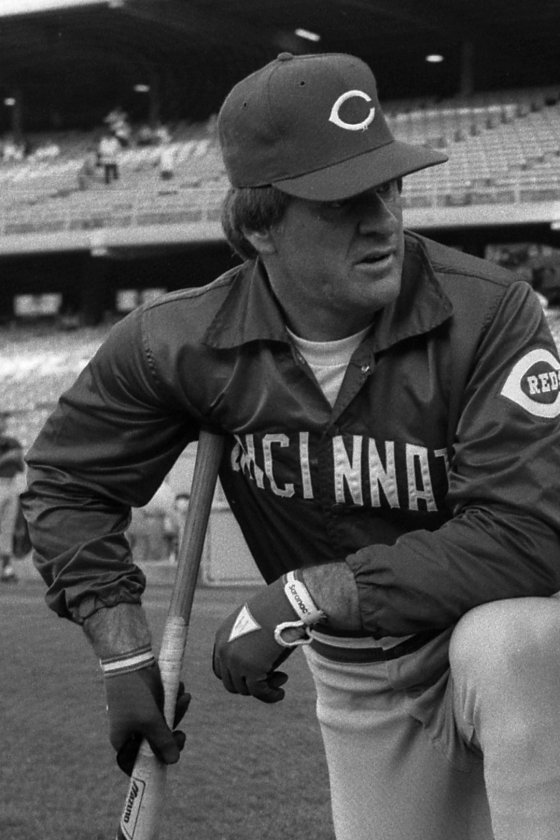
Player knowledge
Pete Rose
OF / 1B 1963–1986
- Born
- April 14, 1941, in Cincinnati, Ohio
- Bats / Throws
- S/R
- Height / Weight
- 5'11", 192 lbs
- Hometown
- Anderson Ferry (Cincinnati), Ohio
- High School
- Western Hills High School
- Full Name
- Peter Edward Rose
- Died
- September 30, 2024, in Las Vegas, Nevada (age 83)
- Nickname
- Charlie Hustle
- MLB Debut
- April 8, 1963, vs. Pittsburgh at Crosley Field
- Final Game
- August 17, 1986, vs. San Diego
- Uniform
- No. 14 with all three clubs, retired by the Reds in 2016
- Hits
- 4,256, the most in major-league history
- Managing
- 412–373 with the Reds (1984–1989)
- Hall of Fame
- Not elected; barred until MLB lifted his ban in May 2025. The Classic Baseball Era Committee next votes in December 2027
The story
Bio
Pete Rose ran to first base on walks. He slid into bases headfirst, bowled over catchers, and treated a Tuesday in May like Game 7 of the World Series. That fury carried a switch-hitter of ordinary size to 4,256 hits, more than anyone who has ever played the game, and earned him the nickname that fit him like a glove: Charlie Hustle.
Peter Edward Rose grew up on the west side of Cincinnati and signed with his hometown Reds out of high school. He was Rookie of the Year in 1963, won three batting titles and an MVP award, and sparked the Big Red Machine to two World Series titles. Then he carried Philadelphia to its first championship, passed Ty Cobb’s hit record as the Reds’ player-manager, and set records for games, at-bats, and plate appearances that still stand. In 1989 a gambling investigation ended with Rose accepting a place on baseball’s permanently ineligible list, and for more than three decades that kept him off the Hall of Fame ballot. He died in 2024, and in 2025 baseball lifted the ban.
Here is the whole story, from Anderson Ferry to the Reds, the Phillies, and a half-season with the Montreal Expos, the franchise that is now the Washington Nationals. When you’re done, see how much stuck with the Pete Rose Reds quiz.
Pete Rose
The Anderson Ferry Kid
Rose was born April 14, 1941, in Cincinnati, the third of four children of Harry and LaVerne Rose. He grew up in the Anderson Ferry section on the city’s west side, near the Ohio River. Harry worked at Fifth Third Bank for more than 40 years, but his neighbors knew him as a semipro athlete who boxed and played football into his 40s. He taught his son that you play to win. When Pete was 8, Harry told a youth coach that the boy would join the team only if he was allowed to switch-hit.
At Western Hills High School, Pete played football and baseball and struggled in the classroom. He had to repeat a grade, partly because his father didn’t want summer school cutting into summer baseball. By his senior year he had used up his high school eligibility, so in the spring of 1960 he played for a Dayton amateur-league team and hit well over .600.
His uncle, Buddy Bloebaum, was a bird-dog scout for the Reds, and he lobbied the club to take a chance on his undersized nephew. On the day Pete graduated in 1960, the Reds offered $7,000, plus another $5,000 if he reached the majors. He signed. “I never prepared for anything else,” Rose said years later.
Pete Rose
Charlie Hustle Arrives
Rose reported to the Class D Geneva Redlegs of the New York–Penn League and took over second base from a young Cuban named Tony Pérez, who moved to third. Rose hit .277 there, then .331 for Tampa in 1961 and .330 for Macon in 1962. Nobody expected much when he arrived at big-league camp in 1963, but he hit his way onto the roster.
That spring he also got his nickname. In an exhibition against the Yankees, Rose drew a walk and sprinted to first base. Whitey Ford mocked him as “Charlie Hustle.” Rose took the insult as a badge of honor and wore it for the rest of his life. Years later Dodgers broadcaster Vin Scully joked that Rose had “just beat out another walk.”
He debuted on Opening Day, April 8, 1963, against the Pirates at Crosley Field, and drew a walk in his first trip to the plate. After a hitless first week, he lined a triple off Pittsburgh’s Bob Friend on April 13 for his first hit. He hit .273, scored 101 runs, and was named NL Rookie of the Year. After the season he spent six months on active duty with the Army Reserve at Fort Knox, Kentucky.
Pete Rose
Batting Champion
Rose slumped to .269 in 1964 and was benched late in the season. He spent the winter playing for the Leones del Caracas in Venezuela and came back a different hitter. In 1965 he led the league with 209 hits, made his first All-Star team, and hit .312, the first of nine straight .300 seasons. In 1967 he moved from second base to the outfield.
In 1968 he broke his thumb and missed three weeks, then went 6-for-9 in the final days to edge Pittsburgh’s Matty Alou for his first batting title at .335. He finished second in the MVP vote to Bob Gibson. In 1969 he did it again, hitting a career-best .348 to beat Roberto Clemente by three points, and led the league with 120 runs. He also won Gold Gloves in right field in 1969 and 1970.
Pete Rose
The Fosse Collision
Riverfront Stadium had been open for barely two weeks when Cincinnati hosted the All-Star Game on July 14, 1970. The score was tied 4–4 in the bottom of the 12th. Rose singled, moved to second on a single by Billy Grabarkewitz, and broke for home when Jim Hickman singled to center. As Amos Otis’s throw arrived, Rose barreled into Cleveland catcher Ray Fosse. The ball got away, and Rose scored the winning run.
The play is still argued about. Fosse suffered a fractured and separated shoulder that wasn’t diagnosed until the next year. He had 16 home runs before the break and only two after it, and he never matched that first-half form again. Rose missed three games with a bruised knee. To him, it was simply the only way he knew how to play.
That fall, in Sparky Anderson’s first season as manager, the Reds swept Pittsburgh for the pennant before losing the World Series to Baltimore in five games.
Pete Rose
The Big Red Machine
The arrival of second baseman Joe Morgan in a trade with Houston after the 1971 season completed one of the great lineups in history. Rose led off, and behind him came Morgan, Pérez, and catcher Johnny Bench. Before Game 5 of the 1972 World Series, Rose told reporters that Oakland’s Catfish Hunter wasn’t all that special. Then he homered off Hunter to lead off the game and won it with a ninth-inning single off Rollie Fingers. Oakland still won the Series in seven.
1973 was his finest season. He led the league with 230 hits and a .338 average and was named NL MVP. In Game 3 of the NLCS at Shea Stadium, his hard slide into second base started a fight with Mets shortstop Bud Harrelson that emptied both benches. When fans pelted Rose in left field, Anderson pulled his team off the field until Mets manager Yogi Berra, Willie Mays, and Tom Seaver walked out to calm the crowd. Rose answered the next day with a 12th-inning home run to win Game 4, but the Mets took the series in five.
Pete Rose
Champions at Last
The Reds had a hole at third base in 1975. On May 2, Anderson asked Rose to move there for the good of the team, starting the next day. Rose agreed on the spot and wore out his coaches with extra ground balls. The move opened left field for slugger George Foster, and from May 3 on the Reds went 96–42. They won 108 games.
The 1975 World Series against Boston is remembered as one of the best ever played. During the 12-inning classic in Game 6, which ended with Carlton Fisk waving his homer fair, Rose kept telling anyone within earshot what a great game it was. The next night his single in the seventh inning tied Game 7, and Joe Morgan’s bloop single in the ninth won it, 4–3. It was Cincinnati’s first title since 1940. Rose hit .370 and was named World Series MVP, and Sports Illustrated made him its Sportsman of the Year.
In 1976 the Reds won 102 games, swept the Phillies in the NLCS, and swept the Yankees in the World Series. A perfect 7–0 October gave the Big Red Machine back-to-back championships.
Pete Rose
3,000 and 44 Straight
On April 29, 1978, Rose hit three home runs in a game at Shea Stadium, the only time he ever did it. Six days later, on May 5, 1978, he singled off Montreal’s Steve Rogers at Riverfront for his 3,000th hit, becoming the 13th player to reach the mark. Waiting at first base was his old friend Tony Pérez, by then an Expo.
On June 14 he singled off the Cubs’ Dave Roberts and kept hitting. On July 19 against the Phillies he was hitless entering the ninth, but the Reds batted around and Rose dropped a bunt single to keep the streak alive at 32. He passed Tommy Holmes’s modern National League record of 37 and tied Willie Keeler’s NL mark of 44 games from 1897. He hit .385 during the streak.
It ended in Atlanta on August 1, 1978, when reliever Gene Garber struck him out on an off-speed pitch to end the game. Rose fumed that Garber had pitched him like it was the ninth inning of the seventh game of the World Series. Garber took it as a compliment. No major leaguer has hit in 40 straight games since.
Pete Rose
Bound for Philadelphia
After the 1978 season the Reds let Rose leave as a free agent. The bidding got creative: Cardinals owner Gussie Busch offered a beer distributorship, and Royals owner Ewing Kauffman offered stock in his pharmaceutical company. On December 5, 1978, Rose signed with the Phillies for four years and $3.2 million, briefly making him the highest-paid athlete in team sports. The club said it sold $3 million in tickets over the next 30 days.
Philadelphia had Mike Schmidt at third, so Rose moved to first base, a position he had played exactly three times. He hit .331 in 1979 with a league-leading .418 on-base percentage. His new manager, Dallas Green, had given up the only grand slam of Rose’s career, and Rose never let him forget it.
In the 1980 NLCS at Houston, Rose scored the go-ahead run in the 10th inning of Game 4 by plowing into catcher Bruce Bochy. In Game 5 he worked a bases-loaded walk off Nolan Ryan, and the Phillies won the pennant in 10 innings. In Game 6 of the World Series against Kansas City, with the bases loaded in the ninth, a foul pop bounced out of catcher Bob Boone’s mitt. Rose snatched it before it hit the ground. Tug McGraw struck out Willie Wilson moments later, and the Phillies had the first World Series title in their 97-year history.
Pete Rose
Wheeze Kids and Expos
When play resumed after the 1981 strike, Rose broke Stan Musial’s National League record of 3,630 hits on August 10, 1981. He hit .325 that year and won a Silver Slugger. In 1983 the Phillies added Joe Morgan and Tony Pérez, and the aging roster became the “Wheeze Kids.” Rose, 42, hit .245 and lost playing time in September, then hit .375 in the NLCS win over the Dodgers. He was benched for Game 3 of the World Series, which Baltimore won in five games, and the Phillies released him that October.
The Montreal Expos signed him in January 1984. On April 13, 1984, exactly 21 years after his first hit, he doubled off the Phillies’ Jerry Koosman for his 4,000th hit, joining Ty Cobb as the only players to get there. On August 16, 1984, Montreal traded him home to Cincinnati for infielder Tom Lawless, and the Reds named him player-manager. He hit .365 in 26 games for the Reds. No one has served as a player-manager in the majors since.
Pete Rose
Hit No. 4,192
The record books of the day credited Ty Cobb with 4,191 hits. Later research found that two of them were counted twice, and Baseball-Reference now lists Cobb at 4,189, but in 1985 the target was 4,192. On September 8 at Wrigley Field, Rose collected two hits off Reggie Patterson to tie Cobb, in a game called for darkness.
Three nights later, on September 11, 1985, at Riverfront Stadium, Rose looped a first-inning single to left-center off San Diego’s Eric Show. The crowd stood and cheered for minutes. Rose, in tears, hugged his 15-year-old son, Pete Jr., near first base.
He played one more season. His last at-bat came on August 17, 1986, a strikeout against the Padres’ Goose Gossage. He finished with 4,256 hits, along with records for games (3,562), at-bats (14,053), plate appearances (15,890), and singles (3,215). That November the Reds took him off the 40-man roster. He never formally filed retirement papers.
Pete Rose
The Dowd Report
As a manager, Rose guided the Reds to four straight second-place finishes from 1985 to 1988. On April 30, 1988, he shoved umpire Dave Pallone during an argument and drew a 30-day suspension from National League president A. Bartlett Giamatti.
In February 1989, outgoing commissioner Peter Ueberroth and Giamatti questioned Rose about reports that he bet on baseball. He admitted betting on other sports but denied betting on baseball. After Giamatti became commissioner in April, he hired attorney John Dowd to investigate. Dowd’s report, delivered in May, concluded that Rose had bet on baseball while managing the Reds and documented bets on 52 Reds games in 1987. It found no evidence that he bet against the Reds. Rose denied the findings and sued to stop the commissioner’s hearing.
The case ended in a settlement. On August 24, 1989, Rose accepted a place on baseball’s permanently ineligible list. Baseball made no formal finding that he had bet on the game, and he kept the right to apply for reinstatement. Tommy Helms replaced him as manager, with Rose’s record standing at 412–373. Eight days later, Giamatti died of a heart attack at 51.
Pete Rose
Prison and Penance
On April 20, 1990, Rose pleaded guilty to two felony counts of filing false federal income tax returns, which had left out income from autograph shows, memorabilia sales, and horse-racing winnings. He was sentenced to five months at the federal prison camp in Marion, Illinois, fined $50,000, and ordered to do 1,000 hours of community service. He was released in January 1991. On February 4, 1991, the Hall of Fame’s board voted to bar anyone on the ineligible list from the ballot.
Baseball made exceptions only rarely. In 1999 fans voted Rose onto the All-Century Team, and he got the loudest ovation at the ceremony before Game 2 of the World Series in Atlanta. His requests for reinstatement went unanswered or were denied, including by Commissioner Rob Manfred in December 2015.
For 15 years Rose denied betting on baseball. In his 2004 book, My Prison Without Bars, he admitted that he had, including on the Reds, though he said he never bet against them. In 2015 ESPN published records showing he had also bet on baseball as a player in 1986. In 2017 a woman said in court filings that she had a sexual relationship with Rose in the 1970s, beginning when she was under 16. Rose acknowledged the relationship but said he believed she was 16, and the Phillies canceled his induction into their Wall of Fame. In Cincinnati, the Reds inducted him into their Hall of Fame and retired his No. 14 in 2016, and in 2017 they unveiled a bronze statue of him in a headfirst slide outside Great American Ball Park.
Pete Rose
Death and Reinstatement
Rose spent his last years signing autographs in Las Vegas, often on baseballs inscribed “I’m sorry I bet on baseball.” He died at his home there on September 30, 2024, at 83, the day after an autograph show in Tennessee. The Reds wore a No. 14 patch throughout the 2025 season.
In January 2025 his daughter Fawn and the family’s attorney asked MLB to remove him from the ineligible list. On May 13, 2025, Manfred ruled that permanent ineligibility ends when a person dies, reasoning that someone who has died can no longer threaten the integrity of the game. The decision took Rose, “Shoeless” Joe Jackson, and other deceased players off the list.
That made Rose eligible for the Hall of Fame for the first time. Because his greatest contributions came before 1980, his case belongs to the Classic Baseball Era Committee, a 16-member panel that next meets in December 2027 to elect the class of 2028. A screening committee picks the eight names on that ballot, and a candidate needs 75 percent of the panel’s votes. As of 2026, Rose is not in the Hall of Fame.
Pete Rose
Records and Honors
- 4,256 hits: the most in major-league history
- 3,562 games, 14,053 at-bats, and 15,890 plate appearances: all major-league records
- 3,215 singles: the major-league record
- 10 seasons of 200 or more hits, tied with Ichiro Suzuki for the most
- 44-game hitting streak in 1978, tied for the NL record
- 17 All-Star selections at five positions: 1B, 2B, 3B, LF, and RF
- 1963 NL Rookie of the Year, 1973 NL MVP, and 1975 World Series MVP
- Three batting titles: 1968 (.335), 1969 (.348), and 1973 (.338)
- Three World Series titles: 1975 and 1976 with the Reds, 1980 with the Phillies
- .303 career average over 24 seasons and 79.6 career WAR, per Baseball-Reference
- Gold Gloves in 1969 and 1970, a Silver Slugger in 1981
- MLB All-Century Team (1999); Reds Hall of Fame and No. 14 retired by the Reds (2016)
- National Baseball Hall of Fame: not elected; eligible for Classic Baseball Era consideration beginning December 2027
Pete Rose
Charlie Hustle Fun Facts
- He is the only player to play at least 500 games at five different positions.
- He had played first base only three times before the Phillies signed him. He finished with 939 games there, more than at any other position.
- His only career grand slam came off Dallas Green, who later managed him to the 1980 title.
- His 4,000th hit came on April 13, 1984, 21 years to the day after his first.
- He loved being around smoke and drink but neither smoked nor drank himself.
- Billy Joel name-checks him in the 1978 song “Zanzibar.”
- At WrestleMania XIV in 1998 he took a Tombstone piledriver from Kane, and in 2004 he became the first celebrity inducted into the WWE Hall of Fame.
- In 2014 he managed one game for the independent Bridgeport Bluefish, and they won 2–0.
Think you know Charlie Hustle now? Prove it with all ten quizzes in the Pete Rose collection, take the Pete Rose Reds quiz, meet his Big Red Machine teammate on the Johnny Bench page, read about the man whose record he broke on the Ty Cobb page, or browse the full Cincinnati Reds and Philadelphia Phillies quiz collections.
The postseason
October Accolades
| Year | Series | Result | G | H-AB | BA | HR | RBI |
|---|---|---|---|---|---|---|---|
| 1970 | NLCS | Reds def. Pirates, 3–0 Sparky Anderson’s first Reds team swept Pittsburgh for the pennant | 3 | 3-13 | .231 | 0 | 1 |
| 1970 | World Series | Orioles def. Reds, 4–1 Homered once, but Brooks Robinson’s glove at third ruled the Series | 5 | 5-20 | .250 | 1 | 2 |
| 1972 | NLCS | Reds def. Pirates, 3–2 Hit .450 with four doubles; Game 5 ended on a wild pitch | 5 | 9-20 | .450 | 0 | 2 |
| 1972 | World Series | Athletics def. Reds, 4–3 Led off Game 5 with a homer off Catfish Hunter and won it with a ninth-inning single | 7 | 6-28 | .214 | 1 | 2 |
| 1973 | NLCS | Mets def. Reds, 3–2 Brawled with Bud Harrelson in Game 3, then won Game 4 with a 12th-inning homer | 5 | 8-21 | .381 | 2 | 2 |
| 1975 | NLCS | Reds def. Pirates, 3–0 Hit .357 with a homer in another sweep of Pittsburgh | 3 | 5-14 | .357 | 1 | 2 |
| 1975 | World Series | Reds def. Red Sox, 4–3 Series MVP; his seventh-inning single tied Game 7 at 3–3 | 7 | 10-27 | .370 | 0 | 2 |
| 1976 | NLCS | Reds def. Phillies, 3–0 Hit .429 against the team he would join three years later | 3 | 6-14 | .429 | 0 | 2 |
| 1976 | World Series | Reds def. Yankees, 4–0 The Big Red Machine finished a perfect 7–0 October | 4 | 3-16 | .188 | 0 | 1 |
| 1980 | NLCS | Phillies def. Astros, 3–2 Bowled over catcher Bruce Bochy to score the go-ahead run in the 10th inning of Game 4 | 5 | 8-20 | .400 | 0 | 2 |
| 1980 | World Series | Phillies def. Royals, 4–2 Caught the foul pop that bounced out of Bob Boone’s mitt in the ninth inning of Game 6 | 6 | 6-23 | .261 | 0 | 1 |
| 1981 | NLDS | Expos def. Phillies, 3–2 Hit .300 in the strike-year Division Series | 5 | 6-20 | .300 | 0 | 2 |
| 1983 | NLCS | Phillies def. Dodgers, 3–1 Hit .375 as the “Wheeze Kids” won the pennant | 4 | 6-16 | .375 | 0 | 0 |
| 1983 | World Series | Orioles def. Phillies, 4–1 Benched for Game 3, then had four hits in his last seven at-bats | 5 | 5-16 | .313 | 0 | 1 |
| Postseason | 14 series | 67 | 86-268 | .321 | 5 | 22 | |
The clubs
Teams
-
Cincinnati Reds
1963–1978, 1984–1986
Rookie of the Year, the 1973 MVP, three batting titles, two Big Red Machine titles, and hit No. 4,192
-
Philadelphia Phillies
1979–1983
Brought Philadelphia its first World Series title in 1980 and passed Stan Musial’s NL hit record
-
Washington Nationals
1984
As a Montreal Expo, doubled for his 4,000th hit, 21 years to the day after his first
The numbers
Season Stats
| Season | Team | League | WAR | Games | PA | AB | Runs | Hits | RBI | 2B | 3B | HR | SB | BB | BA | OBP | SLG | OPS |
|---|---|---|---|---|---|---|---|---|---|---|---|---|---|---|---|---|---|---|
| 1963 | Cincinnati Reds | NL | 2.4 | 157 | 696 | 623 | 101 | 170 | 41 | 25 | 9 | 6 | 13 | 55 | .273 | .334 | .371 | .705 |
| 1964 | Cincinnati Reds | NL | 1.3 | 136 | 558 | 516 | 64 | 139 | 34 | 13 | 2 | 4 | 4 | 36 | .269 | .319 | .326 | .645 |
| 1965 | Cincinnati Reds | NL | 5.6 | 162 | 757 | 670 | 117 | 209 | 81 | 35 | 11 | 11 | 8 | 69 | .312 | .382 | .446 | .828 |
| 1966 | Cincinnati Reds | NL | 4.1 | 156 | 701 | 654 | 97 | 205 | 70 | 38 | 5 | 16 | 4 | 37 | .313 | .351 | .460 | .811 |
| 1967 | Cincinnati Reds | NL | 4.8 | 148 | 650 | 585 | 86 | 176 | 76 | 32 | 8 | 12 | 11 | 56 | .301 | .364 | .444 | .808 |
| 1968 | Cincinnati Reds | NL | 5.5 | 149 | 692 | 626 | 94 | 210 | 49 | 42 | 6 | 10 | 3 | 56 | .335 | .391 | .470 | .861 |
| 1969 | Cincinnati Reds | NL | 6.6 | 156 | 731 | 627 | 120 | 218 | 82 | 33 | 11 | 16 | 7 | 88 | .348 | .428 | .512 | .940 |
| 1970 | Cincinnati Reds | NL | 4.8 | 159 | 730 | 649 | 120 | 205 | 52 | 37 | 9 | 15 | 12 | 73 | .316 | .385 | .470 | .855 |
| 1971 | Cincinnati Reds | NL | 5.1 | 160 | 709 | 632 | 86 | 192 | 44 | 27 | 4 | 13 | 13 | 68 | .304 | .373 | .421 | .793 |
| 1972 | Cincinnati Reds | NL | 6.1 | 154 | 731 | 645 | 107 | 198 | 57 | 31 | 11 | 6 | 10 | 73 | .307 | .382 | .417 | .799 |
| 1973 | Cincinnati Reds | NL | 8.3 | 160 | 752 | 680 | 115 | 230 | 64 | 36 | 8 | 5 | 10 | 65 | .338 | .401 | .437 | .838 |
| 1974 | Cincinnati Reds | NL | 5.9 | 163 | 771 | 652 | 110 | 185 | 51 | 45 | 7 | 3 | 2 | 106 | .284 | .385 | .388 | .773 |
| 1975 | Cincinnati Reds | NL | 4.1 | 162 | 764 | 662 | 112 | 210 | 74 | 47 | 4 | 7 | 0 | 89 | .317 | .406 | .432 | .838 |
| 1976 | Cincinnati Reds | NL | 7.0 | 162 | 759 | 665 | 130 | 215 | 63 | 42 | 6 | 10 | 9 | 86 | .323 | .404 | .450 | .854 |
| 1977 | Cincinnati Reds | NL | 2.9 | 162 | 732 | 655 | 95 | 204 | 64 | 38 | 7 | 9 | 16 | 66 | .311 | .377 | .432 | .809 |
| 1978 | Cincinnati Reds | NL | 3.4 | 159 | 731 | 655 | 103 | 198 | 52 | 51 | 3 | 7 | 13 | 62 | .302 | .362 | .421 | .783 |
| 1979 | Philadelphia Phillies | NL | 3.1 | 163 | 732 | 628 | 90 | 208 | 59 | 40 | 5 | 4 | 20 | 95 | .331 | .418 | .430 | .848 |
| 1980 | Philadelphia Phillies | NL | -0.4 | 162 | 739 | 655 | 95 | 185 | 64 | 42 | 1 | 1 | 12 | 66 | .282 | .352 | .354 | .706 |
| 1981 | Philadelphia Phillies | NL | 1.7 | 107 | 486 | 431 | 73 | 140 | 33 | 18 | 5 | 0 | 4 | 46 | .325 | .391 | .390 | .781 |
| 1982 | Philadelphia Phillies | NL | -1.1 | 162 | 720 | 634 | 80 | 172 | 54 | 25 | 4 | 3 | 8 | 66 | .271 | .345 | .338 | .683 |
| 1983 | Philadelphia Phillies | NL | -2.1 | 151 | 555 | 493 | 52 | 121 | 45 | 14 | 3 | 0 | 7 | 52 | .245 | .316 | .286 | .602 |
| 1984 | Montreal Expos | NL | 0.3 | 95 | 314 | 278 | 34 | 72 | 23 | 6 | 2 | 0 | 1 | 31 | .259 | .334 | .295 | .629 |
| 1984 | Cincinnati Reds | NL | 0.7 | 26 | 107 | 96 | 9 | 35 | 11 | 9 | 0 | 0 | 0 | 9 | .365 | .430 | .458 | .888 |
| 1985 | Cincinnati Reds | NL | 0.6 | 119 | 501 | 405 | 60 | 107 | 46 | 12 | 2 | 2 | 8 | 86 | .264 | .395 | .319 | .713 |
| 1986 | Cincinnati Reds | NL | -0.9 | 72 | 272 | 237 | 15 | 52 | 25 | 8 | 2 | 0 | 3 | 30 | .219 | .316 | .270 | .586 |
| Career | 24 seasons | NL | 79.8 | 3,562 | 15,890 | 14,053 | 2,165 | 4,256 | 1,314 | 746 | 135 | 160 | 198 | 1,566 | .303 | .375 | .409 | .784 |