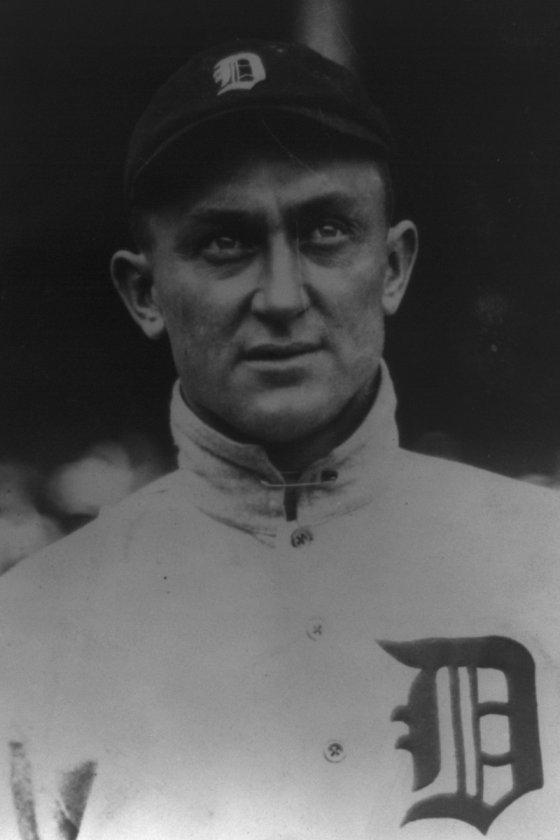
Player knowledge
Ty Cobb
CF / RF 1905–1928 Hall of Fame
- Born
- December 18, 1886, in Narrows, Georgia
- Bats / Throws
- L/R
- Height / Weight
- 6'1", 175 lbs
- Hometown
- Royston, Georgia
- High School
- Franklin County High School
- Full Name
- Tyrus Raymond Cobb
- Died
- July 17, 1961, in Atlanta, Georgia (age 74)
- Nickname
- The Georgia Peach
- MLB Debut
- August 30, 1905, vs. New York at Bennett Park
- Final Game
- September 11, 1928, at New York (Yankee Stadium)
- Uniform
- None; he never wore a number. Honored by name on the Comerica Park wall
- Batting Titles
- 12 as MLB counts them (1907–1915, 1917–1919), including the disputed 1910 race
- Career Hits
- 4,189 per Baseball-Reference; 4,191 in MLB’s traditional record
- Hall of Fame
- Inaugural class of 1936, 98.2% of the vote, the most of any candidate
The story
Bio
Ty Cobb played baseball like a man trying to win an argument. He bunted, slashed, and ran the bases as if every pitch decided a tie game in September, and for 24 seasons pitchers rarely found an answer. He retired holding more records than anyone in the sport, and nearly a century later the loudest debate is less about his numbers than about the man.
Tyrus Raymond Cobb came out of the Georgia hills in 1905, three weeks after his mother shot and killed his father. He won his first batting title at 20, the Triple Crown at 22, and 12 batting titles in all as Major League Baseball counts them. He hit over .400 three times, stole home 54 times, managed the Tigers for six seasons, survived a game-fixing accusation, and collected 4,189 hits by Baseball-Reference’s count (4,191 in baseball’s traditional record). When the Hall of Fame held its first election, he drew more votes than Babe Ruth.
Here is the whole story, from Royston, Georgia, to the Tigers, two final seasons with the Philadelphia Athletics, and Cooperstown. When you’re done, see how much stuck with the Ty Cobb Tigers quiz.
Ty Cobb
Royston to Augusta
Cobb was born December 18, 1886, in The Narrows, a farming community in northeast Georgia, the first of three children of William Herschel Cobb and Amanda Chitwood Cobb. His mother was 15. His father named him for Tyre, the ancient city that held out against Alexander the Great. The family soon moved to nearby Royston, where W.H. Cobb was a schoolteacher, a newspaper editor, and later a state senator. His son worshiped him. “He was the only man who ever made me do his bidding,” Cobb said.
The father wanted a lawyer or a doctor. The son wanted baseball. By 14 Ty was playing for the Royston town team, and his younger brother Paul later spent nine seasons in the minors. In 1904, at 17, Ty wrote to clubs in the new South Atlantic League. The Augusta Tourists invited him to camp if he paid his own way, at $50 a month if he made the team. His father reluctantly let him go. Augusta released him after two games.
Before he caught on with a semipro club in Anniston, Alabama, his father gave him advice he never forgot: “Don’t come home a failure.” In Anniston, as Cobb told it, he promoted himself by mailing postcards under made-up names to Grantland Rice, sports editor of the Atlanta Journal, praising a young phenom named Cobb. Rice eventually mentioned him in print. By August, Augusta wanted him back. The Detroit Tigers trained in Augusta in the spring of 1905 and saw him in exhibition games, and that summer new manager George Leidy took him under his wing, drilling him on bunting and aggressive baserunning. Cobb became the best hitter in the league.
Ty Cobb
The Worst Summer
On the night of August 8, 1905, W.H. Cobb told his wife he was going out to the family farm. He suspected her of infidelity. After midnight he came back with a pistol and climbed onto the porch roof outside the bedroom window. Amanda Cobb fired twice and killed him. She said she had mistaken him for a burglar. The physical evidence raised doubts and she was charged in his death, but a jury acquitted her in March 1906.
Ty, 18, buried his father and went back to Augusta. Before the month was out, the Tigers bought his contract, for $750 in most accounts. “I only thought, Father won’t know it,” he wrote later. On August 30, 1905, at Bennett Park in Detroit, he doubled in his first big-league at-bat off the New York Highlanders’ Jack Chesbro, who had won 41 games the year before. Cobb was the youngest player in the American League.
He hit .238 in 41 games, and the veterans hazed him without mercy. They broke his bats, ruined his hats, and froze him out, and he called it the most miserable and humiliating experience of his life. The strain caught up with him in 1906. He missed the second half of July and all of August with what may have been a physical and emotional collapse, then came back to hit .316. Hughie Jennings, who became manager in 1907, later said he ordered the veterans to leave the kid alone. Late in life Cobb explained why he played so hard: “I did it for my father.”
Ty Cobb
Three Pennants, No Rings
The breakout came in 1907. Playing right field, Cobb led the league with a .350 average, 212 hits, and 119 RBI, and he stole 53 bases. At 20 he was the youngest batting champion in history, a distinction he held until Al Kaline in 1955. On September 30, 1907, in Philadelphia, his two-run homer off Rube Waddell in the ninth inning tied a pennant showdown that went 17 innings and ended in a tie. Days later the Tigers clinched their first pennant. Cobb called that home run the biggest thrill of his career.
The World Series was a letdown. Game 1 against the Chicago Cubs ended in a 3–3 tie, called for darkness after 12 innings, and Chicago won the next four. Cobb hit .200. In 1908 the Tigers edged Cleveland by half a game and Cobb won a second batting title at .324. That August he left the club for six days in the middle of the race to marry Charlotte “Charlie” Lombard in Augusta. He hit .368 in the World Series rematch, but the Cubs won again in five games.
1909 was his masterpiece. Cobb won the Triple Crown with a .377 average, 9 home runs, and 107 RBI, and he also led the league with 76 steals. All nine of his homers stayed inside the park. That August he spiked Philadelphia third baseman Frank “Home Run” Baker on a slide into third. Cobb was within the rules, but Philadelphia fans sent him death threats. In the World Series against Honus Wagner and the Pittsburgh Pirates, he stole home in Game 2, but Pittsburgh won Game 7 in Detroit. Cobb was 22, with three pennants. He never played in another World Series.
Ty Cobb
Two Chalmers Cars
In 1910 automaker Hugh Chalmers promised a new car to the batting champion. Cobb and Cleveland’s Nap Lajoie went down to the wire, and Cobb sat out the last two games to protect his lead. On the final day, Lajoie went 8-for-8 in a doubleheader in St. Louis, most of the hits bunts toward a rookie third baseman, Red Corriden, who was playing back on the outfield grass. Browns manager Jack O’Connor, who disliked Cobb, was behind it. Several Tigers wired their congratulations to Lajoie.
American League president Ban Johnson investigated and declared Cobb the winner, .385 to .384. O’Connor was banned from the majors, and Chalmers gave both men a car. Seven decades later the story took another turn. In 1981 The Sporting News reported historian Pete Palmer’s discovery that one Tigers game had been counted twice in Cobb’s 1910 record, crediting him with two hits he never got. Without them, Lajoie finished first. Commissioner Bowie Kuhn refused to change a 70-year-old record, so MLB still lists Cobb as the 1910 champion and keeps his traditional totals of 4,191 hits and a .367 average. Baseball-Reference and most researchers use the corrected figures, 4,189 hits and .366, and so does the stats table on this page.
Cobb answered with the best season of his life. In 1911 he hit .419 by Baseball-Reference’s count (.420 in the traditional record), with 248 hits, 47 doubles, 24 triples, 127 RBI, and 83 steals, and he hit safely in 40 straight games. Shoeless Joe Jackson hit .408 and finished second. That season the writers voted Cobb the American League’s Chalmers Award as its most valuable player, and he drove off with another Chalmers. On May 12 that year, against New York, he wandered off second base while the Highlanders argued a call, drifted toward home, and slid in with the winning run. Branch Rickey later said Cobb had “brains in his feet.”
Ty Cobb
Into the Stands
On May 15, 1912, at Hilltop Park in New York, a heckler named Claude Lucker rode Cobb for innings. Cobb asked to have him removed, and nothing happened. After Lucker shouted a racial slur and insults about Cobb’s mother, Cobb climbed into the stands and beat him. Lucker had lost one hand and three fingers of the other in an industrial accident. When fans yelled that the man had no hands, Cobb reportedly answered, “I don’t care if he’s got no feet!”
Ban Johnson suspended him indefinitely. His teammates, many of whom did not like him, refused to play until he was reinstated: the first strike in baseball history. Owner Frank Navin faced a $5,000 fine for every game the Tigers failed to play, so on May 18 in Philadelphia, manager Hughie Jennings fielded a team of sandlotters and college students, plus himself and two coaches. The Athletics won 24–2. Pitcher Allan Travers, a college student, went the distance and gave up 26 hits. He later became a Catholic priest.
Johnson warned the strikers they faced lifetime bans, and Cobb told his teammates to go back to work. His suspension was cut to 10 days. Cobb later said the episode helped launch the Base Ball Players’ Fraternity, an early players’ union. He finished 1912 at .409, his second straight .400 season.
Ty Cobb
King of the Deadball Era
By 1913 Cobb was earning $12,000 a season, likely the first five-figure salary in baseball. He won nine straight batting titles from 1907 through 1915. In 1915 he stole 96 bases, a record until Maury Wills stole 104 in 1962, and the Tigers won 100 games but finished second to Boston. Tris Speaker broke his title streak in 1916. Cobb took the crown back in each of the next three seasons, for 12 in all as MLB counts them.
He was a thinker on the bases more than a pure sprinter. “He didn’t outhit the opposition and he didn’t outrun them,” said Sam Crawford, who played beside him for years and did not like him. “He outthought them!” Cobb ran wild in lopsided games so fielders would rush in close ones, and he kicked the bag toward the next base to gain a few inches before a steal. He stole home 54 times, still the career record, and four times he stole second, third, and home in succession.
In 1917 he hit in 35 straight games and starred as himself in a silent movie, Somewhere in Georgia, based on a Grantland Rice story. In the fall of 1918 he joined the Army’s Chemical Warfare Service as a captain and went to France, serving in the Gas and Flame Division alongside Christy Mathewson, George Sisler, and Major Branch Rickey. He was home in time for 1919 and won his 12th batting title. Then, in 1920, Babe Ruth hit 54 home runs for the Yankees, and the game Cobb had mastered began to change.
Ty Cobb
The Player-Manager
Owner Frank Navin made Cobb player-manager for 1921, replacing Hughie Jennings, and Cobb signed the deal on his 34th birthday. On August 19, 1921, he collected his 3,000th hit off Boston’s Elmer Myers. At 34 he is still the youngest player to reach 3,000. He preached hitting to anyone who would listen, and outfielder Harry Heilmann won the 1921 batting title at .394, with his manager second at .389.
Cobb hit .401 in 1922, his third .400 season. His Tigers finished second in 1923 and third in 1924, six games out, but never won a pennant. His managerial record was 479–444, and he blamed the frugal Navin for passing on the pitchers he wanted.
Ruth’s style grated on him. On May 5, 1925, in St. Louis, Cobb told a reporter that for once he would try to hit home runs. He went 6-for-6 with three homers and 16 total bases, an American League record that stood until 2012. The next day he homered twice more, five in two games, then went back to his old game. On October 4 that season, at 38, he pitched a perfect inning against the Browns. On November 3, 1926, he resigned as manager and announced he was retiring.
Ty Cobb
The Leonard Letters
Weeks later Cleveland’s player-manager, Tris Speaker, quit too, and the reason soon came out. Former Tigers pitcher Hubert “Dutch” Leonard had accused Cobb, Speaker, and Smoky Joe Wood of conspiring to fix a Tigers–Indians game in Detroit on September 25, 1919, and of betting on it. As proof, he produced two letters from that fall, one from Wood and one from Cobb. Wood’s letter showed bets had been placed. Cobb’s suggested an attempt to bet had been made and had fallen through. Cobb said Leonard was settling a grudge, because Cobb had let him go from the Tigers.
The box score did not look like a fix. Cobb went 1-for-5, and Speaker, who was supposed to be helping Detroit win, had three hits, including two triples. Leonard refused to travel to Chicago to face the men he had accused. On January 27, 1927, Commissioner Kenesaw Mountain Landis cleared Cobb and Speaker. “By no decent system of justice could such finding be made,” he wrote. Both men were reinstated and free to sign with any club.
Ty Cobb
Last Act in Philadelphia
Cobb chose Connie Mack’s Philadelphia Athletics. Mack was one of the few men in baseball Cobb truly admired. At 40 Cobb hit .357 in 133 games in 1927. In his first game back in Detroit, on May 10, he doubled in his first trip to the plate. On July 18, 1927, at Navin Field, he doubled off former teammate Sam Gibson to become the first player with 4,000 hits. The A’s finished second to the 110-win Yankees.
In 1928 his teammates included Speaker and four young future Hall of Famers: Jimmie Foxx, Mickey Cochrane, Lefty Grove, and Al Simmons. Cobb, now 41, played less and less. His last hit came on September 3, 1928, a pinch-hit double off Bump Hadley in Washington. On September 11, at Yankee Stadium, he pinch-hit in the ninth inning and made an out in his final big-league at-bat. He had hit .300 or better in 23 straight seasons, every year but his first.
Ty Cobb
Coca-Cola and Cooperstown
Cobb did not need baseball’s money. His ties to Coca-Cola began in 1907, and by the end of his life he owned more than 20,000 shares plus bottling plants in Santa Maria, California, Twin Falls, Idaho, and Bend, Oregon. He was also an early investor in United Motors, which merged into General Motors. His estate was reported at nearly $12 million, most of it in GM and Coca-Cola stock.
In retirement he toured Europe, hunted, golfed, and traded stocks, and around 1930 he moved his family to Atherton, California. In February 1936 the first Hall of Fame election results came out. Cobb was named on 222 of 226 ballots, or 98.2 percent, more than Babe Ruth and Honus Wagner (215 each), Christy Mathewson, and Walter Johnson. No player topped that percentage until Tom Seaver in 1992. When the Hall opened in Cooperstown in 1939, Cobb arrived too late to appear in the famous photograph of the original inductees.
Home life was harder. He and Charlie had five children, and his relationships with them were often strained. After several divorce filings they finally split in 1947, after 39 years of marriage. A second marriage, to Frances Fairbairn Cass in 1949, ended in divorce in 1956. Yet he also helped young players, including Joe DiMaggio with his first Yankees contract, and he and his old rival Ruth became friends, squaring off in a series of charity golf matches in 1941.
Ty Cobb
Royston’s Benefactor
In 1945 Cobb gave $100,000 to build a hospital in Royston in memory of his parents. Cobb Memorial Hospital became the cornerstone of today’s Ty Cobb Healthcare System. In 1953 he put another $100,000 into the Cobb Educational Fund for Georgia students who needed help paying for college, and his will left it a quarter of his estate. As of 2025, the Ty Cobb Educational Foundation reported more than $21.5 million in scholarships awarded.
His health failed in his last years. Doctors diagnosed prostate cancer in 1959, he drank heavily, and he finally agreed to write an autobiography with sportswriter Al Stump. Cobb died at Emory University Hospital in Atlanta on July 17, 1961, at 74. About 150 friends and relatives attended a private service in Cornelia, Georgia. Baseball was represented by three old players, Ray Schalk, Mickey Cochrane, and Nap Rucker, and Hall of Fame director Sid Keener. He was buried in the family mausoleum at Rose Hill Cemetery in Royston.
His hit record lasted for decades. Pete Rose passed the traditional total of 4,191 on September 11, 1985, 57 years to the day after Cobb’s final game.
Ty Cobb
Myth and Record
Much of Cobb’s image as a violent bigot traces to Stump. Their book, My Life in Baseball: The True Record, came out after Cobb’s death and treated him sympathetically. Then Stump told a much darker story, first in a 1961 True magazine article and later in a 1994 biography, Cobb, which became the basis for a film starring Tommy Lee Jones. In 2010 an article by researcher Ron Cobb (no relation) in SABR’s journal The National Pastime accused Stump of forging Cobb documents and inventing episodes. In 2015 Charles Leerhsen’s Ty Cobb: A Terrible Beauty argued that much of the popular picture, from sharpened spikes to his reputation as a raging racist, was exaggerated or invented. Some reviewers say Leerhsen swung too far the other way.
Some of the record is not in dispute. Cobb fought often, on and off the field. In 1908 he was convicted of battery for attacking a Black laborer in Detroit, and the sentence was suspended. In 1909 he cut a Cleveland hotel watchman with a penknife during a fight and later pleaded guilty to assault; accounts differ on the man’s race. In 1914 he was fined for pulling a revolver during an argument in a Detroit butcher shop. He also spoke publicly in favor of integration in 1952. “I see no reason in the world why we shouldn’t compete with colored athletes,” he told the Associated Press, “as long as they conduct themselves with politeness and gentility.” Historians still argue over where the man ends and the myth begins.
Ty Cobb
Records and Honors
- 12 batting titles as MLB counts them (1907–1915, 1917–1919): the most ever
- .366 career average per Baseball-Reference (.367 in MLB’s traditional record)
- 4,189 hits (4,191 traditional): the career record until Pete Rose in 1985
- 2,245 runs: the career record until Rickey Henderson in 2001
- 897 stolen bases and a record 54 steals of home
- 1909 Triple Crown: .377, 9 HR, 107 RBI
- 1911 Chalmers Award as the AL’s most valuable player
- Three .400 seasons (1911, 1912, 1922) and 23 straight .300 seasons
- 149.8 career WAR, per Baseball-Reference
- Three straight AL pennants with Detroit (1907–1909)
- National Baseball Hall of Fame, inaugural class of 1936 (222 of 226 ballots, 98.2%)
Ty Cobb
Georgia Peach Fun Facts
- His first big-league hit was a double off Jack Chesbro, who had won 41 games the season before.
- All nine of his league-leading home runs in 1909 were inside-the-park.
- He starred as himself in the 1917 silent film Somewhere in Georgia.
- He reached 3,000 hits at 34, still the youngest player to get there.
- At 38 he pitched a perfect inning against the Browns in 1925.
- He never wore a uniform number. The Tigers honor him by name alone on the Comerica Park wall.
- Pete Rose broke his hit record 57 years to the day after Cobb’s last game.
- A 1977 statue of Cobb by Felix de Weldon, first installed outside Atlanta–Fulton County Stadium, moved to his hometown of Royston in 2017.
Think you know the Georgia Peach now? Prove it with all ten quizzes in the Ty Cobb collection, take the Ty Cobb Tigers quiz, meet the slugger who changed his game on the Babe Ruth page, see the man who broke his hit record on the Pete Rose page, or browse the full Detroit Tigers and Oakland Athletics quiz collections.
The postseason
October Accolades
| Year | Series | Result | G | H-AB | BA | HR | RBI |
|---|---|---|---|---|---|---|---|
| 1907 | World Series | Cubs def. Tigers, 4–0 Hit .200 as Chicago swept after Game 1 ended in a 12-inning tie called for darkness | 5 | 4-20 | .200 | 0 | 0 |
| 1908 | World Series | Cubs def. Tigers, 4–1 Led Detroit with a .368 average, but the Cubs repeated as champions | 5 | 7-19 | .368 | 0 | 4 |
| 1909 | World Series | Pirates def. Tigers, 4–3 Stole home in Game 2; Honus Wagner’s Pirates won Game 7 in Detroit | 7 | 6-26 | .231 | 0 | 5 |
| Postseason | 3 series | 17 | 17-65 | .262 | 0 | 9 | |
The clubs
Teams
-
Detroit Tigers
1905–1926
12 batting titles, the 1909 Triple Crown, three pennants, 3,900 hits, and six years as player-manager
-
Oakland Athletics
1927–1928
Philadelphia finale: hit .357 at age 40 and became the first player with 4,000 hits
The numbers
Season Stats
| Season | Team | League | WAR | Games | PA | AB | Runs | Hits | RBI | 2B | 3B | HR | SB | BB | BA | OBP | SLG | OPS |
|---|---|---|---|---|---|---|---|---|---|---|---|---|---|---|---|---|---|---|
| 1905 | Detroit Tigers | AL | 0.2 | 41 | 165 | 151 | 19 | 36 | 15 | 6 | 0 | 1 | 2 | 10 | .238 | .286 | .298 | .584 |
| 1906 | Detroit Tigers | AL | 2.6 | 98 | 394 | 358 | 45 | 113 | 41 | 15 | 5 | 1 | 23 | 19 | .316 | .355 | .394 | .749 |
| 1907 | Detroit Tigers | AL | 6.8 | 150 | 642 | 605 | 99 | 212 | 119 | 28 | 14 | 5 | 53 | 24 | .350 | .380 | .468 | .848 |
| 1908 | Detroit Tigers | AL | 6.2 | 150 | 635 | 580 | 88 | 188 | 108 | 36 | 20 | 4 | 39 | 34 | .324 | .368 | .476 | .844 |
| 1909 | Detroit Tigers | AL | 9.9 | 156 | 655 | 573 | 115 | 216 | 107 | 33 | 10 | 9 | 76 | 48 | .377 | .431 | .517 | .947 |
| 1910 | Detroit Tigers | AL | 10.3 | 140 | 598 | 508 | 106 | 194 | 91 | 35 | 13 | 8 | 65 | 64 | .382 | .455 | .549 | 1.004 |
| 1911 | Detroit Tigers | AL | 10.5 | 146 | 656 | 592 | 148 | 248 | 127 | 47 | 24 | 8 | 83 | 44 | .419 | .466 | .620 | 1.086 |
| 1912 | Detroit Tigers | AL | 8.9 | 140 | 610 | 553 | 119 | 226 | 83 | 30 | 23 | 7 | 61 | 43 | .409 | .456 | .584 | 1.040 |
| 1913 | Detroit Tigers | AL | 7.0 | 122 | 504 | 429 | 70 | 167 | 67 | 18 | 16 | 4 | 51 | 58 | .389 | .466 | .534 | 1.000 |
| 1914 | Detroit Tigers | AL | 5.5 | 98 | 415 | 345 | 69 | 127 | 57 | 22 | 11 | 2 | 35 | 57 | .368 | .466 | .513 | .979 |
| 1915 | Detroit Tigers | AL | 9.5 | 156 | 701 | 563 | 144 | 208 | 99 | 31 | 13 | 3 | 96 | 118 | .369 | .486 | .487 | .973 |
| 1916 | Detroit Tigers | AL | 8.0 | 145 | 637 | 543 | 113 | 201 | 68 | 31 | 10 | 5 | 68 | 78 | .370 | .451 | .492 | .943 |
| 1917 | Detroit Tigers | AL | 11.0 | 152 | 671 | 588 | 107 | 225 | 106 | 44 | 24 | 6 | 55 | 61 | .383 | .444 | .570 | 1.014 |
| 1918 | Detroit Tigers | AL | 6.4 | 111 | 474 | 421 | 81 | 161 | 62 | 19 | 14 | 3 | 34 | 41 | .382 | .440 | .515 | .955 |
| 1919 | Detroit Tigers | AL | 5.4 | 124 | 548 | 498 | 92 | 191 | 67 | 36 | 13 | 1 | 28 | 38 | .384 | .428 | .514 | .942 |
| 1920 | Detroit Tigers | AL | 3.4 | 112 | 496 | 428 | 87 | 143 | 63 | 28 | 8 | 2 | 15 | 58 | .334 | .416 | .451 | .867 |
| 1921 | Detroit Tigers | AL | 6.8 | 128 | 582 | 507 | 124 | 197 | 101 | 37 | 16 | 12 | 22 | 56 | .389 | .452 | .596 | 1.048 |
| 1922 | Detroit Tigers | AL | 6.8 | 137 | 613 | 526 | 99 | 211 | 99 | 42 | 16 | 4 | 9 | 55 | .401 | .462 | .565 | 1.026 |
| 1923 | Detroit Tigers | AL | 5.6 | 145 | 648 | 556 | 103 | 189 | 88 | 40 | 7 | 6 | 9 | 66 | .340 | .413 | .469 | .882 |
| 1924 | Detroit Tigers | AL | 5.5 | 155 | 727 | 625 | 114 | 211 | 79 | 38 | 10 | 4 | 23 | 85 | .338 | .418 | .450 | .867 |
| 1925 | Detroit Tigers | AL | 5.6 | 121 | 492 | 415 | 97 | 157 | 102 | 31 | 12 | 12 | 13 | 65 | .378 | .468 | .598 | 1.066 |
| 1926 | Detroit Tigers | AL | 1.7 | 79 | 273 | 233 | 48 | 79 | 62 | 18 | 5 | 4 | 9 | 26 | .339 | .408 | .511 | .918 |
| 1927 | Philadelphia Athletics | AL | 4.4 | 133 | 574 | 490 | 104 | 175 | 93 | 32 | 7 | 5 | 22 | 67 | .357 | .440 | .482 | .921 |
| 1928 | Philadelphia Athletics | AL | 2.0 | 95 | 393 | 353 | 54 | 114 | 40 | 27 | 4 | 1 | 6 | 34 | .323 | .389 | .431 | .819 |
| Career | 24 seasons | AL | 150.0 | 3,034 | 13,103 | 11,440 | 2,245 | 4,189 | 1,944 | 724 | 295 | 117 | 897 | 1,249 | .366 | .433 | .512 | .944 |