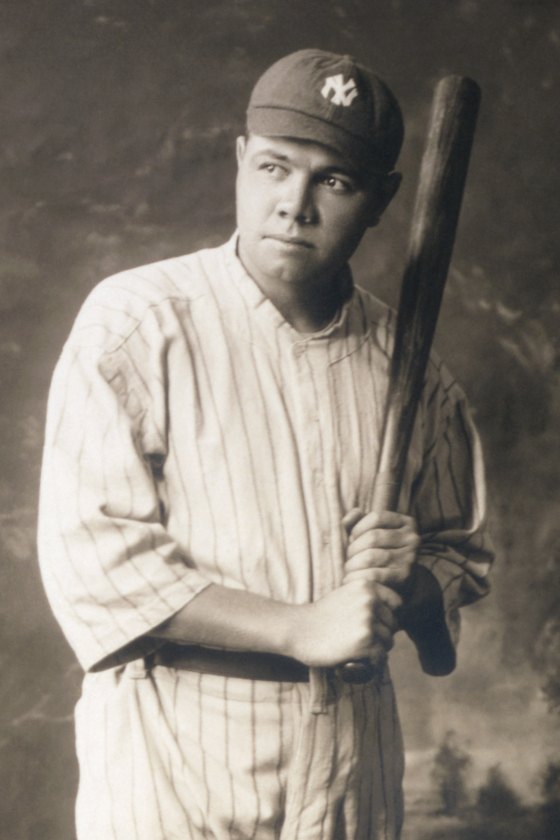
Player knowledge
Babe Ruth
RF / P 1914–1935 Hall of Fame
- Born
- February 6, 1895, in Baltimore, Maryland
- Bats / Throws
- L/L
- Height / Weight
- 6'2", 215 lbs
- High School
- St. Mary’s Industrial School for Boys
- Full Name
- George Herman Ruth Jr.
- Died
- August 16, 1948, in New York, New York (age 53)
- Nicknames
- The Bambino, The Sultan of Swat, The Colossus of Clout, Jidge
- MLB Debut
- July 11, 1914, vs. Cleveland at Fenway Park
- Final Game
- May 30, 1935
- Uniform
- No. 3 (1929–1935)
- Pitching
- 94–46, 2.28 ERA, 17 shutouts
- Hall of Fame
- Inaugural class of 1936, 95.1% of the vote
The story
Bio
Babe Ruth was the best left-handed pitcher in the American League before he became the greatest hitter who ever lived, and along the way he changed what baseball looked like. When he arrived, a dozen home runs could lead the league. By the time he left, he had hit 714 of them, and the whole game was chasing the long ball.
George Herman Ruth Jr. came out of a Baltimore reform school with a strong left arm and not much else. He won 89 games and three World Series for the Red Sox, was sold to the Yankees for a record $100,000, and then out-homered entire teams by himself. He hit 60 in 1927, christened Yankee Stadium with a home run, may or may not have called his shot at Wrigley Field, and became the most famous athlete in America, larger than life in every possible sense.
Here is the whole story, from the Baltimore waterfront to the Red Sox, the Yankees, one last spring with the Boston Braves, and Cooperstown. When you’re done, see how much stuck with the Babe Ruth Yankees quiz.
Babe Ruth
Pigtown to St. Mary’s
Ruth was born February 6, 1895, in his mother’s parents’ house at 216 Emory Street in Baltimore’s Pigtown neighborhood, the son of George Ruth Sr. and Katherine Schamberger. His father worked long hours in his waterfront saloon, and his mother was often sick. Of their eight children, only George and his sister Mamie survived infancy. Left mostly on his own, “Little George” roamed the docks, stole from the till at his father’s bar, and was chewing tobacco by the age of six.
Shortly after he turned seven, his parents had the courts declare him “incorrigible” and sent him to St. Mary’s Industrial School for Boys, a reform school and orphanage run by the Xaverian Brothers on the edge of the city. He went home a few times, but St. Mary’s was where he grew up. There he met Brother Matthias, a big, Canadian-born Xaverian who taught him to read and write and spent afternoons swatting fly balls to the boys. “He was the father I needed and the greatest man I’ve ever known,” Ruth said. George copied everything about Matthias’s swing, from the grip down at the knob of the bat to the way he ran with quick, tiny steps.
At St. Mary’s he played everywhere, including catcher and third base, even though he threw left-handed. In one 1913 game he caught, played third, pitched, struck out six, and hit a double, a triple, and a home run. Word got around Baltimore.
Babe Ruth
Jack’s Newest Babe
In February 1914, Jack Dunn, owner of the minor-league Baltimore Orioles, signed the 19-year-old pitcher. Because Ruth was under 21, Dunn also became his legal guardian, and as the story goes, the veterans took one look at the big kid and called him one of “Jack’s babes.” The nickname stuck for life. That spring in Fayetteville, North Carolina, Ruth hit his first home run as a professional, a blast still marked by a state historical sign. He also discovered hotel elevators and restaurant menus, and made the most of both.
Ruth dominated exhibitions against big-league clubs, but Dunn was short on cash. In July 1914 he sold Ruth to the Boston Red Sox in a package with pitcher Ernie Shore and catcher Ben Egan. Ruth debuted on July 11, 1914, at Fenway Park, less than five months after leaving St. Mary’s, and beat Cleveland 4–3. After a rough second start he was sent to the Providence Grays, helped them win the International League pennant, and returned for the final week of the season. That October he married Helen Woodford, a waitress he had met at a Boston coffee shop.
Babe Ruth
The Best Lefty in the League
Ruth stuck in the Red Sox rotation in 1915 and went 18–8. On May 6 at the Polo Grounds he hit his first major-league home run, off the Yankees’ Jack Warhop, and he finished the year with four homers in just 92 at-bats, the most on the team. Nobody quite knew what to do with a pitcher who hit like that. Boston won the World Series, though Ruth’s only appearance was as a pinch hitter.
In 1916 he was simply the best pitcher in the American League: 23–12 with a league-leading 1.75 ERA and nine shutouts, still the AL record for a left-hander (Ron Guidry tied it in 1978). In Game 2 of the World Series against Brooklyn he pitched all 14 innings of a 2–1 win, and the Red Sox repeated as champions.
He went 24–13 in 1917 and completed 35 of his 38 starts. His temper came along for the ride. On June 23 against Washington, Ruth walked the leadoff hitter, stormed off the mound, and punched umpire Brick Owens. Ernie Shore came in, the runner was thrown out stealing, and Shore retired the next 26 batters in a row. Ruth got a 10-day suspension and a $100 fine.
Babe Ruth
Pitcher, Slugger, Both
With World War I thinning rosters in 1918, manager Ed Barrow finally put Ruth in the everyday lineup. On May 6, 1918, three years to the day after his first homer, he played first base at the Polo Grounds, batted sixth, and homered. The next day he was batting cleanup. For the rest of the summer Ruth pitched every fourth day and played left field, center field, or first base in between. He tied for the league lead with 11 home runs and still went 13–7 on the mound.
In the World Series against the Cubs he threw a 1–0 shutout in Game 1 and won Game 4, stretching his run of consecutive scoreless World Series innings to 29⅔. The record stood until Whitey Ford broke it in 1961, and Ruth always counted it among the achievements he was proudest of. It was Boston’s fifth championship. The next one would take 86 years.
In 1919 Ruth played 110 games in left field and hit 29 home runs, breaking the single-season record of 27 set by Ned Williamson in 1884. He also led the majors in runs, RBI, on-base percentage, slugging, and total bases, and still won nine games as a pitcher.
Babe Ruth
The Sale
To Red Sox management, Ruth was a headache. He ignored curfews, demanded raises, and threatened to quit and become a boxer. On December 26, 1919, owner Harry Frazee sold him to the New York Yankees for $100,000, by far the largest sum ever paid for a player, and the deal was announced after New Year’s. Frazee called him “one of the most selfish and inconsiderate men that ever wore a baseball uniform” and dismissed his homers as “more spectacular than useful.” Boston would not win another World Series until 2004, and the sale became the root of the so-called Curse of the Bambino. The Boston side of the story lives in the Babe Ruth Red Sox quiz.
Babe Ruth
1920–1921: The Home Run Revolution
Jazz Age New York was made for Ruth, and the game changed around him just in time: the spitball and other trick pitches were banned and a livelier ball came into use. In 1920, his first season in pinstripes, Ruth hit 54 home runs. Nobody else in the American League hit more than 19, and Ruth by himself out-homered 14 of the other 15 major-league teams. His .847 slugging percentage stood as the single-season record for more than 80 years, until Barry Bonds in 2001.
Italian fans in the neighborhood around the Polo Grounds, where the Yankees then played, gave him his most enduring nickname: the Bambino. Sportswriters kept inventing more, from the Sultan of Swat to the Colossus of Clout to the Wali of Wallop. His teammates just called him “Jidge,” short for George.
Then 1921 was even better. Ruth hit .378, drove in 168 runs, and broke his own home run record for the third straight year with 59. He scored a modern-record 177 runs and piled up 119 extra-base hits and 457 total bases, two single-season records that still stand. On July 18 he hit career homer No. 139, passing Roger Connor as baseball’s all-time home run leader, a title he would hold for 53 years. The Yankees won their first pennant.
That September, psychologists at Columbia University put Ruth through three hours of tests. They found that his eyes and ears worked faster than the average person’s, that his nerves were steadier than those of 499 out of 500 people, and that he didn’t breathe at all during his swing.
Babe Ruth
The House That Ruth Built
Ruth barnstormed after the 1921 World Series, which was against the rules, and new commissioner Kenesaw Mountain Landis suspended him for the first six weeks of 1922. He came back as team captain and lost the job within a week after throwing dirt at an umpire and charging into the stands after a heckler. By his standards it was a lost year: 35 homers in 110 games and a 2-for-17 World Series.
On April 18, 1923, the Yankees opened their own ballpark in the Bronx, and Ruth christened it with a home run. Sportswriter Fred Lieb called it “The House That Ruth Built,” and with its short right-field porch it might as well have been built for him. He hit a career-best .393 with 41 homers, won the American League MVP, and hit three homers in the World Series as the Yankees beat the Giants for their first championship. The rules of the day barred repeat winners, so it was the only MVP of his career.
In 1924 he won his only batting title, at .378. Then came 1925. Ruth reported to spring training at 256 pounds, collapsed on the trip north, and had surgery in April for what doctors called an intestinal abscess. A New York writer dubbed it “the Bellyache Heard ’Round the World,” and the papers blamed hot dogs. Ruth missed two months, hit just 25 homers, and was suspended and fined $5,000 by manager Miller Huggins for insubordination. The Yankees fell to seventh. That winter Ruth started training at Artie McGovern’s gym in Manhattan and dropped 44 pounds before spring training.
Babe Ruth
Murderers’ Row and 60
From 1926 through 1931, Ruth averaged 50 home runs, 155 RBI, and 147 runs a season while batting .354, the finest sustained stretch of hitting the game had ever seen. In Game 4 of the 1926 World Series at St. Louis, he hit three home runs, the first three-homer game in World Series history. Legend says he had promised one to Johnny Sylvester, a sick 11-year-old boy. But the Series ended in Game 7 with Ruth on first, two outs in the ninth, and the Yankees down a run. He tried to steal second and was thrown out, the only World Series ever to end on a caught stealing.
The 1927 Yankees, with Ruth, Lou Gehrig, Tony Lazzeri, Earle Combs, and Bob Meusel, became known as Murderers’ Row. They went 110–44 and swept Pittsburgh in the World Series. On September 30, Ruth hit his 60th home run off Washington’s Tom Zachary, breaking his own record. “Sixty! Count ’em, sixty!” he roared in the clubhouse. “Let’s see some other son of a gun match that!” His 60 homers were more than any other American League team hit that year, and the record lasted 34 years, until Roger Maris hit 61 in 1961. Gehrig, 24, had arguably the better season and won the MVP; his story is in the Lou Gehrig quiz.
In the 1928 World Series against the Cardinals, Ruth batted .625 (10-for-16) and hit three home runs in Game 4 at St. Louis, his second three-homer World Series game. The Yankees swept again.
Babe Ruth
No. 3, No. 500, and the Called Shot
Ruth’s first wife, Helen, from whom he had long been separated, died in a house fire in January 1929. That April he married Claire Hodgson, a former actress and model, and the next day the Yankees opened the season with numbers on their backs for the first time. Numbers followed the batting order, so Ruth, hitting third, wore No. 3. He homered in his first at-bat and tipped his cap to Claire as he rounded the bases. On August 11, 1929, in Cleveland, he became the first player to hit 500 home runs.
When Huggins died late that season, Ruth lobbied to manage the Yankees; the team never seriously considered it. He signed for $80,000 a year in 1930, and when a reporter pointed out that he was making more than President Herbert Hoover, Ruth supposedly replied, “I had a better year than he did.” At 36, in 1931, he hit .373 with 46 homers and 162 RBI.
His last World Series came in 1932 against the Cubs. In Game 3 at Wrigley Field on October 1, with the score tied in the fifth and the Chicago bench riding him hard, Ruth took two strikes from Charlie Root and held up his fingers. Then he drove the next pitch deep into center field, one of the longest home runs ever seen at Wrigley. Did he point to the bleachers first and call his shot? Root always insisted he didn’t. A home movie that surfaced in 1999 shows Ruth gesturing but can’t settle it. Asked whether he had really called it, Ruth just smiled: “It’s in the papers, isn’t it?” The Yankees swept, and Ruth had his seventh World Series ring.
Babe Ruth
The Last Innings
Ruth was 38 when baseball held its first All-Star Game, at Chicago’s Comiskey Park on July 6, 1933. Naturally, he hit the first home run in All-Star history, and he robbed Chick Hafey of a homer in the eighth to help the American League win. In the Yankees’ last home game that season, he pitched a complete game against the Red Sox and won, 6–5.
On July 13, 1934, in Detroit, he hit his 700th home run. At the time only two other players had even 300. That fall he toured Japan with a team of American all-stars, and while applying for a passport he learned he had been born on February 6, 1895, not February 7, 1894, as he had always believed. He was a year younger than he thought.
Ruth still wanted to manage. The Yankees wanted to move on. In 1935 he signed with the Boston Braves as a player, “assistant manager,” and vice president, and learned that the Yankees had already given his No. 3 to George Selkirk. It was a sad coda: he batted .181 in 28 games. But on May 25, 1935, at Forbes Field in Pittsburgh, the 40-year-old Babe hit three home runs in one game. The last of them, No. 714, cleared the right-field roof, the longest home run ever hit at Forbes Field. He played his final game five days later and retired in June.
Babe Ruth
The Babe Bows Out
In 1936 Ruth was elected to the Hall of Fame’s first class, alongside Ty Cobb, Honus Wagner, Christy Mathewson, and Walter Johnson. He coached first base for the Brooklyn Dodgers in 1938 but never got the managing job he wanted. He played himself in the 1942 film The Pride of the Yankees and spent a lot of time on the golf course.
In late 1946 he was diagnosed with cancer, though the newspapers never printed the word. On April 27, 1947, every major-league park celebrated Babe Ruth Day, and 58,339 fans at Yankee Stadium saw how frail he had become. His last visit came on June 13, 1948, the stadium’s 25th anniversary, when the Yankees retired his No. 3. Nat Fein’s photograph of Ruth from behind, leaning on a bat, won a Pulitzer Prize as “The Babe Bows Out.”
Ruth died on August 16, 1948, at 53. His casket lay at the entrance to Yankee Stadium, and tens of thousands of fans filed past. He is buried at Gate of Heaven Cemetery in Westchester County, New York. In 2018 he was posthumously awarded the Presidential Medal of Freedom.
Babe Ruth
Records and Honors
- 714 home runs: the career record from 1921 until Hank Aaron passed him in 1974; still third all-time
- .690 slugging percentage and 1.164 OPS: second all-time only to Negro Leagues star Josh Gibson, whose statistics MLB recognized in 2024 (see the Josh Gibson quiz)
- 457 total bases and 119 extra-base hits in 1921: single-season records that still stand
- 182.6 career WAR, batting and pitching combined: the most of any player, per Baseball-Reference
- .474 on-base percentage: second only to Ted Williams
- 2,214 RBI, 2,174 runs, and 2,062 walks: all among the top four in history
- 12 home run titles: the most in major-league history
- 1923 AL MVP and the 1924 AL batting title (.378)
- Seven World Series titles: 1915, 1916, and 1918 with Boston; 1923, 1927, 1928, and 1932 with New York
- 94–46 with a 2.28 ERA as a pitcher, including the 1916 ERA title and 29⅔ straight scoreless World Series innings
- Inaugural Hall of Fame class (1936), No. 3 retired by the Yankees (1948), and the Presidential Medal of Freedom (2018)
Babe Ruth
Bambino Fun Facts
- He hit the first home run at Yankee Stadium (1923) and the first home run in All-Star Game history (1933).
- He wore No. 3 because he batted third; Lou Gehrig, batting cleanup, wore No. 4.
- His first career home run (1915) and his first game as an everyday position player (1918) both came on May 6 at the Polo Grounds.
- He finished his career with exactly the same number of runs scored as Hank Aaron: 2,174.
- He had a winning record in all 10 seasons he pitched, including brief returns to the mound in 1920, 1921, 1930, and 1933.
- The Baby Ruth candy bar debuted in 1921. Its maker claimed it was named for President Grover Cleveland’s daughter Ruth, not the Babe, which conveniently meant it never had to pay him.
- In 1920 he starred in a silent movie, Headin’ Home, and sometimes showed up at the Polo Grounds still wearing his movie makeup.
- His name became an adjective: “Ruthian” means colossal, prodigious, magnificent.
Think you know the Bambino now? Prove it with all ten quizzes in the Babe Ruth collection, take the Babe Ruth Yankees quiz and the Babe Ruth Red Sox quiz, read how the man who broke his record handled the chase on the Hank Aaron page, or browse the full New York Yankees and Boston Red Sox quiz collections.
The postseason
October Accolades
| Year | Series | Result | G | H-AB | BA | HR | RBI |
|---|---|---|---|---|---|---|---|
| 1915 | World Series | Red Sox def. Phillies, 4–1 Rookie pitcher; his only appearance was as a pinch hitter in Game 1 | 1 | 0-1 | .000 | 0 | 0 |
| 1916 | World Series | Red Sox def. Brooklyn, 4–1 Pitched all 14 innings of a 2–1 win in Game 2 | 1 | 0-5 | .000 | 0 | 1 |
| 1918 | World Series | Red Sox def. Cubs, 4–2 Won Games 1 and 4 on the mound; ran his scoreless streak to 29⅔ innings | 3 | 1-5 | .200 | 0 | 2 |
| 1921 | World Series | Giants def. Yankees, 5–3 First World Series homer; an infected arm limited him to one pinch-hit at-bat in the last three games | 6 | 5-16 | .313 | 1 | 4 |
| 1922 | World Series | Giants def. Yankees, 4–0 Held to 2-for-17; Game 2 ended in a tie called for darkness | 5 | 2-17 | .118 | 0 | 1 |
| 1923 | World Series | Yankees def. Giants, 4–2 Three home runs as the Yankees won their first championship | 6 | 7-19 | .368 | 3 | 3 |
| 1926 | World Series | Cardinals def. Yankees, 4–3 First three-homer game in World Series history; caught stealing to end Game 7 | 7 | 6-20 | .300 | 4 | 5 |
| 1927 | World Series | Yankees def. Pirates, 4–0 Hit .400 with two homers as Murderers’ Row swept | 4 | 6-15 | .400 | 2 | 7 |
| 1928 | World Series | Yankees def. Cardinals, 4–0 Hit .625 and slugged three homers in Game 4, again | 4 | 10-16 | .625 | 3 | 4 |
| 1932 | World Series | Yankees def. Cubs, 4–0 The “called shot” off Charlie Root in Game 3 at Wrigley Field | 4 | 5-15 | .333 | 2 | 6 |
| Postseason | 10 series | 41 | 42-129 | .326 | 15 | 33 | |
The clubs
Teams
-
New York Yankees
1920–1934
659 HR, 60 in 1927, the 1923 MVP, and four World Series titles
-
Boston Red Sox
1914–1919
89–46 with a 2.19 ERA, a record 29 homers in 1919, and three World Series titles
-
Atlanta Braves
1935
Boston Braves finale: his last three homers, Nos. 712–714, came in one game at Forbes Field
The numbers
Season Stats
| Season | Team | League | WAR | Games | PA | AB | Runs | Hits | RBI | 2B | 3B | HR | SB | BB | BA | OBP | SLG | OPS |
|---|---|---|---|---|---|---|---|---|---|---|---|---|---|---|---|---|---|---|
| 1914 | Boston Red Sox | AL | 0.0 | 5 | 10 | 10 | 1 | 2 | 0 | 1 | 0 | 0 | 0 | 0 | .200 | .200 | .300 | .500 |
| 1915 | Boston Red Sox | AL | 1.8 | 42 | 104 | 92 | 16 | 29 | 20 | 10 | 1 | 4 | 0 | 9 | .315 | .376 | .576 | .952 |
| 1916 | Boston Red Sox | AL | 1.6 | 67 | 151 | 136 | 18 | 37 | 16 | 5 | 3 | 3 | 0 | 10 | .272 | .322 | .419 | .741 |
| 1917 | Boston Red Sox | AL | 2.0 | 52 | 142 | 123 | 14 | 40 | 14 | 6 | 3 | 2 | 0 | 12 | .325 | .385 | .472 | .857 |
| 1918 | Boston Red Sox | AL | 4.7 | 95 | 382 | 317 | 50 | 95 | 61 | 26 | 11 | 11 | 6 | 58 | .300 | .411 | .555 | .966 |
| 1919 | Boston Red Sox | AL | 9.2 | 130 | 544 | 432 | 103 | 139 | 113 | 34 | 12 | 29 | 7 | 101 | .322 | .456 | .657 | 1.114 |
| 1920 | New York Yankees | AL | 11.9 | 142 | 617 | 458 | 158 | 172 | 135 | 36 | 9 | 54 | 14 | 150 | .376 | .532 | .847 | 1.379 |
| 1921 | New York Yankees | AL | 12.9 | 152 | 693 | 540 | 177 | 204 | 168 | 44 | 16 | 59 | 17 | 145 | .378 | .512 | .846 | 1.359 |
| 1922 | New York Yankees | AL | 6.4 | 110 | 496 | 406 | 94 | 128 | 96 | 24 | 8 | 35 | 2 | 84 | .315 | .434 | .672 | 1.106 |
| 1923 | New York Yankees | AL | 14.1 | 152 | 699 | 522 | 151 | 205 | 130 | 45 | 13 | 41 | 17 | 170 | .393 | .545 | .764 | 1.309 |
| 1924 | New York Yankees | AL | 11.3 | 153 | 681 | 529 | 143 | 200 | 124 | 39 | 7 | 46 | 9 | 142 | .378 | .513 | .739 | 1.252 |
| 1925 | New York Yankees | AL | 3.5 | 98 | 426 | 359 | 61 | 104 | 67 | 12 | 2 | 25 | 2 | 59 | .290 | .393 | .543 | .936 |
| 1926 | New York Yankees | AL | 11.4 | 152 | 652 | 495 | 139 | 184 | 153 | 30 | 5 | 47 | 11 | 144 | .372 | .516 | .737 | 1.253 |
| 1927 | New York Yankees | AL | 12.6 | 151 | 691 | 540 | 158 | 192 | 165 | 29 | 8 | 60 | 7 | 137 | .356 | .486 | .772 | 1.258 |
| 1928 | New York Yankees | AL | 10.2 | 154 | 684 | 536 | 163 | 173 | 146 | 29 | 8 | 54 | 4 | 137 | .323 | .463 | .709 | 1.172 |
| 1929 | New York Yankees | AL | 8.1 | 135 | 588 | 499 | 121 | 172 | 154 | 26 | 6 | 46 | 5 | 72 | .345 | .430 | .697 | 1.128 |
| 1930 | New York Yankees | AL | 10.3 | 145 | 676 | 518 | 150 | 186 | 153 | 28 | 9 | 49 | 10 | 136 | .359 | .493 | .732 | 1.225 |
| 1931 | New York Yankees | AL | 10.6 | 145 | 663 | 534 | 149 | 199 | 162 | 31 | 3 | 46 | 5 | 128 | .373 | .495 | .700 | 1.195 |
| 1932 | New York Yankees | AL | 8.5 | 133 | 589 | 457 | 120 | 156 | 137 | 13 | 5 | 41 | 2 | 130 | .341 | .489 | .661 | 1.150 |
| 1933 | New York Yankees | AL | 6.2 | 137 | 576 | 459 | 97 | 138 | 104 | 21 | 3 | 34 | 4 | 114 | .301 | .442 | .582 | 1.023 |
| 1934 | New York Yankees | AL | 5.0 | 125 | 472 | 365 | 78 | 105 | 84 | 17 | 4 | 22 | 1 | 104 | .288 | .448 | .537 | .985 |
| 1935 | Boston Braves | NL | 0.1 | 28 | 92 | 72 | 13 | 13 | 12 | 0 | 0 | 6 | 0 | 20 | .181 | .359 | .431 | .789 |
| Career | 22 seasons | AL/NL | 162.4 | 2,503 | 10,628 | 8,399 | 2,174 | 2,873 | 2,214 | 506 | 136 | 714 | 123 | 2,062 | .342 | .474 | .690 | 1.164 |