Player knowledge
Hank Aaron
RF 1954–1976 Hall of Fame
- Born
- February 5, 1934, in Mobile, Alabama
- Bats / Throws
- R/R
- Height / Weight
- 6'0", 180 lbs
- Hometown
- Toulminville (Mobile), Alabama
- High School
- Josephine Allen Institute
- Died
- January 22, 2021, in Atlanta, Georgia (age 86)
- Nicknames
- Hammer, Hammerin’ Hank, Bad Henry
- MLB Debut
- April 13, 1954, at Cincinnati
- Final Game
- October 3, 1976
- Uniform
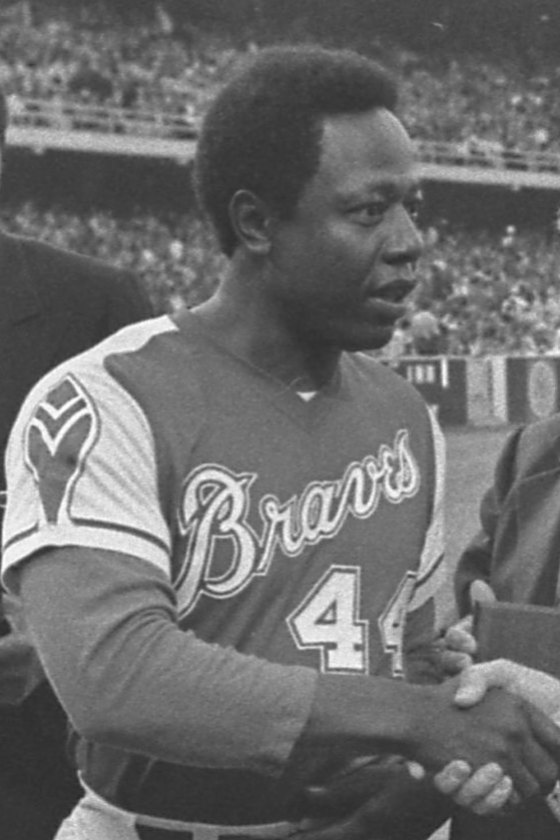
- No. 5 (1954), No. 44 (1955–1976)
- Hall of Fame
- Class of 1982, 97.8% of the vote
The story
Bio
Hank Aaron hit 755 home runs, drove in more runs than anyone in history, and passed Babe Ruth with a dignity that outlasted the hate mail. For 23 seasons he was the most relentlessly excellent hitter in baseball — never flashy, rarely hurt, and almost impossible to fool.
Henry Louis Aaron grew up poor in Mobile, Alabama, learned to hit by swatting bottle caps with a broomstick, and came up through the Negro Leagues and the newly integrated minor leagues of the Jim Crow South. He reached the majors at 20 and won an MVP and a World Series at 23. Then he did something rarer than any single great season: he stayed great. Twenty straight seasons with 20 or more homers. Twenty-one straight years as an All-Star. And in April 1974, the swing that made him a national figure.
Here is the full story, from the sandlots of Toulminville to the Braves, the Brewers, and Cooperstown. When you’re done, see how much stuck with the Hank Aaron quiz.
Hank Aaron
Bottle Caps and Broomsticks
Aaron was born February 5, 1934, in a Mobile neighborhood called “Down the Bay,” one of eight children of Herbert and Estella Aaron. The family soon moved to nearby Toulminville, where Herbert worked at the shipyards and everyone pitched in. Henry picked potatoes, tended the garden, and helped on an ice truck. Nobody could afford real equipment, so he hit bottle caps with sticks and broom handles for hours at a time.
That homemade training left him with a quirk: he batted cross-handed, with his hands reversed on the bat, and kept doing it into his first year as a pro. He starred in football and baseball at Central High School, and at 15 he tried out for the Brooklyn Dodgers, inspired by Jackie Robinson, whom he had watched in exhibitions in Alabama. The Dodgers passed. Aaron finished school at the private Josephine Allen Institute while playing semipro ball for the Pritchett Athletics and then the Mobile Black Bears, who paid him $3 a game. His mother’s one condition: no road trips.
Hank Aaron
From the Clowns to the Sally League
On November 20, 1951, Aaron signed with the Indianapolis Clowns of the Negro American League for $200 a month. The skinny shortstop hit a reported .366, and by the spring of 1952 two big-league clubs had sent offers. The New York Giants wanted him. So did the Boston Braves. Aaron picked Boston, he later said, because the Braves offered $50 more a month. Aaron and Willie Mays in the same outfield came down to fifty dollars. His Clowns season is part of the larger story on our Negro Leagues page.
The Braves sent him to the Class C Eau Claire Bears, where he hit .336 and was named Northern League Rookie of the Year. In 1953 he was one of five Black players who integrated the South Atlantic League, playing second base for Jacksonville in the heart of the segregated South. He led the league in batting (.362), hits, runs, and doubles, won the MVP, and carried Jacksonville to the title. One writer put it best: Aaron “led the league in everything except hotel accommodations.” That summer he met Barbara Lucas at a Jacksonville game; they married in October.
Hank Aaron
A Broken Ankle Opens the Door
After a winter in Puerto Rico learning the outfield and refining his new conventional grip with coach Mickey Owen, Aaron reported to spring training in 1954 as a long shot. Then on March 13, veteran outfielder Bobby Thomson (the man who hit the “Shot Heard ’Round the World”) broke his ankle sliding into second. Aaron took the job and never gave it back.
He debuted April 13, 1954, at Cincinnati. His first hit, a double, and his first home run a week later both came off the Cardinals’ Vic Raschi. A broken ankle of his own ended his rookie season in September, the only serious injury of his career. Around then the Braves’ publicity man, Don Davidson, started calling the quiet kid “Hank” to make him seem more approachable. Family and friends always called him Henry.
Hank Aaron
1957: MVP, Pennant, and a Ring
Aaron won his first batting title in 1956 (.328), then made 1957 his masterpiece. Topps printed his baseball card backward that spring, with the photo flipped so he looked like a lefty, and it didn’t slow him down at all. He led the National League with 44 homers, 132 RBI, and 118 runs and won the NL MVP, the only one of his career.
The signature moment came September 23 at County Stadium: an 11th-inning, two-run walk-off homer off St. Louis’s Billy Muffett that clinched the pennant. His teammates carried him off the field, and Aaron always ranked that night among the greatest of his career. In the World Series against the Yankees he hit .393 with three homers, and Milwaukee won in seven for its only championship. His partner in the middle of that lineup gets his own spotlight in the Eddie Mathews quiz.
Hank Aaron
The Quiet Superstar
The Braves returned to the World Series in 1958. Aaron hit .333, but New York won in seven, and he began a three-year run of Gold Gloves in right field. His 1959 season might have been his best: a .355 average, 223 hits, a .636 slugging percentage, and 400 total bases, all tops in the majors. That year he also won six straight matches, and $13,000, on the TV show Home Run Derby. He later joked that he retooled his swing for power because “they never had a show called ‘Singles Derby.’”
Through the 1960s, the so-called decade of the pitcher, Aaron simply kept producing. On June 8, 1961, he was part of the first four consecutive home runs in major-league history, alongside Eddie Mathews, Joe Adcock, and Frank Thomas. In 1963 he hit 44 homers and stole 31 bases to join the 30-30 club, leading the league in homers and RBI and missing the Triple Crown only because Tommy Davis out-hit him by seven points.
He did it with his wrists. At six feet and 180 pounds he was slender by slugger standards, but his hands were so quick he could wait an extra split second and still turn on anything. “I never worried about the fastball,” he said. “They couldn’t throw it past me. None of them.” Don Drysdale gave up 17 of his home runs, more than any other pitcher. The league’s hurlers had their own nickname for him: Bad Henry.
Hank Aaron
Atlanta and the Road to 714
When the franchise moved to Atlanta in 1966, Aaron, a son of Alabama who had already helped integrate one Southern league, went with it. He led the NL in homers and RBI in that first Atlanta season, hit his 500th homer in 1968, and passed Mickey Mantle for third on the all-time list in 1969. In the first National League Championship Series that October, he hit .357 with three home runs in three games before the Miracle Mets swept Atlanta.
On May 17, 1970, he singled against Cincinnati for hit No. 3,000, becoming the first player with both 3,000 hits and 500 home runs. In 1971, at 37, he hit No. 600 off Gaylord Perry on the way to a career-high 47. In 1972 he passed Willie Mays for second place. By the end of 1973, at 39, he sat at 713, one shy of Babe Ruth.
Hank Aaron
The Chase
What should have been a celebration turned ugly. Aaron received roughly 930,000 pieces of mail in 1973, more than any American outside politics, and a staggering amount of it was racist. There were death threats, the FBI investigated threats against his family, and he spent a long winter stuck on 713 knowing exactly what waited for him in the spring. He kept the letters.
Plenty of Americans rallied to him once the hatred became public, but Aaron carried the weight mostly in silence. He never lashed out, and he never stopped hitting. “I don’t want them to forget Ruth,” he said. “I just want them to remember me.”
Hank Aaron
April 8, 1974: 715
The Braves opened 1974 in Cincinnati, and Aaron tied Ruth in his first at-bat of the season: No. 714 off Jack Billingham on April 4. Four days later, in front of 53,775 fans at Atlanta–Fulton County Stadium, he drove a 1-0 pitch from the Dodgers’ Al Downing into the left-field bullpen in the fourth inning. Braves reliever Tom House caught it. Two fans jogged alongside Aaron around the bases, and his mother, Estella, met him at home plate with a hug.
Braves announcer Milo Hamilton shouted, “There’s a new home run champion of all time, and it’s Henry Aaron!” On the Dodgers broadcast, Vin Scully let the crowd roar and then summed it up: “A black man is getting a standing ovation in the Deep South for breaking a record of an all-time baseball idol.” Aaron’s own first words were simpler: he just thanked God it was over.
Hank Aaron
Home to Milwaukee: No. 755
Aaron hit his 733rd and final home run as a Brave in October 1974. On November 2, Atlanta traded him to the Milwaukee Brewers for outfielder Dave May and a minor-league pitcher, and Aaron was thrilled: “I’m going back home.” As the Brewers’ designated hitter he passed Ruth’s career RBI record on May 1, 1975, made his 21st straight All-Star team that summer, and on July 20, 1976, hit No. 755 off the Angels’ Dick Drago at County Stadium. He played his last game on October 3, 1976, and went 1-for-3 with an RBI.
Hank Aaron
Front Office, Cooperstown, and Beyond
Aaron went straight back to the Braves as vice president of player development, one of the first Black executives in a major-league front office, and later served as a senior vice president with the club and with Turner Broadcasting. He was elected to the Hall of Fame in 1982 on 406 of 415 ballots (97.8 percent, at the time second only to Ty Cobb) and was inducted alongside Frank Robinson that August.
Away from the field he built a business career in car dealerships and restaurants, wrote the 1990 autobiography I Had a Hammer, and with his wife Billye founded the Chasing the Dream Foundation to help young people pursue their talents. Mobile named its minor-league ballpark Hank Aaron Stadium, Major League Baseball created the Hank Aaron Award in 1999 for the top hitter in each league, and President George W. Bush awarded him the Presidential Medal of Freedom in 2002.
When Barry Bonds hit No. 756 in 2007, Aaron congratulated him in a video message on the scoreboard, saying he had been “privileged to hold this record for 33 of those years.” Aaron died in his sleep in Atlanta on January 22, 2021, two weeks shy of his 87th birthday, and is buried at South View Cemetery.
Hank Aaron
Records and Honors
- 2,297 RBI: the all-time major-league record
- 6,856 total bases: the all-time record, more than 600 ahead of anyone else
- 1,477 extra-base hits: the all-time record
- 25 All-Star selections: the all-time record, across 21 straight seasons (1955–1975)
- 755 home runs: the career record from 1974 to 2007; still second all-time
- 3,771 hits: third all-time
- 1957 NL MVP and 1957 World Series champion
- Two batting titles (1956, 1959), four home run titles (1957, 1963, 1966, 1967), and four RBI titles (1957, 1960, 1963, 1966)
- Three Gold Gloves (1958–1960)
- National Baseball Hall of Fame, class of 1982
- No. 44 retired by both the Braves and the Brewers
- MLB All-Century Team, Presidential Citizens Medal (2001), and Presidential Medal of Freedom (2002)
Hank Aaron
Hammer Fun Facts
- He wore No. 5 as a rookie before switching to No. 44, then hit exactly 44 homers in four different seasons (1957, 1963, 1966, and 1969).
- For all that power, he never hit 50 in a season. His career high was 47, at age 37.
- Take away all 755 home runs and he still has 3,016 hits.
- He and Babe Ruth finished with the exact same number of career runs: 2,174.
- He and Eddie Mathews hit 863 home runs as teammates, the most by any pair in history.
- He and his brother Tommie hold the record for home runs by siblings: 768 (Hank 755, Tommie 13).
- He hit 20 or more home runs in 20 consecutive seasons, from 1955 through 1974.
- Muhammad Ali called him “the only man I idolize more than myself.”
Think you know the Hammer now? Prove it with all ten quizzes in the Hank Aaron collection, take the Hank Aaron quiz in the Braves lineup, tour his ballparks in the Braves Stadiums quiz, or browse the full Atlanta Braves and Milwaukee Brewers quiz collections.
The postseason
October Accolades
| Year | Series | Result | G | H-AB | BA | HR | RBI |
|---|---|---|---|---|---|---|---|
| 1957 | World Series | Braves def. Yankees, 4–3 World Series champion; led both teams with 11 hits and 3 home runs | 7 | 11-28 | .393 | 3 | 7 |
| 1958 | World Series | Yankees def. Braves, 4–3 Second straight NL pennant | 7 | 9-27 | .333 | 0 | 2 |
| 1969 | NLCS | Mets def. Braves, 3–0 Homered in all three games of the first NLCS | 3 | 5-14 | .357 | 3 | 7 |
| Postseason | 3 series | 17 | 25-69 | .362 | 6 | 16 | |
The clubs
Teams
-
Atlanta Braves
1954–1974
Milwaukee 1954–65, Atlanta 1966–74 · 733 HR, 1957 MVP and World Series title
-
Milwaukee Brewers
1975–1976
Came home to Milwaukee as a DH and hit No. 755 at County Stadium
The numbers
Season Stats
| Season | Team | League | WAR | Games | PA | AB | Runs | Hits | RBI | 2B | 3B | HR | SB | BB | BA | OBP | SLG | OPS |
|---|---|---|---|---|---|---|---|---|---|---|---|---|---|---|---|---|---|---|
| 1954 | Milwaukee Braves | NL | 1.5 | 122 | 509 | 468 | 58 | 131 | 69 | 27 | 6 | 13 | 2 | 28 | .280 | .322 | .447 | .769 |
| 1955 | Milwaukee Braves | NL | 6.2 | 153 | 665 | 602 | 105 | 189 | 106 | 37 | 9 | 27 | 3 | 49 | .314 | .366 | .540 | .906 |
| 1956 | Milwaukee Braves | NL | 7.2 | 153 | 660 | 609 | 106 | 200 | 92 | 34 | 14 | 26 | 2 | 37 | .328 | .365 | .558 | .923 |
| 1957 | Milwaukee Braves | NL | 8.0 | 151 | 675 | 615 | 118 | 198 | 132 | 27 | 6 | 44 | 1 | 57 | .322 | .378 | .600 | .978 |
| 1958 | Milwaukee Braves | NL | 7.3 | 153 | 664 | 601 | 109 | 196 | 95 | 34 | 4 | 30 | 4 | 59 | .326 | .386 | .546 | .931 |
| 1959 | Milwaukee Braves | NL | 8.7 | 154 | 693 | 629 | 116 | 223 | 123 | 46 | 7 | 39 | 8 | 51 | .355 | .401 | .636 | 1.037 |
| 1960 | Milwaukee Braves | NL | 8.0 | 153 | 664 | 590 | 102 | 172 | 126 | 20 | 11 | 40 | 16 | 60 | .292 | .352 | .566 | .919 |
| 1961 | Milwaukee Braves | NL | 9.5 | 155 | 671 | 603 | 115 | 197 | 120 | 39 | 10 | 34 | 21 | 56 | .327 | .381 | .594 | .974 |
| 1962 | Milwaukee Braves | NL | 8.6 | 156 | 667 | 592 | 127 | 191 | 128 | 28 | 6 | 45 | 15 | 66 | .323 | .390 | .618 | 1.008 |
| 1963 | Milwaukee Braves | NL | 9.1 | 161 | 714 | 631 | 121 | 201 | 130 | 29 | 4 | 44 | 31 | 78 | .319 | .391 | .586 | .977 |
| 1964 | Milwaukee Braves | NL | 6.8 | 145 | 634 | 570 | 103 | 187 | 95 | 30 | 2 | 24 | 22 | 62 | .328 | .393 | .514 | .907 |
| 1965 | Milwaukee Braves | NL | 7.9 | 150 | 639 | 570 | 109 | 181 | 89 | 40 | 1 | 32 | 24 | 60 | .318 | .379 | .560 | .938 |
| 1966 | Atlanta Braves | NL | 7.9 | 158 | 688 | 603 | 117 | 168 | 127 | 23 | 1 | 44 | 21 | 76 | .279 | .356 | .539 | .895 |
| 1967 | Atlanta Braves | NL | 8.5 | 155 | 669 | 600 | 113 | 184 | 109 | 37 | 3 | 39 | 17 | 63 | .307 | .369 | .573 | .943 |
| 1968 | Atlanta Braves | NL | 6.8 | 160 | 676 | 606 | 84 | 174 | 86 | 33 | 4 | 29 | 28 | 64 | .287 | .354 | .498 | .852 |
| 1969 | Atlanta Braves | NL | 8.0 | 147 | 639 | 547 | 100 | 164 | 97 | 30 | 3 | 44 | 9 | 87 | .300 | .396 | .607 | 1.003 |
| 1970 | Atlanta Braves | NL | 5.0 | 150 | 598 | 516 | 103 | 154 | 118 | 26 | 1 | 38 | 9 | 74 | .298 | .385 | .574 | .958 |
| 1971 | Atlanta Braves | NL | 7.2 | 139 | 573 | 495 | 95 | 162 | 118 | 22 | 3 | 47 | 1 | 71 | .327 | .410 | .669 | 1.079 |
| 1972 | Atlanta Braves | NL | 3.9 | 129 | 545 | 449 | 75 | 119 | 77 | 10 | 0 | 34 | 4 | 92 | .265 | .390 | .514 | .904 |
| 1973 | Atlanta Braves | NL | 4.7 | 120 | 465 | 392 | 84 | 118 | 96 | 12 | 1 | 40 | 1 | 68 | .301 | .402 | .643 | 1.045 |
| 1974 | Atlanta Braves | NL | 2.1 | 112 | 382 | 340 | 47 | 91 | 69 | 16 | 0 | 20 | 1 | 39 | .268 | .341 | .491 | .832 |
| 1975 | Milwaukee Brewers | AL | 0.1 | 137 | 543 | 465 | 45 | 109 | 60 | 16 | 2 | 12 | 0 | 70 | .234 | .332 | .355 | .687 |
| 1976 | Milwaukee Brewers | AL | 0.4 | 85 | 308 | 271 | 22 | 62 | 35 | 8 | 0 | 10 | 0 | 35 | .229 | .315 | .369 | .684 |
| Career | 23 seasons | NL/AL | 143.4 | 3,298 | 13,941 | 12,364 | 2,174 | 3,771 | 2,297 | 624 | 98 | 755 | 240 | 1,402 | .305 | .374 | .555 | .928 |