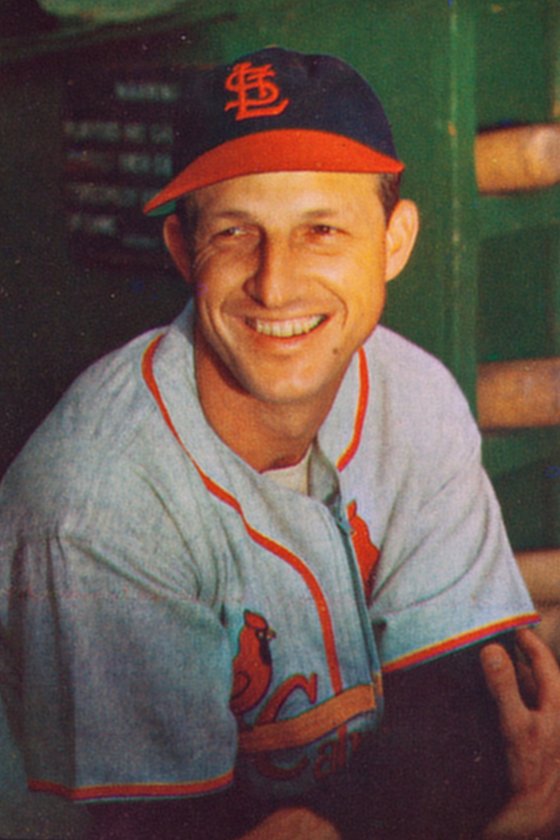
Player knowledge
Stan Musial
OF / 1B 1941–1963 Hall of Fame
- Born
- November 21, 1920, in Donora, Pennsylvania
- Bats / Throws
- L/L
- Height / Weight
- 6'0", 175 lbs
- High School
- Donora High School
- Full Name
- Stanley Frank Musial (born Stanislaw Franciszek Musial)
- Died
- January 19, 2013, in Ladue, Missouri (age 92)
- Nicknames
- Stan the Man, The Donora Greyhound, Stash
- MLB Debut
- September 17, 1941, vs. the Boston Braves at Sportsman’s Park
- Final Game
- September 29, 1963, vs. Cincinnati (two singles)
- Uniform
- No. 6, retired by the Cardinals in 1963
- Hits
- 3,630: exactly 1,815 at home and 1,815 on the road
- Batting Titles
- Seven (1943, 1946, 1948, 1950, 1951, 1952, 1957)
- Hall of Fame
- Class of 1969, first ballot, 93.2% of the vote
The story
Bio
Stan Musial never led the National League in home runs, never got thrown out of a game, and never stopped smiling. He simply hit, from the day he arrived in St. Louis in 1941 until the day he left in 1963, and he did it so well and so evenly that he collected exactly 1,815 hits at home and 1,815 on the road.
Stanley Frank Musial grew up in a Pennsylvania mill town, signed with the Cardinals as a 16-year-old pitcher, and hurt his throwing shoulder so badly in 1940 that his pitching career was over before it started. Less than 13 months later he was in the big leagues as an outfielder. He won seven batting titles and three MVP awards, played in four World Series in his first five full seasons, and retired with 3,630 hits, more than any National Leaguer before him. Along the way, Brooklyn fans gave him the nickname that became his name: Stan the Man.
Here is the whole story, from the hills above the Monongahela River to 22 seasons with the St. Louis Cardinals, a year in the Navy, and Cooperstown. When you’re done, see how much stuck with the Stan Musial Cardinals quiz.
Stan Musial
Stash from Donora
Musial was born November 21, 1920, in Donora, Pennsylvania, a steel and zinc town on the Monongahela River about 28 miles south of Pittsburgh. His father, Lukasz, had come from Poland in 1910 and worked hard, dirty jobs in the mills. His mother, Mary Lancos, the daughter of Czech immigrants, had been working as a housekeeper since she was eight. Stan was the fifth of their six children and the first son. His father named him Stanislaw and called him “Stashu,” soon shortened to “Stash.” At school the name became Stanley.
Money was always short. Mary mended clothes until they fell apart and wrapped string around old socks to make baseballs for her boy. Stan was a so-so student with a slight stutter, but he was a natural athlete. Gymnastics training with the Polish Falcons, a Polish-American club, made him limber and quick, and he starred in basketball and baseball at Donora High School. One of his teammates was Buddy Griffey, whose son and grandson, both named Ken, would reach the majors too.
A favorite story says the University of Pittsburgh offered Stan a basketball scholarship, that his father insisted he take it, and that his mother won the argument with “This is America, and he has the right not to go to college.” It makes a good scene, but his biographer James Giglio found a simpler truth: Stan had already signed a professional contract with a Cardinals farm team on September 29, 1937, two months before his 17th birthday. He was the only one of the six Musial children to finish high school.
Stan Musial
The Pitcher with the Wild Arm
Musial began as a left-handed pitcher. With the Class D Williamson Colts of West Virginia in 1938 he went 6–6 but walked 80 men in 110 innings. He was better in 1939, 9–2, and he hit .352 when he played the outfield between starts. Back home, he had fallen for Lillian Labash, a grocer’s daughter from Donora.
In 1940 the Cardinals sent him to Daytona Beach in the Florida State League, where he met the man he later called one of the great influences of his life: manager Dick Kerr, a former White Sox pitcher who had won two games in the scandal-soaked 1919 World Series. Kerr and his wife, Cora, all but adopted the young couple. They stood as witnesses when Stan and Lil married in Daytona Beach on May 25, 1940, and the Musials named their first child, Richard, after Kerr. Years later Musial bought the Kerrs a house in Houston.
On the mound Musial went 18–5 with a 2.62 ERA, and because the roster was tiny, he played the outfield on his off days and hit .311. Then on August 11, 1940, chasing a sinking liner in center field, he tried a tumbling catch, caught his spikes, and landed hard on his left shoulder. The arm was never the same. Kerr told the Cardinals what he had seen for months: this kid was a hitter.
Stan Musial
Class C to the Big Leagues in One Summer
The Cardinals sent their converted outfielder to Springfield, Missouri, in the Class C Western Association in 1941. He tore the league apart, batting .379 with 26 home runs in just 87 games, and was promoted to Rochester of the International League, where he hit .326. On September 17, 1941, less than 13 months after his shoulder injury, he made his major-league debut at Sportsman’s Park against the Boston Braves and doubled for his first hit. Six days later at Forbes Field in Pittsburgh he hit his first home run, off Rip Sewell.
In 12 games he batted .426 and struck out once. St. Louis still finished 2½ games behind Brooklyn, and some Cardinals veterans grumbled that the kid should have been called up sooner.
Stan Musial
The Peekaboo Stance
Nobody had ever seen a stance like his. Musial dug in deep in the back of the box, crouched low, and twisted his body away from the pitcher, peering over his right shoulder with his feet close together. Hall of Fame pitcher Ted Lyons said he looked like a kid peeking around a corner to see if the cops were coming. Pitchers compared it to a coiled rattlesnake. Then the ball arrived and Musial uncoiled into a line drive.
In his first full season, 1942, he batted .315, just behind teammate Enos Slaughter’s .318, and was batting cleanup by late June. The Cardinals won 106 games and edged the Dodgers by two. In the World Series they met the Yankees, who had won the championship in five of the previous six seasons. Musial hit just .222, but in Game 2 his eighth-inning single drove in the go-ahead run, and St. Louis stunned New York in five games.
Stan Musial
Pennants in Wartime
With many stars off to World War II, the 22-year-old Musial became the best player in the National League. In 1943 he led the league with a .357 average, 220 hits, 48 doubles, and 20 triples, plus the top on-base and slugging marks, and won his first MVP award. The Cardinals won the pennant again, but the Yankees took the World Series in five.
In 1944 the Cardinals won 100 games for the third straight season, and Musial hit .347 with a league-leading 197 hits and 51 doubles. That October the World Series never left town. The lowly St. Louis Browns, the Cardinals’ own tenants at Sportsman’s Park, had won their first pennant, and after the Browns took two of the first three games, Musial hit a two-run homer off Sig Jakucki in the first inning of Game 4. St. Louis won that game and the next two, and Musial had his second ring. In the off-season he worked at a steel and wire plant in Donora and joined a USO tour to visit troops in the Aleutian Islands.
Stan Musial
Seaman Musial
Musial enlisted in the Navy in January 1945 and missed the entire season. He did his basic training at Bainbridge, Maryland, where he played first base for the first time, and then shipped out to Pearl Harbor with a ship repair unit. His job was running a liberty launch, a small boat ferrying sailors and officers between the docks and the damaged ships. Afternoons were for baseball in a service league full of big leaguers. His fellow sailors wanted to see home runs, so he tinkered with his stance to pull the ball with more power, a change that paid off for years.
That fall his father fell gravely ill, and Musial received emergency leave to come home. Lukasz recovered, and Stan finished his hitch at the Philadelphia Navy Yard. He was discharged on March 1, 1946, in time for spring training.
Stan Musial
1946: Home, Rich Offers, and a Second MVP
That spring the Mexican League’s Pasquel brothers tried to lure big-league stars south of the border, and they reportedly dangled a $50,000 signing bonus in front of Musial. He was tempted and said no. Players who did jump were suspended by the commissioner.
When rookie Dick Sisler struggled at first base, manager Eddie Dyer asked Musial to move there “for a while.” He ended up playing more than 1,000 games at first base to go with nearly 1,900 in the outfield. The move didn’t slow him down at all. He led the league with a .365 average, 228 hits, 50 doubles, and 20 triples, drove in 103 runs, and won his second MVP. The Cardinals beat the Dodgers in the National League’s first-ever tiebreaker playoff, then faced Ted Williams and the Red Sox in the World Series. Both MVPs struggled: Musial hit .222 and Williams .200. Musial did hit four doubles, and Enos Slaughter’s “Mad Dash” home from first in Game 7 gave St. Louis the title. It was Musial’s third championship in five seasons, and his last.
That year also gave him his nickname. St. Louis writer Bob Broeg recalled that during a June series at Ebbets Field, when Musial went 8-for-12, Brooklyn fans groaned “Here comes that man again” every time he stepped in. Broeg put it in print, and he was Stan the Man from then on. His speed out of the box earned him a second, less famous nickname: the Donora Greyhound.
Stan Musial
“That Lousy Year”
Musial called 1947 “that lousy year.” He hit .146 in April and was down to .139 in mid-May, feeling weak and sick. Doctors found an inflamed appendix and infected tonsils. Rather than lose him for weeks, team physician Robert Hyland treated the appendix with ice packs, “freezing” it so Musial could keep playing, and both organs came out after the season. He rallied to finish at .312 with 95 RBI, which for anyone else would have been a fine year.
It was also Jackie Robinson’s rookie season, and the Cardinals, whose radio network blanketed the South, were at the center of the tension. Rumors spread that some Cardinals would refuse to play Brooklyn, though no strike ever happened. Musial had played alongside Black teammates in Donora and kept clear of the ugliness. After Slaughter spiked Robinson at first base in an August game, Robinson told Musial, playing first for St. Louis, what he wanted to do about it. “I don’t blame you,” Musial quietly replied. Robinson later named Musial as one of the opponents who treated him decently that year.
Stan Musial
1948: One Homer Short of Everything
Healthy again, Musial produced one of the greatest seasons in National League history. He batted a career-high .376 and led the league in hits (230), runs (135), RBI (131), doubles (46), triples (18), on-base percentage (.450), slugging (.702), and total bases (429). The only major category he missed was home runs: his 39 were one behind Ralph Kiner and Johnny Mize. By his own account he lost a homer to a rained-out game, so he came within a single swing of the Triple Crown. He also had four five-hit games, tying a record set by Ty Cobb. He won his third MVP.
The year ended in grief. In late October a toxic smog settled over Donora for five days, killing 20 people and sickening thousands. His father, already weakened by lung disease and strokes, moved in with Stan in St. Louis, but he died that December.
Stan Musial
Mr. Consistency
From 1949 through 1958, Musial’s seasons were almost interchangeable: on average, a .335 batting average, 189 hits, 29 homers, and 105 RBI a year. He won batting titles in 1950, 1951, and 1952, but the Cardinals, aging and outspent, never got back to the World Series in his career. Some days still stood out.
On September 28, 1952, with the batting title almost locked up, Musial took the mound for the only time in his big-league career to face Frank Baumholtz of the Cubs, his closest pursuer. Baumholtz, a lefty, switched to the right side of the plate and reached on an error. Musial never pitched again. On May 2, 1954, in a doubleheader against the Giants in St. Louis, he hit five home runs, three in the opener and two in the nightcap, a major-league record for a doubleheader. An eight-year-old in the stands, Nate Colbert, tied it for the Padres in 1972.
The All-Star Game was his personal stage. In 1955 at Milwaukee’s County Stadium, he led off the bottom of the 12th inning with a walk-off home run off Boston’s Frank Sullivan to win it 6–5 for the National League. He played in 24 All-Star Games and hit six home runs in them, still the record. He was durable, too: on June 12, 1957, he broke Gus Suhr’s National League record for consecutive games, and the streak reached 895 before a shoulder injury ended it that August. At 36 he won his seventh and final batting title that season at .351, and Sports Illustrated named him its Sportsman of the Year.
Stan Musial
3,000 and the Long Goodbye
Musial began 1958 at 2,997 hits. Manager Fred Hutchinson wanted him to reach 3,000 in front of the home fans, so he kept him on the bench at Wrigley Field on May 13, 1958. In the sixth inning, with a rally going, Hutchinson changed his mind. Musial pinch-hit a double off Moe Drabowsky and became the eighth player to reach 3,000 hits, the first in 16 years. That season he signed for $100,000, the first National Leaguer paid that much.
Then, suddenly, he was mortal. He hit just .255 in 1959 and asked the Cardinals to cut his salary. He bounced back to hit .275 and .288, and in 1962, at 41, he hit a stunning .330. That May he passed Honus Wagner as the National League’s career hits leader. That summer’s All-Star Game was in Washington, and President John F. Kennedy, a friend, joked with him: “They tell me you’re too old to play baseball and I’m too young to be president, but maybe we’ll fool them.”
In 1963 Musial announced it would be his final season. On September 10, hours after his first grandchild was born, he homered in his first at-bat. On September 29 he played his last game, against Cincinnati, and singled twice. The first ground ball skipped past a rookie second baseman named Pete Rose. At the farewell ceremony that day, Commissioner Ford Frick said, “Here stands baseball’s perfect warrior. Here stands baseball’s perfect knight.” The Cardinals retired his No. 6.
Stan Musial
The Man After Baseball
Musial never really left the Cardinals. He became a vice president, and in 1967 he served one season as general manager. The Cardinals won the World Series, and he stepped down in December, joking that he quit while he was ahead. President Lyndon Johnson named him his physical fitness adviser in 1964. He ran a popular St. Louis restaurant, Stan and Biggie’s, with his friend Julius “Biggie” Garagnani, and he loved entertaining crowds with his harmonica.
In January 1969 he was elected to the Hall of Fame on his first ballot, named on 317 of 340 ballots (93.2 percent), and he was inducted that summer alongside Roy Campanella. A statue went up outside Busch Stadium in 1968 with Frick’s “perfect warrior” words on its base, and it still greets fans at the ballpark today. In 2011 President Barack Obama awarded him the Presidential Medal of Freedom.
Lil died in May 2012, after nearly 72 years of marriage. Musial died at home in suburban St. Louis on January 19, 2013, at 92. In February 2014, the new Mississippi River bridge linking St. Louis and Illinois opened as the Stan Musial Veterans Memorial Bridge.
Stan Musial
Records and Honors
- 3,630 hits: fourth all-time, and the National League record until Pete Rose passed him in 1981
- 6,134 total bases: third all-time, behind only Hank Aaron and Albert Pujols
- 725 doubles: third all-time
- .331 batting average, .417 on-base percentage, .559 slugging over 22 seasons, with 475 home runs
- Seven NL batting titles: 1943, 1946, 1948, 1950, 1951, 1952, and 1957
- Three NL MVP awards: 1943, 1946, and 1948
- Three World Series titles: 1942, 1944, and 1946
- 24 All-Star Games and a record six All-Star home runs
- 128.5 career WAR, per Baseball-Reference
- Five home runs in a doubleheader (May 2, 1954): a major-league record he now shares with Nate Colbert
- Hall of Fame (1969, first ballot), No. 6 retired by the Cardinals, MLB All-Century Team (1999), and the Presidential Medal of Freedom (2011)
Stan Musial
Stan the Man Fun Facts
- His 3,630 hits split perfectly: 1,815 at home and 1,815 on the road.
- He finished with 1,949 runs scored and 1,951 RBI, almost a perfect match.
- He hit 475 home runs without ever leading the league. His career high was 39, in 1948.
- He never struck out more than 46 times in a season, and he fanned only once in his 12-game debut in 1941.
- He pitched to exactly one major-league batter, Frank Baumholtz in 1952, who reached on an error.
- Ken Griffey Jr. was born in Donora on November 21, 1969, Musial’s 49th birthday. Griffey’s grandfather Buddy had been Musial’s high school teammate.
- He was never ejected from a major-league game.
- A doctor “froze” his inflamed appendix with ice in 1947 so he could keep playing all season.
Think you know Stan the Man now? Prove it with all ten quizzes in the Stan Musial collection, take the Stan Musial Cardinals quiz, read about his 1946 World Series rival on the Ted Williams page, meet another Cardinals icon on the Ozzie Smith page, or browse the full St. Louis Cardinals quiz collection.
The postseason
October Accolades
| Year | Series | Result | G | H-AB | BA | HR | RBI |
|---|---|---|---|---|---|---|---|
| 1942 | World Series | Cardinals def. Yankees, 4–1 Rookie cleanup hitter; drove in the winning run in the eighth inning of Game 2 in a big upset | 5 | 4-18 | .222 | 0 | 2 |
| 1943 | World Series | Yankees def. Cardinals, 4–1 Fresh off his first MVP, held without an extra-base hit as New York got its revenge | 5 | 5-18 | .278 | 0 | 0 |
| 1944 | World Series | Cardinals def. Browns, 4–2 The all–St. Louis “Streetcar Series”; his first-inning homer in Game 4 evened it at two games apiece | 6 | 7-23 | .304 | 1 | 2 |
| 1946 | World Series | Cardinals def. Red Sox, 4–3 Four doubles in the MVP duel with Ted Williams; Enos Slaughter’s “Mad Dash” won Game 7 | 7 | 6-27 | .222 | 0 | 4 |
| Postseason | 4 series | 23 | 22-86 | .256 | 1 | 8 | |
The clubs
Teams
-
St. Louis Cardinals
1941–1944, 1946–1963
3,630 hits, seven batting titles, three MVPs, and three World Series titles in 22 seasons
The numbers
Season Stats
| Season | Team | League | WAR | Games | PA | AB | Runs | Hits | RBI | 2B | 3B | HR | SB | BB | BA | OBP | SLG | OPS |
|---|---|---|---|---|---|---|---|---|---|---|---|---|---|---|---|---|---|---|
| 1941 | St. Louis Cardinals | NL | 0.7 | 12 | 49 | 47 | 8 | 20 | 7 | 4 | 0 | 1 | 1 | 2 | .426 | .449 | .574 | 1.023 |
| 1942 | St. Louis Cardinals | NL | 5.3 | 140 | 536 | 467 | 87 | 147 | 72 | 32 | 10 | 10 | 6 | 62 | .315 | .397 | .490 | .888 |
| 1943 | St. Louis Cardinals | NL | 9.5 | 157 | 701 | 617 | 108 | 220 | 81 | 48 | 20 | 13 | 9 | 72 | .357 | .425 | .562 | .988 |
| 1944 | St. Louis Cardinals | NL | 8.9 | 146 | 668 | 568 | 112 | 197 | 94 | 51 | 14 | 12 | 7 | 90 | .347 | .440 | .549 | .990 |
| 1946 | St. Louis Cardinals | NL | 9.3 | 156 | 702 | 624 | 124 | 228 | 103 | 50 | 20 | 16 | 7 | 73 | .365 | .434 | .587 | 1.021 |
| 1947 | St. Louis Cardinals | NL | 5.1 | 149 | 678 | 587 | 113 | 183 | 95 | 30 | 13 | 19 | 4 | 80 | .312 | .398 | .504 | .902 |
| 1948 | St. Louis Cardinals | NL | 11.3 | 155 | 698 | 611 | 135 | 230 | 131 | 46 | 18 | 39 | 7 | 79 | .376 | .450 | .702 | 1.152 |
| 1949 | St. Louis Cardinals | NL | 9.1 | 157 | 722 | 612 | 128 | 207 | 123 | 41 | 13 | 36 | 3 | 107 | .338 | .438 | .624 | 1.062 |
| 1950 | St. Louis Cardinals | NL | 7.3 | 146 | 645 | 555 | 105 | 192 | 109 | 41 | 7 | 28 | 5 | 87 | .346 | .437 | .596 | 1.034 |
| 1951 | St. Louis Cardinals | NL | 8.8 | 152 | 678 | 578 | 124 | 205 | 108 | 30 | 12 | 32 | 4 | 98 | .355 | .449 | .614 | 1.063 |
| 1952 | St. Louis Cardinals | NL | 7.5 | 154 | 678 | 578 | 105 | 194 | 91 | 42 | 6 | 21 | 7 | 96 | .336 | .432 | .538 | .970 |
| 1953 | St. Louis Cardinals | NL | 7.7 | 157 | 698 | 593 | 127 | 200 | 113 | 53 | 9 | 30 | 3 | 105 | .337 | .437 | .609 | 1.046 |
| 1954 | St. Louis Cardinals | NL | 6.5 | 153 | 705 | 591 | 120 | 195 | 126 | 41 | 9 | 35 | 1 | 103 | .330 | .428 | .607 | 1.036 |
| 1955 | St. Louis Cardinals | NL | 6.2 | 154 | 656 | 562 | 97 | 179 | 108 | 30 | 5 | 33 | 5 | 80 | .319 | .408 | .566 | .974 |
| 1956 | St. Louis Cardinals | NL | 5.6 | 156 | 682 | 594 | 87 | 184 | 109 | 33 | 6 | 27 | 2 | 75 | .310 | .386 | .522 | .908 |
| 1957 | St. Louis Cardinals | NL | 6.1 | 134 | 579 | 502 | 82 | 176 | 102 | 38 | 3 | 29 | 1 | 66 | .351 | .422 | .612 | 1.034 |
| 1958 | St. Louis Cardinals | NL | 4.1 | 135 | 549 | 472 | 64 | 159 | 62 | 35 | 2 | 17 | 0 | 72 | .337 | .423 | .528 | .950 |
| 1959 | St. Louis Cardinals | NL | 0.3 | 115 | 404 | 341 | 37 | 87 | 44 | 13 | 2 | 14 | 0 | 60 | .255 | .364 | .428 | .792 |
| 1960 | St. Louis Cardinals | NL | 1.9 | 116 | 378 | 331 | 49 | 91 | 63 | 17 | 1 | 17 | 1 | 41 | .275 | .354 | .486 | .841 |
| 1961 | St. Louis Cardinals | NL | 2.6 | 123 | 431 | 372 | 46 | 107 | 70 | 22 | 4 | 15 | 0 | 52 | .288 | .371 | .489 | .860 |
| 1962 | St. Louis Cardinals | NL | 3.6 | 135 | 505 | 433 | 57 | 143 | 82 | 18 | 1 | 19 | 3 | 64 | .330 | .416 | .508 | .924 |
| 1963 | St. Louis Cardinals | NL | 1.3 | 124 | 379 | 337 | 34 | 86 | 58 | 10 | 2 | 12 | 2 | 35 | .255 | .325 | .404 | .728 |
| Career | 22 seasons | NL | 128.7 | 3,026 | 12,721 | 10,972 | 1,949 | 3,630 | 1,951 | 725 | 177 | 475 | 78 | 1,599 | .331 | .417 | .559 | .976 |