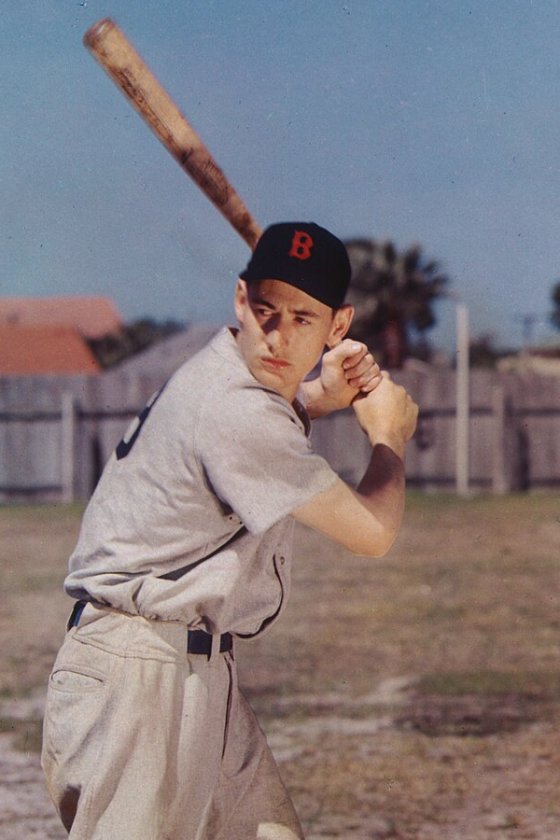
Player knowledge
Ted Williams
LF 1939–1960 Hall of Fame
- Born
- August 30, 1918, in San Diego, California
- Bats / Throws
- L/R
- Height / Weight
- 6'3", 205 lbs
- Hometown
- North Park (San Diego), California
- High School
- Herbert Hoover High School
- Full Name
- Theodore Samuel Williams
- Died
- July 5, 2002, in Inverness, Florida (age 83)
- Nicknames
- The Kid, The Splendid Splinter, Teddy Ballgame, Thumper
- MLB Debut
- April 20, 1939, vs. New York at Yankee Stadium
- Final Game
- September 28, 1960, homered in his last at-bat
- Uniform
- No. 9 (1939–1960), retired by the Red Sox in 1984
- Last .400 Season
- .406 in 1941
- Military
- U.S. Marine Corps aviator in World War II and Korea, 39 combat missions
- Hall of Fame
- Class of 1966, 93.4% of the vote
The story
Bio
Ted Williams wanted one thing out of life: to walk down the street and have people say, “There goes the greatest hitter who ever lived.” He came about as close as anyone ever has. He is the last man to hit .400, the career leader in on-base percentage, a two-time Triple Crown winner, and he did it all while giving nearly five seasons to the United States Marine Corps.
Theodore Samuel Williams was a skinny, restless kid from San Diego who studied hitting the way other people study medicine. He reached Boston at 20, led the league in RBI as a rookie, and hit .406 at 22. Then he flew planes in two wars, came back each time, and kept hitting into his 40s. He feuded with sportswriters, refused to tip his cap, won six batting titles, and homered in the final at-bat of his career.
Here is the whole story, from a North Park playground to 19 seasons with the Boston Red Sox, the cockpit of a Marine fighter jet, and Cooperstown. When you’re done, see how much stuck with the Ted Williams Red Sox quiz.
Ted Williams
The Kid from North Park
Williams was born August 30, 1918, in San Diego, the first of two sons of Samuel Williams, a photographer who ran a studio downtown, and May Venzor Williams, a tireless Salvation Army worker known around town as “Salvation May.” His mother was of Mexican descent, a heritage Ted seldom talked about in public. The family settled in a small house at 4121 Utah Street in the North Park neighborhood. His father was rarely home, and his mother was out on the streets for the Army most nights, so Ted and his younger brother Danny largely raised themselves.
Ted found his refuge down the street at the North Park playground, where director Rod Luscomb pitched to him for hours. He swung a bat before school, after school, and in the dark. At Herbert Hoover High School he pitched and played the outfield, and by his teens he was the best young hitter in the city. He was also fiercely competitive, wildly impatient, and certain he was going to be great.
Ted Williams
Hometown Padres
In 1936, at 17 and still in high school, Williams signed with the hometown San Diego Padres of the Pacific Coast League. He was so thin his teammates teased him, and he barely played at first. That summer Eddie Collins, general manager of the Boston Red Sox, came to San Diego to scout second baseman Bobby Doerr. He watched the gangly kid take batting practice and left town more excited about him. Collins got Padres owner Bill Lane to give Boston first claim on Williams.
In 1937 Williams became a regular, hit .291 with 23 home runs, and helped the Padres win the PCL playoffs. That December the Red Sox bought his contract for cash and players. He was 19.
Ted Williams
Minneapolis and Mr. Hornsby
Williams arrived at Red Sox camp in Sarasota, Florida, in the spring of 1938 brash and loud, and the club sent him to the Minneapolis Millers of the American Association for seasoning. The veteran Boston outfielders razzed him on his way out. As the story goes, Williams shot back that he would be back, and that he would make more money than all of them put together.
In Minneapolis he talked hitting with Rogers Hornsby, the great Cardinals star, who gave him the advice he would preach for the rest of his life: get a good ball to hit. Williams listened. He won the American Association Triple Crown with a .366 average, 43 homers, and 142 RBI, and the Red Sox could not keep him down any longer.
Ted Williams
The Kid Arrives
Williams debuted on April 20, 1939, at Yankee Stadium. Red Ruffing struck him out twice, but he also lined a double, and Lou Gehrig, in what turned out to be his final season, played first base for New York that day. Playing right field, Williams hit .327 with 31 homers and led the American League with 145 RBI, still the rookie record. Boston fans loved the skinny, excitable kid immediately.
The romance did not last. Williams moved to left field in 1940, hit .344, and led the league in runs, but he also sulked, argued with writers, and heard boos for loafing in the field. He told a reporter he would rather be a fireman like his uncle, and the Boston papers had a field day. Williams decided the writers, whom he called the “Knights of the Keyboard,” were out to get him. Around the same time he stopped tipping his cap to the crowd after home runs, and he never started again.
Ted Williams
1941: .406
The 1941 season is the one people still talk about. On July 8, at the All-Star Game at Briggs Stadium in Detroit, Williams came up with two on, two out, and the American League down a run in the ninth. He crushed a pitch from the Cubs’ Claude Passeau off the right-field facade for a 7–5 win and bounced around the bases like a kid. He always ranked it among the biggest thrills of his career.
He was hitting .3996 entering the final day, a season-ending doubleheader at Shibe Park in Philadelphia. That rounds up to .400, and manager Joe Cronin offered to let him sit and protect it. Williams refused. He went 6-for-8 in the two games and finished at .406. Nobody in the major leagues has hit .400 since. His .553 on-base percentage that year stood as the single-season record for 61 years.
He also led the league with 37 homers, 135 runs, and 147 walks, and still lost the MVP award to Joe DiMaggio, whose 56-game hitting streak had captured the country that summer.
Ted Williams
Triple Crown, Then Flight School
After Pearl Harbor, Williams’s draft board gave him a deferment because he was his mother’s main financial support. It was legal, but the public criticism was harsh, and a sponsor dropped him. In May 1942 he enlisted in the Navy’s V-5 aviation program, which let him finish the season. He finished it in style: a .356 average, 36 homers, and 137 RBI for his first major-league Triple Crown. The MVP went to the Yankees’ Joe Gordon.
Williams went to training with teammate Johnny Pesky and turned out to be a natural pilot, with the reflexes and eyesight that made him a hitter. He was commissioned a second lieutenant in the U.S. Marine Corps in 1944 and spent much of the war as a flight instructor in Pensacola, Florida. He was in Hawaii, awaiting orders for the Pacific, when the war ended. He missed three full seasons, from 1943 through 1945, in what should have been the heart of his prime.
Ted Williams
1946: The Pennant and the Shift
Williams came back as if he had never left. At the All-Star Game at Fenway Park he went 4-for-4 with two home runs and five RBI, and one of the homers came off Rip Sewell’s famous “eephus,” a blooper pitch that floated in on a high arc. Williams stepped into it and hit it out. On June 9 he hit the longest home run ever measured at Fenway, a 502-foot drive off Detroit’s Fred Hutchinson that landed on a fan’s straw hat in the right-field bleachers. That seat is painted red today.
On July 14, after Williams hit three homers in the first game of a doubleheader, Cleveland player-manager Lou Boudreau moved nearly his whole defense to the right side of the field. The “Boudreau Shift” became the template for every shift since, and Williams, stubborn as ever, mostly refused to hit the other way. He clinched the pennant on September 13 in Cleveland with the only inside-the-park home run of his career, in a 1–0 win, and won his first MVP award with a .342 average, 38 homers, and 123 RBI.
The 1946 World Series against the Cardinals was the only October of his career, and it went badly. He was hit on the elbow by a pitch in a tune-up exhibition game, and St. Louis used a shift of its own. He managed just five singles in 25 at-bats, one of them a bunt against the shift that made front-page news. In Game 7 Enos Slaughter scored from first on a hit to left-center, his famous “Mad Dash,” and the Cardinals won the Series. Williams gave his World Series check to Johnny Orlando, the Red Sox clubhouse man.
Ted Williams
So Close: 1947–1951
In 1947 Williams won his second Triple Crown, with a .343 average, 32 homers, and 114 RBI. Only Rogers Hornsby had ever won two. Williams still lost the MVP to DiMaggio by one point, 202 to 201, with at least one writer leaving him off the ballot entirely. In 1948 he won the batting title at .369, but the Red Sox lost a one-game playoff for the pennant to Cleveland at Fenway Park.
The 1949 season was nearly perfect. Williams hit 43 homers, tied teammate Vern Stephens for the league lead with 159 RBI, reached base in a record 84 straight games, and won his second MVP award. He missed a third Triple Crown when Detroit’s George Kell beat him for the batting title by less than a thousandth of a point, .3429 to .3428. Then Boston, needing one win in the final two games at Yankee Stadium, lost both and the pennant.
At the 1950 All-Star Game in Chicago, Williams crashed into the left-field wall catching a drive by Ralph Kiner in the first inning. He stayed in the game for several more innings and even singled, but his elbow was broken. Surgery cost him two months, and he said later that he never hit quite the same.
Ted Williams
Captain Williams Goes to Korea
In 1952, at 33, Williams was recalled to active duty as a Marine reserve pilot for the Korean War. He was angry about it, and said so, but he went. In his last at-bat before leaving, on April 30, 1952, he hit a two-run homer off Detroit’s Dizzy Trout to win the game.
Williams flew 39 combat missions in an F9F Panther jet with Marine squadron VMF-311, often alongside future astronaut and senator John Glenn, who became a lifelong friend. On February 16, 1953, antiaircraft fire hit his jet during a raid near Pyongyang. With the plane trailing flames, he nursed it back to base, crash-landed on its belly, and scrambled out as it burned. Recurring ear and sinus infections ended his tour that summer.
He was back in Boston in August 1953 and hit like a man who had never left: .407 with 13 home runs in 37 games and a .901 slugging percentage.
Ted Williams
The Old Man Can Still Hit
Williams broke his collarbone on the first day of spring training in 1954, came back to hit .345, and was denied the batting title because his 136 walks left him short of 400 at-bats. Bobby Avila won it at .341. Baseball later switched the qualifying standard to plate appearances. Williams said he would retire after that season, sat out the start of 1955 while his divorce was settled, and then returned in May to hit .356.
His temper still flared. In August 1956, after being booed at Fenway, he spat toward the stands and the press box, and owner Tom Yawkey fined him $5,000. Late in the 1958 season he flung his bat in frustration and it sailed into the box seats, striking Gladys Heffernan, Joe Cronin’s housekeeper. A shaken Williams apologized, and she forgave him.
Between the outbursts, he hit. In 1957, at 38, he batted .388, the highest average in the majors since his own .406, with 38 homers, and he reached base in 16 straight plate appearances that September. He finished second in the MVP vote to Mickey Mantle. In 1958, having turned 40 in August, he won his sixth batting title at .328, edging teammate Pete Runnels.
Ted Williams
Hub Fans Bid Kid Adieu
A pinched nerve in his neck wrecked 1959. Williams hit .254, the only time in his career he finished below .300, and he refused to go out that way. He came back for 1960 and insisted on a pay cut of roughly 30 percent, because he felt he hadn’t earned his salary. On June 17, 1960, in Cleveland, he became the fourth player to reach 500 home runs, after Babe Ruth, Jimmie Foxx, and Mel Ott.
His final game at Fenway came on a gray September 28, 1960, before 10,454 fans. In the eighth inning, in his last at-bat, he drove a pitch from Baltimore’s Jack Fisher deep into right-center for a home run. He circled the bases with his head down, did not tip his cap, and did not come out for a curtain call. John Updike, watching from the stands, wrote that “gods do not answer letters” in his New Yorker essay “Hub Fans Bid Kid Adieu.” Williams skipped the season’s last series in New York. He was 42, and he had hit 29 home runs.
Ted Williams
After the Game
Williams was elected to the Hall of Fame in 1966 with 93.4 percent of the vote. In his induction speech in Cooperstown he said he hoped that Negro Leagues stars like Satchel Paige and Josh Gibson would one day be honored there, because they were not in the Hall “only because they weren’t given the chance.” Paige was inducted five years later, Gibson the year after that.
He managed the Washington Senators from 1969 to 1971, won Manager of the Year in his first season, and stayed one more year when the team moved and became the Texas Rangers. He wrote The Science of Hitting, spent decades in the Florida Keys as one of the world’s best-known sport fishermen, and raised millions for the Jimmy Fund, the Boston children’s cancer charity. The Red Sox retired his No. 9 in 1984, and President George H. W. Bush awarded him the Presidential Medal of Freedom in 1991. At the 1999 All-Star Game at Fenway, the game’s biggest stars crowded around his golf cart just to shake his hand.
Williams died of cardiac arrest in Inverness, Florida, on July 5, 2002, at 83. His son, John-Henry, and daughter Claudia had his body cryonically preserved at an Alcor facility in Arizona, citing a handwritten family pact. His eldest daughter, Bobby-Jo Ferrell, pointed to his will, which asked for cremation, and challenged them in court before dropping her case. The dispute was a strange, sad coda to a heroic life.
Ted Williams
Records and Honors
- .482 career on-base percentage: the all-time major-league record
- .406 in 1941: the last .400 season in the majors
- .634 slugging percentage and 1.116 OPS: third all-time, behind only Josh Gibson and Babe Ruth
- Two Triple Crowns (1942, 1947), matched only by Rogers Hornsby
- Two AL MVP awards (1946, 1949) and four runner-up finishes
- Six batting titles: 1941, 1942, 1947, 1948, 1957, and 1958
- Four home run titles and four RBI titles, including a rookie-record 145 RBI in 1939
- 521 home runs, 2,654 hits, and 2,021 walks despite missing nearly five seasons to military service
- Led the American League in on-base percentage 12 times
- 19 All-Star selections
- National Baseball Hall of Fame, class of 1966; No. 9 retired by the Red Sox (1984)
- MLB All-Century Team (1999) and the Presidential Medal of Freedom (1991)
Ted Williams
Splendid Splinter Fun Facts
- He homered in his last at-bat before leaving for Korea in 1952 and in the last at-bat of his career in 1960.
- He finished with exactly 521 home runs, tied with Willie McCovey and Frank Thomas.
- He walked 2,021 times and struck out only 709, nearly three walks for every strikeout.
- He pitched once in the majors, two innings in 1940, and struck out one batter.
- His lone inside-the-park home run clinched the 1946 pennant.
- He hit over .400 in both of his Korea-shortened seasons: .400 in 1952 and .407 in 1953.
- A lone red seat in Fenway’s right-field bleachers marks where his 502-foot home run landed in 1946.
- Boston’s Ted Williams Tunnel, which runs under the harbor to Logan Airport, opened in 1995.
Think you know the Splendid Splinter now? Prove it with all ten quizzes in the Ted Williams collection, take the Ted Williams Red Sox quiz, compare him with his great National League rival on the Stan Musial page, meet two later masters of the batting title on the Wade Boggs and Tony Gwynn pages, or browse the full Boston Red Sox quiz collection.
The postseason
October Accolades
| Year | Series | Result | G | H-AB | BA | HR | RBI |
|---|---|---|---|---|---|---|---|
| 1946 | World Series | Cardinals def. Red Sox, 4–3 His only October: five singles on a bruised elbow, including a bunt against the Cardinals’ shift | 7 | 5-25 | .200 | 0 | 1 |
The clubs
Teams
-
Boston Red Sox
1939–1942, 1946–1960
521 HR, a .344 average, two Triple Crowns, two MVPs, and the last .400 season (1941)
The numbers
Season Stats
| Season | Team | League | WAR | Games | PA | AB | Runs | Hits | RBI | 2B | 3B | HR | SB | BB | BA | OBP | SLG | OPS |
|---|---|---|---|---|---|---|---|---|---|---|---|---|---|---|---|---|---|---|
| 1939 | Boston Red Sox | AL | 6.6 | 149 | 677 | 565 | 131 | 185 | 145 | 44 | 11 | 31 | 2 | 107 | .327 | .436 | .609 | 1.045 |
| 1940 | Boston Red Sox | AL | 6.6 | 144 | 661 | 561 | 134 | 193 | 113 | 43 | 14 | 23 | 4 | 96 | .344 | .442 | .594 | 1.036 |
| 1941 | Boston Red Sox | AL | 10.4 | 143 | 606 | 456 | 135 | 185 | 120 | 33 | 3 | 37 | 2 | 147 | .406 | .553 | .735 | 1.287 |
| 1942 | Boston Red Sox | AL | 10.4 | 150 | 671 | 522 | 141 | 186 | 137 | 34 | 5 | 36 | 3 | 145 | .356 | .499 | .648 | 1.147 |
| 1946 | Boston Red Sox | AL | 10.6 | 150 | 672 | 514 | 142 | 176 | 123 | 37 | 8 | 38 | 0 | 156 | .342 | .497 | .667 | 1.164 |
| 1947 | Boston Red Sox | AL | 9.5 | 156 | 693 | 528 | 125 | 181 | 114 | 40 | 9 | 32 | 0 | 162 | .343 | .499 | .634 | 1.133 |
| 1948 | Boston Red Sox | AL | 8.3 | 137 | 638 | 509 | 124 | 188 | 127 | 44 | 3 | 25 | 4 | 126 | .369 | .497 | .615 | 1.112 |
| 1949 | Boston Red Sox | AL | 9.0 | 155 | 730 | 566 | 150 | 194 | 159 | 39 | 3 | 43 | 1 | 162 | .343 | .490 | .650 | 1.141 |
| 1950 | Boston Red Sox | AL | 3.9 | 89 | 416 | 334 | 82 | 106 | 97 | 24 | 1 | 28 | 3 | 82 | .317 | .452 | .647 | 1.099 |
| 1951 | Boston Red Sox | AL | 7.1 | 148 | 675 | 531 | 109 | 169 | 126 | 28 | 4 | 30 | 1 | 144 | .318 | .464 | .556 | 1.019 |
| 1952 | Boston Red Sox | AL | 0.3 | 6 | 12 | 10 | 2 | 4 | 3 | 0 | 1 | 1 | 0 | 2 | .400 | .500 | .900 | 1.400 |
| 1953 | Boston Red Sox | AL | 2.0 | 37 | 110 | 91 | 17 | 37 | 34 | 6 | 0 | 13 | 0 | 19 | .407 | .509 | .901 | 1.410 |
| 1954 | Boston Red Sox | AL | 7.5 | 117 | 526 | 386 | 93 | 133 | 89 | 23 | 1 | 29 | 0 | 136 | .345 | .513 | .635 | 1.148 |
| 1955 | Boston Red Sox | AL | 6.9 | 98 | 417 | 320 | 77 | 114 | 83 | 21 | 3 | 28 | 2 | 91 | .356 | .496 | .703 | 1.200 |
| 1956 | Boston Red Sox | AL | 6.1 | 136 | 503 | 400 | 71 | 138 | 82 | 28 | 2 | 24 | 0 | 102 | .345 | .479 | .605 | 1.084 |
| 1957 | Boston Red Sox | AL | 9.7 | 132 | 547 | 420 | 96 | 163 | 87 | 28 | 1 | 38 | 0 | 119 | .388 | .526 | .731 | 1.257 |
| 1958 | Boston Red Sox | AL | 4.0 | 129 | 517 | 411 | 81 | 135 | 85 | 23 | 2 | 26 | 1 | 98 | .328 | .458 | .584 | 1.042 |
| 1959 | Boston Red Sox | AL | -0.2 | 103 | 331 | 272 | 32 | 69 | 43 | 15 | 0 | 10 | 0 | 52 | .254 | .372 | .419 | .791 |
| 1960 | Boston Red Sox | AL | 3.1 | 113 | 390 | 310 | 56 | 98 | 72 | 15 | 0 | 29 | 1 | 75 | .316 | .451 | .645 | 1.096 |
| Career | 19 seasons | AL | 121.8 | 2,292 | 9,792 | 7,706 | 1,798 | 2,654 | 1,839 | 525 | 71 | 521 | 24 | 2,021 | .344 | .482 | .634 | 1.116 |