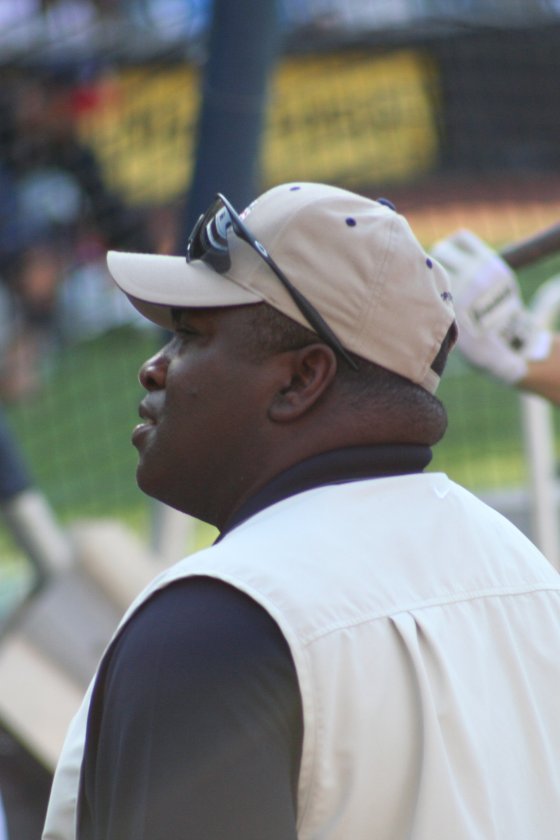
Player knowledge
Tony Gwynn
RF 1982–2001 Hall of Fame
- Born
- May 9, 1960, in Los Angeles, California
- Bats / Throws
- L/L
- Height / Weight
- 5'11", 185 lbs
- Hometown
- Long Beach, California
- High School
- Long Beach Polytechnic High School
- Full Name
- Anthony Keith Gwynn
- Died
- June 16, 2014, in Poway, California (age 54)
- Nicknames
- Mr. Padre, Captain Video
- MLB Debut
- July 19, 1982, vs. Philadelphia
- Final Game
- October 7, 2001
- Uniform
- No. 19 (1982–2001), retired by the Padres in 2004
- Batting Titles
- Eight (1984, 1987–1989, 1994–1997), tied with Honus Wagner for the NL record
- Strikeouts
- 434 in 10,232 plate appearances; never more than 40 in a season
- Hall of Fame
- Class of 2007, 97.6% of the vote
The story
Bio
Tony Gwynn made hitting look like a craft you could learn, if only you were willing to study it as hard as he did. For 20 seasons he sprayed line drives through the gap between third base and shortstop, struck out once every 21 at-bats, and won eight batting titles without ever leaving San Diego.
Anthony Keith Gwynn grew up in Long Beach hitting figs and rolled-up socks in a narrow backyard, went to San Diego State on a basketball scholarship, and walked onto the baseball team almost by accident. He reached the majors in 1982, hit .289 as a rookie, and never hit below .300 again. He was one of the first players to tape and study his own at-bats, chased .400 until a strike stopped him at .394, collected 3,141 hits for one franchise, and became the face of San Diego sports. Mr. Padre died of salivary gland cancer in 2014, at just 54.
Here is the whole story, from the backyard in Long Beach to San Diego State, two decades with the San Diego Padres, and Cooperstown. When you’re done, see how much stuck with the Tony Gwynn Padres quiz.
Tony Gwynn
Figs, Sockballs, and Long Beach Poly
Gwynn was born May 9, 1960, in Los Angeles, the middle of three sons of Charles Gwynn, a warehouse manager, and Vendella Gwynn, a postal worker. Both parents had come west from Gallatin, Tennessee. When Tony was nine, the family bought a house in nearby Long Beach, chosen for its schools, parks, and year-round youth sports.
Charles laid out a ballfield in the backyard, a strip of grass longer than it was wide. Pull the ball too hard and it disappeared over the neighbor’s fence. When the Wiffle balls ran out, Tony and his younger brother Chris hit socks wrapped in rubber bands, wads of tape, or hardened figs from a neighbor’s tree. His hero was Dodgers center fielder Willie Davis, a left-handed line-drive hitter, and while other kids followed the home run leaders, Tony checked the box scores every morning to see how Pete Rose, George Brett, and Rod Carew were hitting.
At Long Beach Polytechnic High School, basketball came first. As a junior he started at point guard for a 30–1 team that won the Southern Section 4A title. He nearly quit baseball as a senior to focus on the court, but his mother talked him out of it. He joined the baseball team late that spring and hit .563 anyway. He still went undrafted in 1977, and every college offer he received was for basketball.
Tony Gwynn
The Aztec Point Guard
Gwynn picked San Diego State, where he became one of the best playmakers in school history. He set the Aztecs’ records for assists in a game (18), a season (221), and a career (590). Baseball wasn’t part of the plan. Then, in the spring of 1979, two Aztec outfielders were hit by a car while riding bicycles, and freshman shortstop Bobby Meacham, who had played against Gwynn in high school, talked coach Jim Dietz into giving him a look. Gwynn later said he doubted he ever would have played college baseball without that accident.
He hit .301 that first season and admitted he “stunk defensively.” Then he hit .423 as a junior and .416 as a senior, earning All-American honors, and became the first athlete in Western Athletic Conference history named all-conference in two sports. In March 1981 he finished the basketball season with 16 points and 16 assists against New Mexico on a Saturday, then drove in five runs in a doubleheader against USC on Monday.
Padres general manager Jack McKeon, whose son Casey played for the Aztecs, came to watch Meacham and came away more impressed by Gwynn. In June 1981 the Padres took him in the third round, 58th overall, after McKeon threatened to walk out of the draft room if they passed again. Later that same day, the NBA’s San Diego Clippers drafted him in the 10th round. He chose baseball, calling it the practical decision. That month he also married Alicia Cureton, whom he had known since elementary school.
Tony Gwynn
“Don’t Catch Me in One Night”
Gwynn tore through the minors. He hit .331 and won the Northwest League MVP award at Walla Walla, where he earned $500 a month. When he was promoted that summer, the national air traffic controllers’ strike kept him from getting to Reno, so the Padres sent him to Double-A Amarillo instead. He hit .462 there. In 1982 he was batting .328 for the Triple-A Hawaii Islanders when San Diego called.
He debuted on July 19, 1982, starting in center field against the Phillies, and went 2-for-4. His first hit was a double, and Phillies first baseman Pete Rose, the man who would retire as the all-time hit king, had a message for him: “Congratulations. Don’t catch me in one night.” A wrist injury at Pittsburgh’s Three Rivers Stadium cost him three weeks, and he finished at .289 in 54 games. It was the only season of his career he hit below .300.
He hurt the wrist again playing winter ball in Puerto Rico and missed the first two months of 1983. By July 29 he was hitting .229. Before a road trip, he asked Alicia to record the games on their home video recorder. When he got back, he watched his at-bats, spotted what had gone wrong, and fixed it in batting practice. He hit his way up to .309 and put together a club-record 25-game hitting streak. Video, he said later, “turned around my career.”
Tony Gwynn
1984: San Diego’s First Pennant
In his first full season, Gwynn hit .351 to win his first batting title, collected a club-record 213 hits, stole 33 bases, and struck out just 23 times in 606 at-bats. Fans voted him an All-Star starter, and he finished third in the MVP race. Batting second behind speedy leadoff man Alan Wiggins, who stole 70 bases, he saw a steady diet of fastballs and made pitchers pay. The Padres won their first division title.
In the NLCS the Cubs won the first two games at Wrigley Field, and the Padres came home needing three straight wins. In Game 4, Gwynn’s one-out single in the ninth set up Steve Garvey’s walk-off home run, and San Diego won the next day to take the pennant. Gwynn hit .368 in the series. Detroit, which had opened the season 35–5, was too much in the World Series and won in five. Gwynn flied out to Larry Herndon for the final out. That winter he signed a six-year, $4.6 million contract, taking less money than he might have gotten elsewhere to stay in San Diego. It became a habit.
Tony Gwynn
Captain Video and the 5.5 Hole
No one prepared like Gwynn. Years before teams hired video coordinators, he bought his own equipment and hauled it from city to city. Alicia traveled with a suitcase-sized Betamax recorder to tape his at-bats, and he kept a tape for every opponent, studying his swing frame by frame and scouting pitchers and even umpires’ strike zones. It earned him the nickname Captain Video. Jack McKeon later called him the father of video in baseball.
He swung one of the smallest bats in the majors, about 32½ inches and 31 ounces, which let him wait an extra instant on every pitch. His favorite target was the gap between the third baseman and shortstop, which he called the “5.5 hole,” since scorers number those positions 5 and 6. The fielders rarely saw it coming. His hands led the swing and the barrel trailed, he explained, which hid the ball until it was already past them.
He worked just as hard in right field. A minor-league teammate, pitcher Dave Dravecky, remembered his early throws as “limp balloons.” In 1986 he won the first of five Gold Gloves and, on September 20 against Houston, stole five bases in one game. In 1987 he hit .370, the best mark in the National League since Stan Musial in 1948, and stole a career-high 56 bases, becoming the first NL player to hit .370 and steal 50 in the same season. In June alone he went 44-for-93.
That was the first of three straight batting titles. In 1988 he was hitting .246 on July 2, then hit .406 in July and won at .313, the lowest average ever to lead the National League. In 1989 he trailed San Francisco’s Will Clark by a point entering the final weekend, went 3-for-4 in the last two games, and won at .336 to Clark’s .333. “I lost to the best,” Clark said. Gwynn was the first NL player to win three in a row since Musial.
Tony Gwynn
Hard Years and a Talk with Ted Williams
The 1990 season was the most painful of his career. First baseman Jack Clark publicly accused Gwynn of caring more about his batting average than about winning, and a few teammates sided with Clark. Gwynn countered that he was moving runners along for the team’s power hitters. In September a figure resembling Gwynn was found hanging in effigy in the Padres’ dugout; the club blamed a groundskeeper, and Clark denied any role. That same month Gwynn broke a finger in Atlanta and missed the rest of the year. Clark left as a free agent that winter, and the Padres gave Gwynn a three-year extension.
Knee trouble ended his 1991, 1992, and 1993 seasons early, the cost of playing basketball and baseball year-round since high school. But in July 1992, at the All-Star Game in San Diego, he met Ted Williams for the first time. Williams teased him about swinging a “toothpick” and told him a man his size should turn on inside pitches and drive them. Gwynn took the advice to heart and read Williams’s book The Science of Hitting over and over. The two became close friends, and Gwynn’s power numbers began to climb.
In 1993, while the Padres traded away their stars and lost 101 games, Gwynn hit .358. On August 4 against the Giants he had six hits in a game, the only time he did it, and two days later he collected hit No. 2,000 off Colorado’s Bruce Ruffin. That winter his father, Charles, died of heart problems at 57. Gwynn thought about walking away from the game, then remembered what his father always told him: never be a quitter.
Tony Gwynn
Chasing .400
Every spring someone predicted that this would be the year Gwynn became the first .400 hitter since Ted Williams in 1941. In 1994 he came closer than anyone had in half a century. He hit .383 at the All-Star break, scored the winning run of the All-Star Game by sliding home from first on Moisés Alou’s 10th-inning double, and then got even hotter, batting .475 in August.
Then the players went on strike on August 11, and the season never resumed. Gwynn finished at .394, three hits short of .400, with a league-leading .454 on-base percentage. It remains the highest average in the majors since Williams hit .406. Gwynn handled it with typical grace, saying he would rather fall short because of a strike than reach .400 and have people say he would have collapsed down the stretch. Over a 179-game stretch from July 1993 to May 1995, he actually hit .403.
Tony Gwynn
Four Straight
The .394 started a run of four straight batting titles. Gwynn hit .368 in 1995. In 1996, playing through a painful heel that turned out to be a partly torn Achilles tendon, he hit .353, but finished four plate appearances short of qualifying. Under a scoring rule that let hitless at-bats be added to his total, he would still have hit .349, ahead of Ellis Burks’s .344, so he won the title anyway. The rule became known as the Tony Gwynn rule. That same weekend his brother Chris, now his teammate, delivered the extra-inning hit that clinched the division.
At 37, in 1997, Gwynn put Williams’s lessons to full use: a .372 average, career highs of 17 home runs and 119 RBI, and a club-record 49 doubles and 220 hits. He was still hitting .402 on July 14. It was his eighth batting title, tying Honus Wagner’s National League record, and it made him the only player to win four batting titles in each of two different decades.
Tony Gwynn
Yankee Stadium, 1998
The 1998 Padres won a franchise-record 98 games. Gwynn opened the year with his first-ever Opening Day homer, and in October San Diego beat a 102-win Houston team in the NLDS and the Braves in a six-game NLCS to reach the World Series for the second time. The Yankees, who had won 114 games, swept the Padres. Gwynn hit .500 (8-for-16) while the rest of the lineup hit about .200.
In Game 1 he lined a two-run homer off David Wells that banged off the upper-deck facade at Yankee Stadium. He called it his favorite hit and the highlight of his career: “That’s the biggest game in the world, a World Series game. And the fact that it was in New York in Yankee Stadium. I’ll remember that forever.”
Tony Gwynn
3,000 and Goodbye
At the 1999 All-Star Game at Fenway Park, Gwynn walked his friend Ted Williams, then 80, to the mound and steadied him as he threw out the ceremonial first pitch. He called it his favorite All-Star memory. Calf injuries had already cost him 44 games, but he closed in on 3,000 hits in St. Louis, collecting No. 2,999 in the same game in which Mark McGwire hit his 500th home run.
On August 6, 1999, in Montreal, he lined a first-inning single to right-center off the Expos’ Dan Smith for hit No. 3,000. The first-base umpire, Kerwin Danley, had been his college teammate, and the date was his mother’s birthday, the same day he had collected No. 2,000 six years earlier. He finished the night with four hits. He reached 3,000 in 2,284 games; no one born after 1900 had ever gotten there faster. One day later, Wade Boggs, the other great contact hitter of his generation, got his 3,000th hit too.
His knees had little left. He played 36 games in 2000 and mostly pinch-hit in 2001, and on June 28 he announced he would retire after the season. At the All-Star Game in Seattle, he and Cal Ripken Jr. received the Commissioner’s Historic Achievement Award. His last hit was a pinch-hit RBI double on October 6, 2001, and his last game came the next day. He finished at .324, his 19th straight .300 season, a National League record.
Tony Gwynn
Coach Gwynn and Cooperstown
Gwynn went straight home to San Diego State as head baseball coach, a job he held from 2002 until his death. His teams went 363–363, won three Mountain West championships, and produced major leaguers including Stephen Strasburg, the No. 1 overall pick in 2009. He also worked as a broadcaster for ESPN and for Padres games. The Padres retired his No. 19 in 2004, and in 2007 they unveiled a bronze statue of him beyond the outfield at Petco Park, whose address is 19 Tony Gwynn Drive.
On January 9, 2007, he was elected to the Hall of Fame on 532 of 545 ballots (97.6 percent), one of the highest percentages ever. Alicia said it was the first time she had ever seen him cry. He was inducted on July 29, 2007, alongside Cal Ripken Jr., before a record crowd estimated at 75,000. Both men had spent their entire careers with one team.
Tony Gwynn
The Final Innings
Gwynn started dipping smokeless tobacco as a college player and kept the habit for about three decades, always tucking it into the same spot. Starting in 1997, doctors removed noncancerous growths from his parotid, a salivary gland, three times. In 2010 he was diagnosed with salivary gland cancer in the spot where he had held the tobacco. Surgery left part of his face paralyzed for a time, and he went through eight weeks of radiation and chemotherapy, then more surgery in 2012. He blamed the tobacco and urged young players not to start, though some doctors noted that research had not firmly linked chewing tobacco to that kind of cancer.
Gwynn died on June 16, 2014, at a hospital in Poway, California, the San Diego suburb where he had lived for more than two decades. He was 54. More than 23,000 fans came to a public memorial at Petco Park, and he is buried at Dearborn Memorial Park in Poway. His death helped bring about a ban on smokeless tobacco for new players in baseball’s 2016 labor agreement, and pitchers Chris Sale and Stephen Strasburg both said it led them to quit. Gwynn’s family later sued a tobacco company and reached a confidential settlement in 2018.
When the All-Star Game came to San Diego in 2016, Major League Baseball announced that every future batting champion in the league would be known as the Tony Gwynn National League Batting Champion, and the crowd at Petco Park chanted “To-ny! To-ny!” It’s hard to think of a more fitting tribute.
Tony Gwynn
Records and Honors
- 3,141 hits, every one of them for the Padres
- .338 career batting average: the highest career mark by anyone since Ted Williams retired in 1960
- Eight NL batting titles (1984, 1987–1989, 1994–1997): tied with Honus Wagner for the National League record
- 19 straight .300 seasons (1983–2001): a National League record
- .394 in 1994: the highest average in the majors since Ted Williams’s .406 in 1941
- Led the NL in hits seven times, tying Pete Rose’s league record
- 434 strikeouts in 20 seasons, never more than 40 in a year
- 15 All-Star selections, five Gold Gloves, and seven Silver Sluggers
- Branch Rickey Award (1995), Lou Gehrig Memorial Award (1998), and Roberto Clemente Award (1999)
- National Baseball Hall of Fame, class of 2007; No. 19 retired by the Padres (2004)
Tony Gwynn
Mr. Padre Fun Facts
- The Padres and the NBA’s San Diego Clippers drafted him on the same day in 1981.
- He drew more walks than strikeouts in every season except his rookie year.
- In the Padres’ 1987 home opener, Marvell Wynne, Gwynn, and John Kruk homered back-to-back-to-back to start the game, the first time a team had ever opened a game with three straight home runs.
- His 2,000th and 3,000th hits both came on August 6, his mother’s birthday.
- His son, Tony Gwynn Jr., got his first major-league hit, a double, on July 19, 2006, exactly 24 years after his father’s first hit, also a double.
- Teammate Rickey Henderson collected his 3,000th hit in Gwynn’s final game, October 7, 2001.
- Petco Park’s street address is 19 Tony Gwynn Drive.
Think you know Mr. Padre now? Prove it with all ten quizzes in the Tony Gwynn collection, take the Tony Gwynn Padres quiz, read about his hitting mentor on the Ted Williams page, his fellow batting champion on the Wade Boggs page, and the shortstop San Diego traded away the winter before Gwynn’s debut on the Ozzie Smith page, or browse the full San Diego Padres quiz collection.
The postseason
October Accolades
| Year | Series | Result | G | H-AB | BA | HR | RBI |
|---|---|---|---|---|---|---|---|
| 1984 | NLCS | Padres def. Cubs, 3–2 Hit .368; his ninth-inning single in Game 4 set up Steve Garvey’s walk-off homer | 5 | 7-19 | .368 | 0 | 3 |
| 1984 | World Series | Tigers def. Padres, 4–1 The franchise’s first World Series; he flied out to Larry Herndon for the final out | 5 | 5-19 | .263 | 0 | 0 |
| 1996 | NLDS | Cardinals def. Padres, 3–0 San Diego’s first postseason in 12 years ended in a sweep | 3 | 4-13 | .308 | 0 | 1 |
| 1998 | NLDS | Padres def. Astros, 3–1 Two doubles as the Padres upset a 102-win Houston club | 4 | 3-15 | .200 | 0 | 2 |
| 1998 | NLCS | Padres def. Braves, 4–2 Two hits in the pennant-clinching Game 6 in Atlanta | 6 | 6-26 | .231 | 0 | 2 |
| 1998 | World Series | Yankees def. Padres, 4–0 Hit .500; his Game 1 homer off David Wells hit the upper-deck facade at Yankee Stadium | 4 | 8-16 | .500 | 1 | 3 |
| Postseason | 6 series | 27 | 33-108 | .306 | 1 | 11 | |
The clubs
Teams
-
San Diego Padres
1982–2001
3,141 hits, a .338 average, eight batting titles, and the 1984 and 1998 pennants
The numbers
Season Stats
| Season | Team | League | WAR | Games | PA | AB | Runs | Hits | RBI | 2B | 3B | HR | SB | BB | BA | OBP | SLG | OPS |
|---|---|---|---|---|---|---|---|---|---|---|---|---|---|---|---|---|---|---|
| 1982 | San Diego Padres | NL | 1.0 | 54 | 209 | 190 | 33 | 55 | 17 | 12 | 2 | 1 | 8 | 14 | .289 | .337 | .389 | .726 |
| 1983 | San Diego Padres | NL | 1.9 | 86 | 334 | 304 | 34 | 94 | 37 | 12 | 2 | 1 | 7 | 23 | .309 | .355 | .372 | .726 |
| 1984 | San Diego Padres | NL | 6.3 | 158 | 675 | 606 | 88 | 213 | 71 | 21 | 10 | 5 | 33 | 59 | .351 | .410 | .444 | .853 |
| 1985 | San Diego Padres | NL | 5.2 | 154 | 671 | 622 | 90 | 197 | 46 | 29 | 5 | 6 | 14 | 45 | .317 | .364 | .408 | .773 |
| 1986 | San Diego Padres | NL | 6.7 | 160 | 701 | 642 | 107 | 211 | 59 | 33 | 7 | 14 | 37 | 52 | .329 | .381 | .467 | .848 |
| 1987 | San Diego Padres | NL | 8.6 | 157 | 680 | 589 | 119 | 218 | 54 | 36 | 13 | 7 | 56 | 82 | .370 | .447 | .511 | .958 |
| 1988 | San Diego Padres | NL | 3.4 | 133 | 578 | 521 | 64 | 163 | 70 | 22 | 5 | 7 | 26 | 51 | .313 | .373 | .415 | .787 |
| 1989 | San Diego Padres | NL | 2.5 | 158 | 679 | 604 | 82 | 203 | 62 | 27 | 7 | 4 | 40 | 56 | .336 | .389 | .424 | .813 |
| 1990 | San Diego Padres | NL | 2.9 | 141 | 629 | 573 | 79 | 177 | 72 | 29 | 10 | 4 | 17 | 44 | .309 | .357 | .415 | .772 |
| 1991 | San Diego Padres | NL | 5.7 | 134 | 569 | 530 | 69 | 168 | 62 | 27 | 11 | 4 | 8 | 34 | .317 | .355 | .432 | .787 |
| 1992 | San Diego Padres | NL | 4.6 | 128 | 569 | 520 | 77 | 165 | 41 | 27 | 3 | 6 | 3 | 46 | .317 | .371 | .415 | .786 |
| 1993 | San Diego Padres | NL | 3.1 | 122 | 534 | 489 | 70 | 175 | 59 | 41 | 3 | 7 | 14 | 36 | .358 | .398 | .497 | .895 |
| 1994 | San Diego Padres | NL | 4.2 | 110 | 475 | 419 | 79 | 165 | 64 | 35 | 1 | 12 | 5 | 48 | .394 | .454 | .568 | 1.022 |
| 1995 | San Diego Padres | NL | 2.3 | 135 | 577 | 535 | 82 | 197 | 90 | 33 | 1 | 9 | 17 | 35 | .368 | .404 | .484 | .888 |
| 1996 | San Diego Padres | NL | 2.3 | 116 | 498 | 451 | 67 | 159 | 50 | 27 | 2 | 3 | 11 | 39 | .353 | .400 | .441 | .842 |
| 1997 | San Diego Padres | NL | 4.3 | 149 | 651 | 592 | 97 | 220 | 119 | 49 | 2 | 17 | 12 | 43 | .372 | .409 | .547 | .957 |
| 1998 | San Diego Padres | NL | 1.6 | 127 | 505 | 461 | 65 | 148 | 69 | 35 | 0 | 16 | 3 | 35 | .321 | .364 | .501 | .865 |
| 1999 | San Diego Padres | NL | 1.8 | 111 | 446 | 411 | 59 | 139 | 62 | 27 | 0 | 10 | 7 | 29 | .338 | .381 | .477 | .858 |
| 2000 | San Diego Padres | NL | 0.4 | 36 | 140 | 127 | 17 | 41 | 17 | 12 | 0 | 1 | 0 | 9 | .323 | .364 | .441 | .805 |
| 2001 | San Diego Padres | NL | 0.6 | 71 | 112 | 102 | 5 | 33 | 17 | 9 | 1 | 1 | 1 | 10 | .324 | .384 | .461 | .845 |
| Career | 20 seasons | NL | 69.4 | 2,440 | 10,232 | 9,288 | 1,383 | 3,141 | 1,138 | 543 | 85 | 135 | 319 | 790 | .338 | .388 | .459 | .847 |