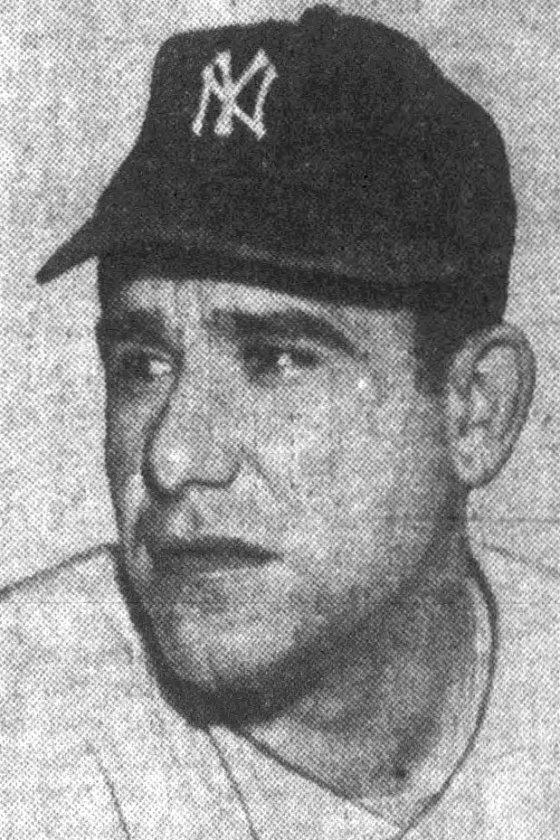
Player knowledge
Yogi Berra
C 1946–1965 Hall of Fame
- Born
- May 12, 1925, in St. Louis, Missouri
- Bats / Throws
- L/R
- Height / Weight
- 5'7", 185 lbs
- Hometown
- The Hill (St. Louis), Missouri
- Full Name
- Lawrence Peter Berra (born Lorenzo Pietro Berra)
- Died
- September 22, 2015, in West Caldwell, New Jersey (age 90)
- Nicknames
- Yogi; Lawdie to his family
- MLB Debut
- September 22, 1946, vs. Philadelphia Athletics at Yankee Stadium
- Final Game
- May 9, 1965
- Uniform
- No. 8 (1948–1963, 1965), retired by the Yankees in 1972
- Military
- U.S. Navy, World War II; rocket-boat gunner off Normandy on D-Day
- Managing
- 484–444; pennants with the 1964 Yankees and 1973 Mets
- Hall of Fame
- Class of 1972, 85.6% of the vote
The story
Bio
Yogi Berra won more World Series rings as a player than anyone in history, ten of them, and he won them as a squat, bad-ball-swinging catcher whom scouts kept mistaking for someone who had wandered into the wrong clubhouse. He also became the most quoted man in baseball, which amused him, because he insisted he hadn’t said half of it.
Lawrence Peter Berra grew up on The Hill in St. Louis, quit school after the eighth grade, was passed over by his hometown Cardinals, and signed with the Yankees for a $500 bonus. Then he went to war, firing rockets at the Normandy coast on D-Day at 19. He came home, learned to catch from Bill Dickey, won three MVP awards, played in 14 World Series, and caught the only perfect game in World Series history. Later he managed pennant winners in both leagues, walked away from the Yankees for 14 years over a broken promise, and came back to a standing ovation.
Here is the whole story, from The Hill to the Yankees, a curtain call with the Mets, and Cooperstown. When you’re done, see how much stuck with the Yogi Berra Yankees quiz.
Yogi Berra
Lawdie from The Hill
Berra was born May 12, 1925, in St. Louis, and christened Lorenzo Pietro. His father, Pietro, had come from a farming town near Milan in 1909. His mother, Paulina Longoni, followed in 1912, and the couple settled on The Hill, the city’s Italian neighborhood. Lorenzo became Lawrence, and his mother’s accent turned that into “Lawdie.” He was the youngest of four boys, and the family also had a daughter, Josie.
The Berras lived on Elizabeth Avenue, directly across the street from the family of Joe Garagiola, who was Lawdie’s age. The two boys played every sport the neighborhood offered, and their block was later renamed Hall of Fame Place. The new nickname came from a movie. After the boys saw a film featuring a Hindu yogi, his friend Jack Maguire said Lawdie sat and moved just like him. From then on he was Yogi, even to his parents.
Yogi quit school after the eighth grade, over his father’s objections, and went to work. He lost a job in a coal yard and another on a Pepsi-Cola truck because he kept leaving early to play ball. When the Cardinals held a tryout for the stars of his American Legion team, they offered Garagiola a $500 bonus. Berra, short and thick at 5-foot-7 and chopping at anything near the plate, was offered no bonus at all. Branch Rickey raised it to $250. Yogi wanted what Joe got, and he said no. The Browns passed too. His Legion coach, Leo Browne, wrote to the Yankees’ George Weiss, and in October 1942 New York signed Berra for the $500 he wanted and $90 a month. Rickey, by then running the Dodgers, sent a telegram inviting him to sign with Brooklyn. Too late. Berra hit .253 with seven homers for the Norfolk Tars in 1943.
Yogi Berra
A Rocket Boat at D-Day
After the 1943 season Berra joined the U.S. Navy. He was 18. Seaman Second Class Berra became a machine gunner on a rocket boat, a small support craft built to blast the beaches ahead of the troops. On June 6, 1944, his six-man crew launched from the attack transport USS Bayfield and fired on the German defenses off the Normandy coast before the first soldiers hit the beach. He spent about 10 days on the 36-foot boat before returning to his ship. That August he took part in Operation Dragoon, the Allied landing in southern France.
Back home in 1945, he was posted to the submarine base at New London in Groton, Connecticut, and played for the base team. Its manager, Lieutenant Commander Jim Gleeson, a former big-league outfielder, had trouble believing this stubby sailor belonged to the Yankees. Then Berra went 3-for-4 in an exhibition against the New York Giants, and Giants manager Mel Ott offered the Yankees $50,000 for him. Yankees president Larry MacPhail turned Ott down. He later admitted he had never heard of Berra, but figured that if Ott wanted him that badly, the Yankees should keep him.
Yogi Berra
Newark to the Bronx
In 1946 the Yankees sent Berra to their top farm club, the Newark Bears. Manager George Selkirk was so skeptical that he made Yogi show him the telegram ordering him to report. Berra hit .314 with 15 homers in 77 games, though his throws from behind the plate went everywhere. Newark lost in the playoffs to a Montreal Royals team that featured Jackie Robinson.
The Yankees called him up anyway. On September 22, 1946, at Yankee Stadium, he caught, batted eighth, and went 2-for-4 against the Philadelphia Athletics, homering off Jesse Flores. He homered again the next day. In 1947 he split time between right field, where he was shaky, and catcher, where he was raw but at least out of harm’s way. He hit .280 with 11 homers as a rookie.
That June, friends from The Hill threw him a Yogi Berra Night at Sportsman’s Park. Teammate Bobby Brown wrote him a short speech thanking everyone for making the night possible. Yogi memorized it, stepped to the microphone, and thanked everyone “for making this night necessary.” He said later he would never live it down, and he was right. That October, in the first World Series ever televised, he came off the bench in Game 3 against Brooklyn and homered off Ralph Branca, the first pinch-hit home run in World Series history.
Yogi Berra
Learning Dickey’s Experience
That winter in St. Louis, Yogi met Carmen Short, a waitress at a restaurant co-owned by Stan Musial. They married on January 26, 1949, with Joe Garagiola as best man, and stayed married for 65 years. In 1948 Berra took over No. 8, the number of Yankees catching great Bill Dickey, hit .305 with 98 RBI, and made the first of his 15 straight All-Star teams. The Yankees still went shopping for a better defensive catcher.
Then they hired Casey Stengel to manage, and Stengel ended that talk. He called Berra “my assistant manager,” shielded him from the jokes about his looks, and assigned Bill Dickey to rebuild his catching from the ground up. That spring Yogi summed up the arrangement in a line the newspapers loved: “Dickey’s teaching me all of his experience.”
Earning the pitchers’ trust took longer. Vic Raschi and Allie Reynolds thought he stabbed at pitches and cost them strikes, and Stengel sometimes called pitches from the dugout. One day Reynolds warned Berra that if he looked over at the bench, he would cross him up on purpose. Yogi ignored his manager, risked the fine, and won over the staff. He hit 20 homers in 1949, went just 1-for-16 in the World Series, and collected his second ring anyway.
Yogi Berra
Five Straight
By 1950 there was no debate. Berra hit .322 with 28 homers and 124 RBI and struck out only 12 times in 597 at-bats. He finished third in the MVP voting as the Yankees swept the Phillies’ Whiz Kids. In 1951 he won his first AL MVP, and the Yankees beat the Giants for a third straight title. In 1952 he hit 30 homers. In 1953 he drove in 108 runs and hit .429 in the World Series as New York beat Brooklyn for a record fifth consecutive championship.
He was the ultimate bad-ball hitter. He swung at pitches at his ankles and over his head and somehow squared them up, golfing low pitches into the seats and chopping high ones into the outfield. He also almost never missed. He had more home runs than strikeouts in five different seasons. On a lineup that included Joe DiMaggio and then Mickey Mantle, Berra led the Yankees in RBI for seven straight seasons, from 1949 through 1955.
Yogi Berra
Three MVPs and a Perfect Game
Cleveland won 111 games and the 1954 pennant, but Berra hit .307 with 125 RBI and won his second MVP. In 1955 he was the highest-paid Yankee at $48,000 and won the award again, his third MVP in five years. Only a handful of players have won three. That October the Dodgers finally beat the Yankees. In Game 1 Jackie Robinson stole home, Berra leaped up and down screaming that he was out, and for the rest of his life he signed photos of the play “He was out.” In Game 7 he sliced a drive toward the left-field corner with two men on, and Sandy Amoros raced over, caught it, and turned it into a double play.
He got even in 1956. On October 8, in Game 5 at Yankee Stadium, Berra caught Don Larsen’s perfect game, still the only one in World Series history. Larsen said he never shook Berra off once. When Dale Mitchell took strike three, Yogi sprinted to the mound and jumped into Larsen’s arms, one of the most famous photographs in sports. Berra hit three homers and drove in 10 runs in that Series, all three homers off Don Newcombe: a grand slam in Game 2 and two more in the 9–0 Game 7 clincher.
Yogi Berra
Left Field and Ring No. 10
Berra slipped to .251 in 1957 but still hit 24 homers, and the Yankees and Milwaukee Braves traded titles over the next two Octobers. In 1958 New York came back from three games to one down to win. In 1959 he hit his 300th home run and set records (since broken) for consecutive errorless games and chances by a catcher. The Yankees finished third that year. His verdict: “We made too many of the wrong mistakes.”
As Elston Howard took over more of the catching, Stengel moved Berra to Yankee Stadium’s tricky left field, and he played it well. In Game 7 of the 1960 World Series at Pittsburgh, his three-run homer in the sixth gave the Yankees a 5–4 lead. In the ninth, Bill Mazeroski’s Series-winning home run sailed over his head. In 1961, the summer Roger Maris hit 61, Berra hit 22 as one of six Yankees with 20 or more homers. On June 24, 1962, at 37, he caught all 22 innings of a seven-hour game in Detroit. That fall the Yankees beat the Giants, and Berra had his 10th World Series ring as a player, a record no one has matched.
He spent 1963 as a player-coach, hitting .293 in 64 games, and retired after the Dodgers swept the World Series. He left with a .285 average, 358 homers, and 306 of them hit as a catcher, then the most ever at the position.
Yogi Berra
The Harmonica Pennant
On October 24, 1963, the Yankees named Berra manager. He took a one-year contract because he wasn’t sure he could do the job, a decision he came to regret. The 1964 clubhouse was a handful, and by mid-August a four-game sweep in Chicago had dropped the Yankees 4½ games back. On the bus to the airport, infielder Phil Linz started playing “Mary Had a Little Lamb” on a harmonica. Berra told him to knock it off. Linz didn’t hear, asked what Yogi said, and Mickey Mantle supposedly told him, “He said to play it louder.” Berra stormed to the back and knocked the harmonica out of his hands.
The Harmonica Incident made headlines, and the Yankees took off. They went 22–6 in September, won the pennant at 99–63, and took the Cardinals to Game 7 of the World Series before Bob Gibson beat them. Berra had also pushed to call up 22-year-old Mel Stottlemyre, who went 9–3 down the stretch. The day after the Series, the Yankees fired him. General manager Ralph Houk later said the decision had been made in August. Then the Yankees hired Johnny Keane, the Cardinals manager who had just beaten them.
Yogi Berra
It Ain’t Over
Berra crossed town to the Mets, where Stengel was managing and Weiss was the general manager. As a player-coach he went 2-for-9 in four games and played his last game on May 9, 1965, three days before his 40th birthday. He stayed on as a coach under four managers and won another ring with the 1969 Miracle Mets. When manager Gil Hodges died of a heart attack on April 2, 1972, Berra replaced him. That summer he was inducted into the Hall of Fame, elected with 85.6 percent of the vote alongside Sandy Koufax and Early Wynn, and the Yankees retired No. 8 for both Berra and his old teacher, Dickey.
The 1973 Mets were hurt and buried, last in the NL East and 9½ games out in July. That summer Berra is credited with the line that became his trademark: “It ain’t over till it’s over.” The wording reporters recorded varied, but the Mets proved the point. They reached .500 and first place on the same day, September 21, and clinched with just 82 wins. In the NLCS, after a brawl between Bud Harrelson and Pete Rose had fans pelting the field, Berra walked out to left field with Willie Mays, Tom Seaver, Rusty Staub, and Cleon Jones to calm the crowd. The Mets upset the Big Red Machine in five games, and Berra became only the second manager, after Joe McCarthy, to win pennants in both leagues. Oakland beat them in a seven-game World Series. The Mets fired him on August 5, 1975.
Yogi Berra
Exile and Homecoming
In 1976 Billy Martin brought Berra back to the Yankees as a coach, and he added rings in 1977 and 1978. He coached through 1983 and was named manager for 1984. The team finished 87–75. Before the 1985 season, owner George Steinbrenner declared that Berra would manage the full year, and the Yankees had just traded for his son Dale. Sixteen games in, at 6–10, Steinbrenner fired him anyway, and sent an executive, Clyde King, to deliver the news.
Upset that Steinbrenner had broken his word, Berra stayed away from Yankee Stadium for the next 14 years. He turned down an offer to manage the Houston Astros but coached for them from 1986 through 1989, reaching one more NLCS. The Yankees put up his Monument Park plaque in 1988, and he stayed away. In 1998 the Yogi Berra Museum and Learning Center opened on the campus of Montclair State University in New Jersey, next to a ballpark bearing his name.
In early 1999 Steinbrenner came to Montclair and apologized in person. On July 18, 1999, the Yankees held Yogi Berra Day. Don Larsen threw the ceremonial first pitch to Berra, and then David Cone went out and pitched a perfect game against the Montreal Expos. It was the kind of thing that only seemed to happen around Yogi.
Yogi Berra
The Yogi-isms
Berra’s sayings became a genre: lines that sound like nonsense and turn out to be true. The trouble is that plenty of them weren’t his. He titled his 1998 collection The Yogi Book: I Really Didn’t Say Everything I Said, and he meant it.
The “night necessary” speech of 1947 is well documented, and so is his spring 1949 line about Dickey teaching him “all of his experience.” He never disowned “It ain’t over till it’s over,” which went on his Monument Park plaque and gave his 1989 autobiography, Yogi: It Ain’t Over, its title. He said “When you come to a fork in the road, take it” was part of his directions to his Montclair house, where both branches of the fork led to his door, though similar lines had appeared in print long before. “It’s déjà vu all over again” is murkier. Berra flatly denied saying it to New York Times columnist William Safire in 1987, then embraced it a decade later, saying it came from watching Mantle and Maris hit back-to-back homers again and again. And versions of “Nobody goes there anymore, it’s too crowded” were in print long before anyone pinned it on him.
When a reporter asked about “It ain’t over till the fat lady sings,” another line regularly credited to him, Berra’s answer was perfect: “That’s one of the things that I said that I never said.”
Yogi Berra
Farewell to No. 8
Yogi and Carmen raised three sons in Montclair, and all three played pro sports. Larry caught in the Mets’ farm system, Tim played for the NFL’s Baltimore Colts, and Dale played 11 big-league seasons, including 1985 with his father managing the Yankees and 1987 with his father coaching the Astros. Carmen died in March 2014, after 65 years of marriage.
Berra died in his sleep on September 22, 2015, in West Caldwell, New Jersey, at 90, 69 years to the day after his major-league debut. The Yankees wore a No. 8 patch, the Empire State Building lit up in pinstripes, and he was buried beside Carmen at Gate of Heaven Cemetery in East Hanover, New Jersey. Two months later President Barack Obama awarded him the Presidential Medal of Freedom, honoring both his baseball career and his Navy service, and borrowed a Yogi-ism for the occasion: “If you can’t imitate him, don’t copy him.”
Yogi Berra
Records and Honors
- 10 World Series titles as a player: the most in major-league history (1947, 1949–1953, 1956, 1958, 1961, 1962)
- 14 World Series, 75 games, 259 at-bats, and 71 hits: all World Series records
- Three AL MVP awards (1951, 1954, 1955), and a top-four finish in the voting seven straight years (1950–1956)
- 18 All-Star selections across 15 straight seasons (1948–1962)
- 358 home runs, 306 of them as a catcher, the most at the position when he retired
- 704 walks against 414 strikeouts, with more homers than strikeouts in five seasons
- Led the Yankees in RBI seven straight seasons (1949–1955)
- Caught Don Larsen’s perfect game, the only one in World Series history (1956)
- Managed pennant winners in both leagues: the 1964 Yankees and the 1973 Mets
- Hall of Fame (1972), No. 8 retired by the Yankees (1972), Monument Park plaque (1988), and MLB All-Century Team (1999)
- Presidential Medal of Freedom (2015)
Yogi Berra
Yogi Fun Facts
- He died on September 22, 2015, exactly 69 years after his major-league debut on September 22, 1946.
- In 1950 he struck out just 12 times in 597 at-bats while hitting 28 home runs.
- The Yankees retired No. 8 for two catchers at once: Berra and his mentor, Bill Dickey.
- Counting his years as a coach and manager, he was in uniform for 21 World Series and won 13 rings.
- Mel Ott once offered $50,000 for him while he was still a sailor; the Yankees president who said no had never heard of him.
- The cartoon Yogi Bear debuted in 1958. Hanna-Barbera insisted the name was a coincidence.
- On Yogi Berra Day in 1999, he caught Don Larsen’s ceremonial first pitch, and David Cone threw a perfect game.
- He grew up across the street from Joe Garagiola, and the block was later renamed Hall of Fame Place.
Think you know Yogi now? Prove it with all ten quizzes in the Yogi Berra collection, take the Yogi Berra Yankees quiz, meet his old teammate on the Mickey Mantle page, compare notes with the original Yankees legend on the Babe Ruth page, see another October hero on the Reggie Jackson page, or browse the full New York Yankees and New York Mets quiz collections.
The postseason
October Accolades
| Year | Series | Result | G | H-AB | BA | HR | RBI |
|---|---|---|---|---|---|---|---|
| 1947 | World Series | Yankees def. Dodgers, 4–3 Hit the first pinch-hit home run in World Series history, off Ralph Branca in Game 3 | 6 | 3-19 | .158 | 1 | 2 |
| 1949 | World Series | Yankees def. Dodgers, 4–1 A 1-for-16 slump, but his first title as the everyday catcher | 4 | 1-16 | .063 | 0 | 1 |
| 1950 | World Series | Yankees def. Phillies, 4–0 Homered as the Yankees swept the Whiz Kids | 4 | 3-15 | .200 | 1 | 2 |
| 1951 | World Series | Yankees def. Giants, 4–2 Capped his first MVP season with a third straight title | 6 | 6-23 | .261 | 0 | 0 |
| 1952 | World Series | Yankees def. Dodgers, 4–3 Two homers in a seven-game win over Brooklyn | 7 | 6-28 | .214 | 2 | 3 |
| 1953 | World Series | Yankees def. Dodgers, 4–2 Hit .429 as the Yankees won a record fifth straight World Series | 6 | 9-21 | .429 | 1 | 4 |
| 1955 | World Series | Dodgers def. Yankees, 4–3 Hit .417, but Jackie Robinson stole home on him and Sandy Amoros robbed him in Game 7 | 7 | 10-24 | .417 | 1 | 2 |
| 1956 | World Series | Yankees def. Dodgers, 4–3 Caught Don Larsen’s perfect game; all three homers came off Don Newcombe | 7 | 9-25 | .360 | 3 | 10 |
| 1957 | World Series | Braves def. Yankees, 4–3 Hit .320 in a seven-game loss to Milwaukee | 7 | 8-25 | .320 | 1 | 2 |
| 1958 | World Series | Yankees def. Braves, 4–3 Three doubles as New York came back from a 3–1 deficit | 7 | 6-27 | .222 | 0 | 2 |
| 1960 | World Series | Pirates def. Yankees, 4–3 Three-run homer in Game 7; Bill Mazeroski’s winner sailed over his head in left | 7 | 7-22 | .318 | 1 | 8 |
| 1961 | World Series | Yankees def. Reds, 4–1 Played left field and drew five walks | 4 | 3-11 | .273 | 1 | 3 |
| 1962 | World Series | Yankees def. Giants, 4–3 A backup role, and a record 10th ring as a player | 2 | 0-2 | .000 | 0 | 0 |
| 1963 | World Series | Dodgers def. Yankees, 4–0 One pinch-hit at-bat in his final World Series as a player | 1 | 0-1 | .000 | 0 | 0 |
| Postseason | 14 series | 75 | 71-259 | .274 | 12 | 39 | |
The clubs
Teams
-
New York Yankees
1946–1963
358 HR, three MVPs, 18 All-Star selections, and a record 10 World Series titles
-
New York Mets
1965
Four games as a 40-year-old player-coach; later managed the 1973 pennant winners
The numbers
Season Stats
| Season | Team | League | WAR | Games | PA | AB | Runs | Hits | RBI | 2B | 3B | HR | SB | BB | BA | OBP | SLG | OPS |
|---|---|---|---|---|---|---|---|---|---|---|---|---|---|---|---|---|---|---|
| 1946 | New York Yankees | AL | 0.5 | 7 | 23 | 22 | 3 | 8 | 4 | 1 | 0 | 2 | 0 | 1 | .364 | .391 | .682 | 1.073 |
| 1947 | New York Yankees | AL | 1.0 | 83 | 306 | 293 | 41 | 82 | 54 | 15 | 3 | 11 | 0 | 13 | .280 | .310 | .464 | .775 |
| 1948 | New York Yankees | AL | 2.4 | 125 | 497 | 469 | 70 | 143 | 98 | 24 | 10 | 14 | 3 | 25 | .305 | .341 | .488 | .830 |
| 1949 | New York Yankees | AL | 2.1 | 116 | 443 | 415 | 59 | 115 | 91 | 20 | 2 | 20 | 2 | 22 | .277 | .323 | .480 | .802 |
| 1950 | New York Yankees | AL | 6.1 | 151 | 656 | 597 | 116 | 192 | 124 | 30 | 6 | 28 | 4 | 55 | .322 | .383 | .533 | .915 |
| 1951 | New York Yankees | AL | 5.3 | 141 | 594 | 547 | 92 | 161 | 88 | 19 | 4 | 27 | 5 | 44 | .294 | .350 | .492 | .842 |
| 1952 | New York Yankees | AL | 5.8 | 142 | 605 | 534 | 97 | 146 | 98 | 17 | 1 | 30 | 2 | 66 | .273 | .358 | .478 | .835 |
| 1953 | New York Yankees | AL | 4.9 | 137 | 557 | 503 | 80 | 149 | 108 | 23 | 5 | 27 | 0 | 50 | .296 | .363 | .523 | .886 |
| 1954 | New York Yankees | AL | 5.3 | 151 | 652 | 584 | 88 | 179 | 125 | 28 | 6 | 22 | 0 | 56 | .307 | .367 | .488 | .855 |
| 1955 | New York Yankees | AL | 4.5 | 147 | 615 | 541 | 84 | 147 | 108 | 20 | 3 | 27 | 1 | 60 | .272 | .349 | .470 | .819 |
| 1956 | New York Yankees | AL | 6.2 | 140 | 597 | 521 | 93 | 155 | 105 | 29 | 2 | 30 | 3 | 65 | .298 | .378 | .534 | .911 |
| 1957 | New York Yankees | AL | 3.0 | 134 | 545 | 482 | 74 | 121 | 82 | 14 | 2 | 24 | 1 | 57 | .251 | .329 | .438 | .767 |
| 1958 | New York Yankees | AL | 3.2 | 122 | 476 | 433 | 60 | 115 | 90 | 17 | 3 | 22 | 3 | 35 | .266 | .319 | .471 | .790 |
| 1959 | New York Yankees | AL | 3.9 | 131 | 521 | 472 | 64 | 134 | 69 | 25 | 1 | 19 | 1 | 43 | .284 | .347 | .462 | .809 |
| 1960 | New York Yankees | AL | 2.2 | 120 | 404 | 359 | 46 | 99 | 62 | 14 | 1 | 15 | 2 | 38 | .276 | .347 | .446 | .792 |
| 1961 | New York Yankees | AL | 2.1 | 119 | 437 | 395 | 62 | 107 | 61 | 11 | 0 | 22 | 2 | 35 | .271 | .330 | .466 | .795 |
| 1962 | New York Yankees | AL | 0.1 | 86 | 263 | 232 | 25 | 52 | 35 | 8 | 0 | 10 | 0 | 24 | .224 | .297 | .388 | .685 |
| 1963 | New York Yankees | AL | 1.3 | 64 | 164 | 147 | 20 | 43 | 28 | 6 | 0 | 8 | 1 | 15 | .293 | .360 | .497 | .856 |
| 1965 | New York Mets | NL | -0.1 | 4 | 9 | 9 | 1 | 2 | 0 | 0 | 0 | 0 | 0 | 0 | .222 | .222 | .222 | .444 |
| Career | 19 seasons | AL/NL | 59.8 | 2,120 | 8,364 | 7,555 | 1,175 | 2,150 | 1,430 | 321 | 49 | 358 | 30 | 704 | .285 | .348 | .482 | .830 |