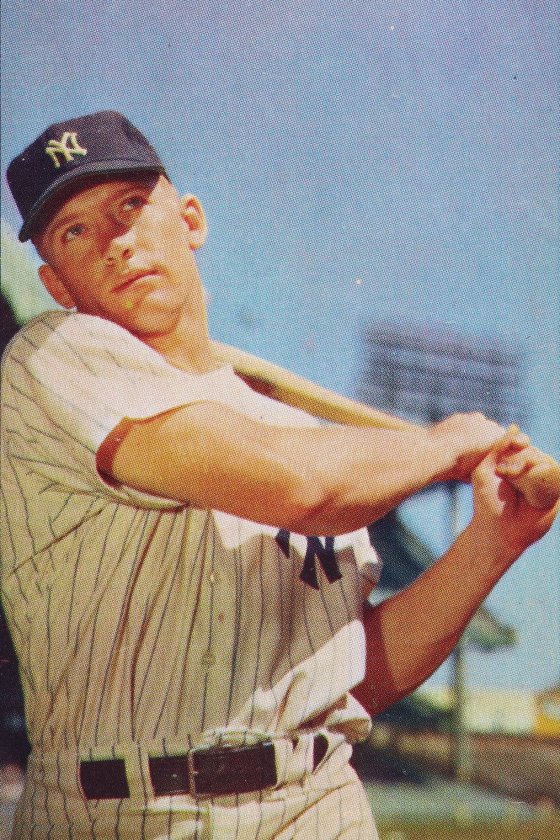
Player knowledge
Mickey Mantle
CF / 1B 1951–1968 Hall of Fame
- Born
- October 20, 1931, in Spavinaw, Oklahoma
- Bats / Throws
- S/R
- Height / Weight
- 5'11", 195 lbs
- Hometown
- Commerce, Oklahoma
- High School
- Commerce High School
- Full Name
- Mickey Charles Mantle
- Died
- August 13, 1995, in Dallas, Texas (age 63)
- Nicknames
- The Mick, The Commerce Comet, Muscles
- MLB Debut
- April 17, 1951, vs. Boston at Yankee Stadium
- Final Game
- September 28, 1968
- Uniform
- No. 6 (1951), No. 7 (1951–1968), retired by the Yankees in 1969
- Triple Crown
- 1956: .353, 52 HR, 130 RBI
- World Series
- Career records for home runs (18), RBI (40), and runs (42)
- Hall of Fame
- Class of 1974, 88.2% of the vote
Test your knowledge
Mickey Mantle Quizzes
10 quizzes drawn from the story below. View the collection
The story
Bio
Mickey Mantle hit a baseball as hard and as far as almost anyone who ever lived, from both sides of the plate, on legs that hurt for nearly his entire career. He was the fastest slugger of his day, the only switch-hitter ever to win a Triple Crown, and the center fielder who carried the Yankees dynasty from Joe DiMaggio into the 1960s.
Mickey Charles Mantle grew up in an Oklahoma mining town, where his father raised him to be a ballplayer almost from the cradle. He reached the Bronx at 19, wrecked his knee in his first World Series, and played 17 more seasons on it anyway. He won three MVP awards, hit 536 home runs, and played in 12 World Series in his first 14 seasons, and he still holds the Series records for home runs, RBI, and runs. He also drank hard for most of his adult life. Near the end he got sober, told the truth about it, and spent his last months asking people not to follow his example.
Here is the whole story, from the zinc mines of Commerce to 18 seasons with the New York Yankees and Cooperstown. When you’re done, see how much stuck with the Mickey Mantle Yankees quiz.
Mickey Mantle
Named for a Catcher
Mantle was born October 20, 1931, in Spavinaw, Oklahoma, the first child of Elvin “Mutt” Mantle and his wife, Lovell. Mutt was a semipro ballplayer and a baseball fanatic, and before the baby arrived he had already decided that a son would be named for Mickey Cochrane, the star catcher of the Philadelphia Athletics. Mutt never knew that Cochrane’s real first name was Gordon. “I would have hated to be named Gordon,” Mantle said years later.
When Mickey was small, the family moved to Commerce, in the northeast corner of the state, where Mutt went to work in the lead and zinc mines. The work was dirty and dangerous, and the Mantle men had a habit of dying young: Mickey’s grandfather and two uncles were gone before 50. Mickey grew up convinced he would be next.
Mutt was sure that managers of the future would platoon their hitters, so he made his son a switch-hitter. After a shift in the mines, Mutt pitched to him right-handed so he would bat lefty, and Mickey’s grandfather Charlie pitched left-handed so he would bat righty. Mickey was a natural righty and hated hitting from the left side at first. His father didn’t care. In high school a kick to the left shin during football practice turned into osteomyelitis, a dangerous bone infection, and doctors talked about amputating the leg. His parents drove him to a children’s hospital in Oklahoma City, where the new wonder drug penicillin saved it.
Mickey Mantle
The Whiz Kid
As a teenager Mantle played shortstop for the Baxter Springs Whiz Kids, a semipro club just across the state line in Kansas. In 1948 Yankees scout Tom Greenwade came to watch a teammate, third baseman Billy Johnson, and came away talking about the 16-year-old shortstop instead. By Mantle’s own account, he hit two long home runs that day, one from each side of the plate. Greenwade had to wait until Mantle finished high school, and in the spring of 1949 he signed him.
The Yankees sent him to the Class D Independence Yankees of the Kansas–Oklahoma–Missouri League, where he hit .313. In 1950, with the Class C Joplin Miners, he won the Western Association batting title at .383 with 26 home runs. His erratic throws from shortstop were another matter, and they worried the Yankees. That fall the Yankees brought him up for the last weeks of the season just to watch DiMaggio, Yogi Berra, and Phil Rizzuto in a pennant race.
The Korean War was under way, and in 1950 the draft board rejected Mantle because of the osteomyelitis in his leg. Fans and writers who saw a healthy-looking young star called him a draft dodger, and some sent threatening letters. He was examined again in 1951 and once more in October 1952, and was rejected each time.
Mickey Mantle
No. 6, Then No. 7
At spring training in 1951, clubhouse man Pete Sheehy handed the 19-year-old No. 6, the next number after Babe Ruth’s 3, Lou Gehrig’s 4, and DiMaggio’s 5. Nobody missed the message. On a spring tour of California he hit two home runs at USC, one from each side, that were reported to travel more than 500 feet. Casey Stengel, who had already moved him from shortstop to the outfield, was dazzled: “He has more speed than any slugger I’ve ever seen, and more slug than any other speedster.” The writers soon had a nickname for the kid from Oklahoma: the Commerce Comet.
Mantle debuted in right field on Opening Day, April 17, 1951, against the Red Sox at Yankee Stadium, and went 1-for-4 with an RBI. His first home run came May 1 at Comiskey Park off the White Sox’s Randy Gumpert. Then he stopped hitting and started striking out, and in July the Yankees sent him down to the Kansas City Blues, their top farm club.
It got worse in Kansas City. Mantle called home and told his father he didn’t think he could play baseball anymore. Mutt drove up from Commerce, walked into his son’s hotel room, and started packing his bags. He said he thought he had raised a man, not a coward, and that Mickey could come home and work in the mines. Mickey begged for another chance. Over 40 games with the Blues he hit .361 with 11 home runs, and in August the Yankees called him back. This time he wore No. 7, and he never wore anything else.
Mickey Mantle
The Drain Cover
The Yankees met the New York Giants in the 1951 World Series. In Game 2 the Giants’ rookie center fielder, Willie Mays, lifted a fly ball into right-center. Mantle, playing right, raced over for it. At the last second DiMaggio, in his final season, called him off. Mantle pulled up short, his spikes caught on a drain cover buried in the outfield grass, and his right knee gave way. Witnesses said he went down as if he had been shot, and he was carried off on a stretcher.
After the game Mutt was helping his son into a taxi when he collapsed on the sidewalk. Father and son were put in the same hospital room and watched the rest of the Series together. Mickey had serious knee damage that the medicine of the day couldn’t fully fix, and he played the rest of his career on a knee that trainers had to wrap tightly every day. Mutt had Hodgkin’s disease. The Yankees won in six, Mickey had his first ring, and on December 23, 1951, he married Merlyn Johnson, a girl from back home. Mutt died on May 7, 1952, at 40.
Mickey Mantle
Center Field and the Tape Measure
DiMaggio retired after the 1951 season, and in 1952 the 20-year-old Mantle took over in center field. He hit .311, made his first All-Star team, and finished third in the MVP vote. In the World Series against Brooklyn he hit .345, homered in Game 6, and won Game 7 with a home run and an RBI single. Jackie Robinson gave him much of the credit for the Yankees’ fourth straight title.
On April 17, 1953, two years to the day after his debut, Mantle batted right-handed against Washington lefty Chuck Stobbs at Griffith Stadium and hit a ball over the left-field bleachers and out of the park. Yankees publicity man Red Patterson went looking for where it landed and announced that it had traveled 565 feet. Historians still argue about how much of that was roll, but the phrase “tape-measure home run” was born. That October he hit a grand slam in Game 5 of the World Series as the Yankees beat the Dodgers for a record fifth straight championship.
In 1954 he hit .300, drove in 102 runs, and led the league with 129 runs scored. In 1955 he won his first home run title with 37, and also led the league in triples and walks, though a pulled hamstring limited him to three games in a World Series the Dodgers finally won.
Mickey Mantle
1956: The Triple Crown
General manager George Weiss nearly doubled Mantle’s salary for 1956, from $17,000 to $33,000, and got his money’s worth. Mantle chased Babe Ruth’s record of 60 homers for much of the summer and finished at .353 with 52 home runs and 130 RBI, leading the major leagues in all three. He remains the only switch-hitter ever to win the Triple Crown. He also led the league with 132 runs, won his first MVP award, and was named the Associated Press Male Athlete of the Year. He called it his favorite summer.
The best was saved for Game 5 of the World Series on October 8, 1956. Mantle homered off Brooklyn’s Sal Maglie in the fourth inning, and in the fifth he sprinted into deep left-center to run down a drive by Gil Hodges. Yankees pitcher Don Larsen finished the only perfect game in World Series history, and Mantle always said that catch was the best play he ever made. He hit three homers in the Series, and the Yankees won in seven.
In 1957 he hit a career-best .365, walked 146 times, and won his second straight MVP. In the World Series against Milwaukee, a collision with Braves second baseman Red Schoendienst hurt his shoulder, and the injury bothered his left-handed swing for years. The Braves won in seven, and the Yankees beat them in a 1958 rematch after trailing three games to one, with Mantle coming off a league-leading 42 home runs.
Mickey Mantle
The M&M Boys
After a third-place finish in 1959, the Yankees traded for Kansas City outfielder Roger Maris. In 1960 Mantle led the league with 40 homers and 119 runs, but Maris edged him for the MVP by a vote of 225 to 222. In the World Series against Pittsburgh, Mantle hit .400 with three homers and 11 RBI, and the Yankees outscored the Pirates 55–27. Then Bill Mazeroski hit a walk-off home run over the left-field wall at Forbes Field to win Game 7, and Mantle, who remembered the slow shrug of left fielder Yogi Berra as the ball went out, cried in the clubhouse. It was, he said later, the only time he really thought the better team had lost.
In 1961 the M&M Boys chased Ruth’s record of 60 together. They shared an apartment in Queens with teammate Bob Cerv, but the New York press cast Mantle as the true Yankee and Maris as the intruder. On September 10, Maris had 56 home runs and Mantle had 53. Then Mantle came down with a bad cold, and a shot he got from a doctor recommended by broadcaster Mel Allen left him with an infected abscess on his hip. He landed in Lenox Hill Hospital and finished with 54, a single-season record for a switch-hitter that lasted until Seattle catcher Cal Raleigh passed it in 2025. Maris hit No. 61 on the final day while Mantle watched from his hospital bed. Mantle played only two games in the World Series, and the Yankees beat Cincinnati in five.
Mickey Mantle
A Third MVP and the Façade
Injuries cost Mantle 39 games in 1962, but he hit .321 with 30 homers and a .486 on-base percentage, won his third MVP, and took home his only Gold Glove. He hit just .120 in the World Series, but the Yankees beat the San Francisco Giants in seven for his seventh and final ring. That winter the Yankees made him a $100,000 player.
On May 22, 1963, in the bottom of the 11th inning against Kansas City, he hit a Bill Fischer fastball off the façade atop the right-field roof at Yankee Stadium, just a few feet from leaving the ballpark entirely. Mantle said it was the hardest ball he ever hit. Two weeks later in Baltimore, chasing a drive by Brooks Robinson, his spikes caught in the chain-link fence and he broke his foot. He played only 65 games. In the World Series the Dodgers swept the Yankees, but Mantle homered off Sandy Koufax in Game 4 for his 15th World Series home run, tying Babe Ruth’s record.
He bounced back in 1964 with a .303 average, 35 home runs, 111 RBI, and the league’s best on-base percentage. In Game 3 of the World Series against St. Louis on October 10, 1964, he led off the bottom of the ninth of a 1–1 game and hit knuckleballer Barney Schultz’s first pitch into the right-field seats. It was his 16th World Series homer, breaking Ruth’s record, and he added two more to finish with 18. The Cardinals won the Series in seven. It was the last October of Mantle’s career.
Mickey Mantle
The Long Goodbye
In 1965 the Yankees fell to sixth place, their worst finish in 40 years, and Mantle, worn down by injuries and late nights, hit .255. On April 9 of that year he hit the first home run ever at the Houston Astrodome, in an exhibition game. He moved to first base in 1967 to spare his legs, and on May 14, 1967, at Yankee Stadium, he hit his 500th home run off Baltimore’s Stu Miller.
On September 19, 1968, at Tiger Stadium, Mantle was tied with Jimmie Foxx at 534 when he faced Denny McLain, who was on his way to 31 wins. The Tigers had already clinched the pennant, and McLain grooved a pitch for him on purpose. Mantle hit it into the right-field seats for No. 535 and third place on the all-time list. The next day at Yankee Stadium he hit No. 536 off Boston’s Jim Lonborg. It was his last. He played his final game on September 28, 1968, and his lifetime batting average slipped to .298. Falling below .300, he said, was the biggest disappointment of his career.
Mantle announced his retirement on March 1, 1969. On Mickey Mantle Day, June 8, 1969, the Yankees retired his No. 7, and DiMaggio presented him with a plaque for the center-field wall. Mantle asked that DiMaggio’s plaque be hung higher than his own. “I always wondered how a man who knew he was going to die could stand here and say he was the luckiest man in the world,” he told the crowd. “Now I think I know how Lou Gehrig felt.” He retired as the Yankees’ career leader in games played with 2,401, a mark that stood until Derek Jeter passed it in 2011.
Mickey Mantle
Cooperstown and the Card Shows
Life after baseball was bumpy at first. Mantle did some broadcasting for NBC, spent part of 1970 as a Yankees coach, and put his name on businesses that failed, including a chain of country-cooking restaurants. In January 1974, in his first year on the ballot, he was elected to the Hall of Fame on 322 of 365 ballots, 88.2 percent. He was inducted that August alongside his close friend and teammate Whitey Ford.
In 1983 Mantle took a job as a greeter and goodwill ambassador for the Claridge casino in Atlantic City, and Commissioner Bowie Kuhn barred him from baseball, just as he had Willie Mays a few years earlier. Kuhn’s successor, Peter Ueberroth, reinstated both men on March 18, 1985. By then the sports memorabilia boom had arrived, and no signature was more valuable than Mantle’s. Card shows finally made him rich, and he often insisted that promoters also book lesser-known old teammates such as Hank Bauer and Moose Skowron so they could earn something too. In 1988 he opened Mickey Mantle’s Restaurant on Central Park South in Manhattan, and this time the business worked.
Mickey Mantle
“Don’t Be Like Me”
Mantle drank heavily from his early years in New York into his 60s, and late in life he said plainly that alcohol had cut short his career and hurt his wife and four sons. Part of it, he explained, was fear. The Mantle men died young, he expected to as well, and he lived accordingly. “If I’d known I was going to live this long,” he liked to say, “I’d have taken better care of myself.”
In January 1994, after a doctor warned him that his liver was badly damaged, and with encouragement from his family and his friend Pat Summerall, Mantle checked into the Betty Ford Center in California. He came out sober and stayed sober, even when his son Billy died that March at 36. In a Sports Illustrated cover story that year he wrote frankly about his drinking: the barroom stories he used to tell for laughs no longer seemed funny, and he apologized to the people he had hurt.
In 1995 doctors found that cirrhosis, hepatitis C, and cancer had ruined his liver. He received a liver transplant at Baylor University Medical Center in Dallas on June 8, 1995. Because he waited only about a day for a donor liver, some critics asked whether his fame had moved him up the list; his doctors said the decision was based on medical need alone. At a news conference in July, thin and frail, he spoke directly to the kids who had idolized him: “This is a role model: Don’t be like me.” He urged people to become organ donors, and the Mickey Mantle Foundation was created to carry on that work.
The cancer had already spread. Mantle died on August 13, 1995, at 63, with Merlyn and his son David at his side. At his funeral in Dallas, broadcaster Bob Costas called him “a fragile hero to whom we had an emotional attachment so strong and lasting that it defied logic.” He is buried at Sparkman-Hillcrest Memorial Park, and at his request his marker carries three words: “A Great Teammate.” The same phrase appears on his monument in Yankee Stadium’s Monument Park.
Mickey Mantle
Records and Honors
- 536 home runs: third all-time when he retired, and still the career record for a switch-hitter
- 1956 Triple Crown (.353, 52 HR, 130 RBI): the only switch-hitter ever to win one
- Three AL MVP awards: 1956, 1957, and 1962
- 18 home runs, 40 RBI, and 42 runs in the World Series: all career records
- Seven World Series titles in 12 trips: 1951, 1952, 1953, 1956, 1958, 1961, and 1962
- Four home run titles (1955, 1956, 1958, 1960) and the 1956 batting title
- .421 on-base percentage, .557 slugging, and .977 OPS, with 1,733 walks
- 110.3 career WAR, per Baseball-Reference
- All-Star in 16 seasons, and the 1962 Gold Glove in center field
- National Baseball Hall of Fame, class of 1974; No. 7 retired by the Yankees (1969); MLB All-Century Team
Mickey Mantle
Mick Fun Facts
- His father named him for Hall of Fame catcher Mickey Cochrane, whose real first name was Gordon.
- His 565-foot “tape-measure” homer off Chuck Stobbs came on April 17, 1953, two years to the day after his major-league debut.
- For his career he hit .330 batting right-handed and .281 batting left-handed, but most of his home runs came from the left side because he faced far more right-handed pitchers.
- He struck out 1,710 times, the career record when he retired, and walked even more often: 1,733 times.
- He hit the first home run ever at the Houston Astrodome, in a 1965 exhibition game.
- He named his son Billy after his best friend and teammate, Billy Martin.
- He and Roger Maris played themselves in the 1962 movie Safe at Home!
- In 2022 a mint-condition 1952 Topps Mickey Mantle card sold for $12.6 million, at the time a record for any sports card.
Think you know the Mick now? Prove it with all ten quizzes in the Mickey Mantle collection, take the Mickey Mantle Yankees quiz, meet his longtime catcher on the Yogi Berra page, the center fielder he was always measured against on the Willie Mays page, and the legend whose records he chased on the Babe Ruth page, or browse the full New York Yankees quiz collection.
The postseason
October Accolades
| Year | Series | Result | G | H-AB | BA | HR | RBI |
|---|---|---|---|---|---|---|---|
| 1951 | World Series | Yankees def. Giants, 4–2 Tore up his right knee on an outfield drain cover chasing a Willie Mays fly in Game 2 | 2 | 1-5 | .200 | 0 | 0 |
| 1952 | World Series | Yankees def. Dodgers, 4–3 Hit .345 and homered in Games 6 and 7 to beat Brooklyn | 7 | 10-29 | .345 | 2 | 3 |
| 1953 | World Series | Yankees def. Dodgers, 4–2 Only .208, but a grand slam in Game 5 as the Yankees won a record fifth straight title | 6 | 5-24 | .208 | 2 | 7 |
| 1955 | World Series | Dodgers def. Yankees, 4–3 A pulled hamstring limited him to three games; homered in Game 3 | 3 | 2-10 | .200 | 1 | 1 |
| 1956 | World Series | Yankees def. Dodgers, 4–3 Homered and made a running catch to save Don Larsen’s perfect game in Game 5 | 7 | 6-24 | .250 | 3 | 4 |
| 1957 | World Series | Braves def. Yankees, 4–3 A collision with Red Schoendienst hurt the shoulder that bothered his lefty swing for years | 6 | 5-19 | .263 | 1 | 2 |
| 1958 | World Series | Yankees def. Braves, 4–3 Revenge on Milwaukee after trailing three games to one | 7 | 6-24 | .250 | 2 | 3 |
| 1960 | World Series | Pirates def. Yankees, 4–3 Hit .400 with 11 RBI, then Bill Mazeroski’s walk-off in Game 7 left him in tears | 7 | 10-25 | .400 | 3 | 11 |
| 1961 | World Series | Yankees def. Reds, 4–1 Played two games with an infected abscess on his hip | 2 | 1-6 | .167 | 0 | 0 |
| 1962 | World Series | Yankees def. Giants, 4–3 Held to .120, but won his seventh and final ring | 7 | 3-25 | .120 | 0 | 0 |
| 1963 | World Series | Dodgers def. Yankees, 4–0 Homered off Sandy Koufax in Game 4 to tie Babe Ruth’s record of 15 World Series homers | 4 | 2-15 | .133 | 1 | 1 |
| 1964 | World Series | Cardinals def. Yankees, 4–3 Walk-off homer in Game 3 broke Ruth’s record; finished with 18 World Series home runs | 7 | 8-24 | .333 | 3 | 8 |
| Postseason | 12 series | 65 | 59-230 | .257 | 18 | 40 | |
The clubs
Teams
-
New York Yankees
1951–1968
536 HR, the 1956 Triple Crown, three MVPs, and seven World Series titles
The numbers
Season Stats
| Season | Team | League | WAR | Games | PA | AB | Runs | Hits | RBI | 2B | 3B | HR | SB | BB | BA | OBP | SLG | OPS |
|---|---|---|---|---|---|---|---|---|---|---|---|---|---|---|---|---|---|---|
| 1951 | New York Yankees | AL | 1.5 | 96 | 386 | 341 | 61 | 91 | 65 | 11 | 5 | 13 | 8 | 43 | .267 | .349 | .443 | .792 |
| 1952 | New York Yankees | AL | 6.3 | 142 | 626 | 549 | 94 | 171 | 87 | 37 | 7 | 23 | 4 | 75 | .311 | .394 | .530 | .924 |
| 1953 | New York Yankees | AL | 5.8 | 127 | 540 | 461 | 105 | 136 | 92 | 24 | 3 | 21 | 8 | 79 | .295 | .398 | .497 | .895 |
| 1954 | New York Yankees | AL | 6.9 | 146 | 651 | 543 | 129 | 163 | 102 | 17 | 12 | 27 | 5 | 102 | .300 | .408 | .525 | .933 |
| 1955 | New York Yankees | AL | 9.5 | 147 | 638 | 517 | 121 | 158 | 99 | 25 | 11 | 37 | 8 | 113 | .306 | .431 | .611 | 1.042 |
| 1956 | New York Yankees | AL | 11.3 | 150 | 652 | 533 | 132 | 188 | 130 | 22 | 5 | 52 | 10 | 112 | .353 | .464 | .705 | 1.169 |
| 1957 | New York Yankees | AL | 11.3 | 144 | 623 | 474 | 121 | 173 | 94 | 28 | 6 | 34 | 16 | 146 | .365 | .512 | .665 | 1.177 |
| 1958 | New York Yankees | AL | 8.7 | 150 | 654 | 519 | 127 | 158 | 97 | 21 | 1 | 42 | 18 | 129 | .304 | .443 | .592 | 1.035 |
| 1959 | New York Yankees | AL | 6.6 | 144 | 640 | 541 | 104 | 154 | 75 | 23 | 4 | 31 | 21 | 93 | .285 | .390 | .514 | .904 |
| 1960 | New York Yankees | AL | 6.4 | 153 | 644 | 527 | 119 | 145 | 94 | 17 | 6 | 40 | 14 | 111 | .275 | .399 | .558 | .957 |
| 1961 | New York Yankees | AL | 10.5 | 153 | 646 | 514 | 131 | 163 | 128 | 16 | 6 | 54 | 12 | 126 | .317 | .448 | .687 | 1.135 |
| 1962 | New York Yankees | AL | 6.0 | 123 | 502 | 377 | 96 | 121 | 89 | 15 | 1 | 30 | 9 | 122 | .321 | .486 | .605 | 1.091 |
| 1963 | New York Yankees | AL | 2.9 | 65 | 213 | 172 | 40 | 54 | 35 | 8 | 0 | 15 | 2 | 40 | .314 | .441 | .622 | 1.063 |
| 1964 | New York Yankees | AL | 4.8 | 143 | 567 | 465 | 92 | 141 | 111 | 25 | 2 | 35 | 6 | 99 | .303 | .423 | .591 | 1.015 |
| 1965 | New York Yankees | AL | 1.8 | 122 | 435 | 361 | 44 | 92 | 46 | 12 | 1 | 19 | 4 | 73 | .255 | .379 | .452 | .831 |
| 1966 | New York Yankees | AL | 3.6 | 108 | 393 | 333 | 40 | 96 | 56 | 12 | 1 | 23 | 1 | 57 | .288 | .389 | .538 | .927 |
| 1967 | New York Yankees | AL | 3.9 | 144 | 553 | 440 | 63 | 108 | 55 | 17 | 0 | 22 | 1 | 107 | .245 | .391 | .434 | .825 |
| 1968 | New York Yankees | AL | 2.7 | 144 | 547 | 435 | 57 | 103 | 54 | 14 | 1 | 18 | 6 | 106 | .237 | .385 | .398 | .782 |
| Career | 18 seasons | AL | 110.5 | 2,401 | 9,910 | 8,102 | 1,676 | 2,415 | 1,509 | 344 | 72 | 536 | 153 | 1,733 | .298 | .421 | .557 | .977 |