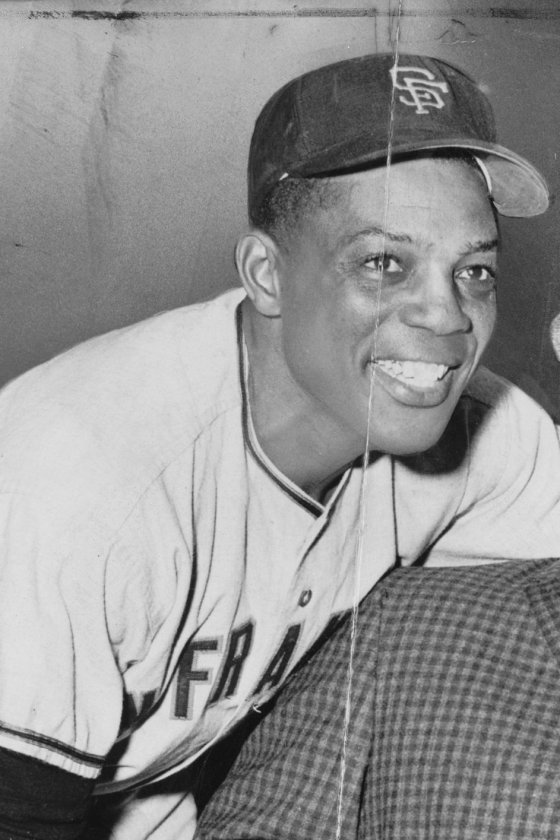
Player knowledge
Willie Mays
CF 1948–1973 Hall of Fame
- Born
- May 6, 1931, in Westfield, Alabama
- Bats / Throws
- R/R
- Height / Weight
- 5'10", 170 lbs
- Hometown
- Fairfield, Alabama
- High School
- Fairfield Industrial High School
- Full Name
- Willie Howard Mays Jr.
- Died
- June 18, 2024, in Palo Alto, California (age 93)
- Nicknames
- The Say Hey Kid, Buck
- Negro Leagues Debut
- 1948, Birmingham Black Barons, at Rickwood Field
- NL Debut
- May 25, 1951, at Philadelphia (Shibe Park)
- Final Game
- September 9, 1973 (last at-bat: Game 3 of the 1973 World Series)
- Uniform
- No. 24, retired by the Giants (1972) and the Mets (2022)
- The Catch
- Robbed Vic Wertz in Game 1 of the 1954 World Series at the Polo Grounds
- Hall of Fame
- Class of 1979, first ballot, 94.7% of the vote
The story
Bio
Willie Mays could beat you every way there was. He hit 660 home runs, stole bases at will, threw runners out from the deepest corners of the outfield, and played center field with a joy you could see from the upper deck. Ask the people who played with him and against him to name the greatest all-around player they ever saw, and an astonishing number of them give the same answer.
Willie Howard Mays Jr. grew up in the steel country outside Birmingham, Alabama, and was a professional at 17 with the Birmingham Black Barons of the Negro American League. He reached the New York Giants at 20, won the Rookie of the Year award, lost almost two seasons to the Army, and came back to win the batting title, the MVP, and the World Series in 1954, the year of The Catch. He followed the Giants to San Francisco, won a second MVP 11 years after his first, collected 12 Gold Gloves and 24 All-Star selections, and finished where he started, in New York, saying goodbye to America.
Here is the whole story, from the sandlots of Fairfield to the Giants in two cities, a final pennant with the Mets, and Cooperstown. When you’re done, see how much stuck with the Willie Mays Giants quiz.
Willie Mays
Westfield and Fairfield
Mays was born May 6, 1931, in Westfield, Alabama, a company town built around the steel mills southwest of Birmingham. His father, William Howard Mays, was named for President William Howard Taft and went by “Cat.” He worked in the mills, later as a Pullman porter, and played semipro ball for the mill team. Willie’s mother was a high school track and basketball star. The couple split up when he was small, and Willie stayed with his father and was largely raised by two young aunts, Sarah and Ernestine. To family and friends he was simply “Buck.”
Family lore says Cat put a baseball in his son’s crib and that the boy learned to walk by toddling toward one. True or not, Willie was playing catch with his father at five. When he was 10 the family moved a few miles to Fairfield, where money was tight and everyone pitched in. His hero was Joe DiMaggio.
At Fairfield Industrial High School he was trained for laundry work, starred at quarterback, and led the county’s Black high schools in basketball scoring. The school had no baseball team, so he played in the outfield and at second base alongside his father on industrial league and semipro clubs, in front of crowds that could reach 6,000.
Willie Mays
Buck of the Black Barons
In 1948, after a brief stint with the Chattanooga Choo-Choos, the 17-year-old joined the Birmingham Black Barons of the Negro American League. The manager, Piper Davis, had played on the mill team with Cat. When the high school principal threatened to suspend Willie for playing pro ball, Davis and Cat worked out a deal: Willie would play only home games so he could stay in school.
In his first game, at Birmingham’s Rickwood Field, he batted seventh, played left field, and got two hits off veteran Chet Brewer. He soon moved to center. The first time he faced Satchel Paige, Mays doubled, and Paige walked over to second base and told the kid that was all he was getting. Mays struck out his next three times up.
He came up big when it mattered. In Game 1 of the league championship series against the Kansas City Monarchs, his two-out, bases-loaded single in the 11th inning won it, and Birmingham went on to take the pennant. The Black Barons then lost the 1948 Negro League World Series to the Homestead Grays, the last one ever played. Grays slugger Buck Leonard came away impressed: the teenager could run and throw, he said, but he couldn’t hit a curveball yet. In 2024, Major League Baseball recognized the Negro American League of 1948 as a major league, so his 13 recorded games with the Black Barons now count in his official career line. Explore that history in the Negro Leagues collection.
Willie Mays
A Barrelful of Money
Big-league clubs could not sign him until he finished high school. Roy Campanella saw him throw out Larry Doby at the plate in a 1949 barnstorming game and urged the Dodgers to grab him, but their scout came back with the same report Leonard gave: can’t hit the curve. In 1950 the Giants sent scout Eddie Montague to Birmingham to look at a first baseman, Alonzo Perry. Montague saw Mays instead, called him the best young player he had ever seen, and signed him at the family’s house in Fairfield for a $4,000 bonus and $250 a month. Because Willie was a minor, Cat signed too.
The Giants planned to send him to Sioux City, but that club would not take a Black player. He went instead to the Class B Trenton Giants and became the first Black player in the Interstate League. In Hagerstown, Maryland, fans screamed slurs, and he had to stay at a Black-only hotel across town; late that night a few of his white teammates climbed in through his window and slept on the floor. He hit .353 in 81 games.
In 1951 he started with the Triple-A Minneapolis Millers and was hitting .477 after 35 games. On an off day in Sioux City he was watching a movie when the house lights came up and the manager asked Willie Mays to report to his hotel. The Giants were calling. Mays said he wasn’t ready. Manager Leo Durocher got on the phone, asked what he was hitting, and then asked, with some colorful language, whether he thought he could hit .250 for the Giants. Mays said yes. Owner Horace Stoneham bought an ad in a Minneapolis paper to apologize to the Millers’ fans.
Willie Mays
Say Hey, New York
Mays debuted on May 25, 1951, at Shibe Park in Philadelphia, batting third and playing center. He went 0-for-12 in his first three games. Then, in his first at-bat at the Polo Grounds, he hit a Warren Spahn pitch over the left-field roof for his first major-league hit. When another slump left him crying at his locker, Durocher told him he was the Giants’ center fielder no matter what and that he was the best center fielder Durocher had ever seen. Mays started hitting.
The Giants found him a room with the Goosby family in Harlem, near St. Nicholas Avenue and 155th Street, and veteran outfielder Monte Irvin looked after him like an older brother. In the mornings he played stickball in the street with neighborhood kids and then treated them to sodas. His habit of greeting people with “Say hey” gave New York writers a nickname that stuck for life: the Say Hey Kid. In Pittsburgh he caught a Rocky Nelson drive barehanded on the dead run, and Branch Rickey called it the finest catch he had ever seen.
The Giants were more than a dozen games behind Brooklyn in mid-August, then roared back to force a playoff. On October 3, Mays was kneeling in the on-deck circle when Bobby Thomson hit the “Shot Heard ’Round the World.” In Game 1 of the World Series against the Yankees, Mays, Monte Irvin, and Hank Thompson formed the first all-Black outfield in American or National League history. Mays hit just .182, and the Series is remembered for another reason too: Yankees rookie Mickey Mantle wrecked his knee on an outfield drain while chasing a Mays fly ball. Mays hit .274 with 20 homers and won the NL Rookie of the Year award.
Willie Mays
Fort Eustis
Mays was drafted into the Army during the Korean War. He played 34 games in 1952, batting .236, and in his last game, at Ebbets Field, even Brooklyn fans cheered him. He was inducted on May 29, 1952. The first-place Giants promptly faded.
He spent most of his service at Fort Eustis, Virginia, as a physical training instructor and as the star of the post’s baseball team. By his own estimate he played about 180 games for Army clubs. It was there that he polished his famous basket catch, glove held palm up at his belt, a style some called showboating and Mays said helped him set his feet to throw. His mother died in 1953 while he was in uniform. He was discharged on March 1, 1954, and reported to spring training the next day.
Willie Mays
1954: The Catch
Mays homered on Opening Day and had 36 home runs by July 28, ahead of Babe Ruth’s record pace. Then Durocher asked him to stop swinging for the fences and help the team by getting on base. He hit only five more homers but raised his average from .326 to .345. On the final day he went 3-for-4 to win the batting title at .345, edging teammate Don Mueller (.342) and the Dodgers’ Duke Snider (.341). He also hit 41 homers, drove in 110 runs, led the league with 13 triples and a .667 slugging percentage, and won the NL MVP at 23.
The Giants won the pennant and met a Cleveland team that had won 111 games. In Game 1 at the Polo Grounds on September 29, 1954, the score was tied 2–2 in the eighth with two Indians on base and nobody out. Vic Wertz drove a pitch from reliever Don Liddle deep to center, well over 400 feet. Mays turned his back to the plate, sprinted, and caught it over his shoulder. Then he spun and fired the ball back to the infield, and Larry Doby could only tag up and go from second to third. Liddle was lifted after the one batter and supposedly said, “Well, I got my man.” Dusty Rhodes won the game with a pinch-hit homer in the 10th, and Mays scored the winning run.
The Catch became the most famous defensive play in baseball history, and the Giants swept the Series. Mays himself always said he had made better catches. It was the only championship of his career.
Willie Mays
51 Homers and the Stolen Base
That winter Mays played in Puerto Rico for Santurce, in the same outfield as a young Roberto Clemente, and hit .393 as the club won the Caribbean Series. In 1955 Durocher told him to swing for the fences again, and he hit 51 home runs. On the last day of that season Durocher told Mays he would not be back. When Mays worried aloud about playing without him, Durocher told him Willie Mays didn’t need help from anybody.
Under new manager Bill Rigney, Mays brought speed back into fashion. In 1956 he hit 36 homers and stole 40 bases to become the first National Leaguer with 30 of each in a season, and on his 25th birthday, May 6, he stole four bases in one game. He led the league in steals four years running, from 1956 through 1959. In 1957 he joined the 20-20-20 club with 26 doubles, 20 triples, and 35 homers, and won the first of 12 straight Gold Gloves in the award’s very first year. He married Marghuerite Wendell in 1956, and the couple later adopted a son, Michael.
After the 1957 season the Giants left for San Francisco. In their last game at the Polo Grounds, on September 29, 1957, the fans gave Mays a standing ovation during his final at-bat.
Willie Mays
Westward to Candlestick
San Francisco did not embrace him right away. When Mays tried to buy a house in a well-to-do neighborhood, the seller backed out after neighbors objected to a Black family moving in. Mayor George Christopher apologized and offered to let the Mays family stay in his own home. The family moved into the house that November after all, and almost immediately a brick came through the window. At the ballpark some fans booed, comparing him to San Francisco’s own Joe DiMaggio. One New York columnist marveled that the city would cheer Nikita Khrushchev and boo Willie Mays.
His play didn’t suffer. In 1958 he hit a career-best .347 and went 3-for-5 on the final day, but Richie Ashburn finished at .350 to win the batting title. That year the fans voted rookie Orlando Cepeda the team’s MVP instead of Mays. In 1960 the Giants moved into windy Candlestick Park, which cost Mays home runs but never his spirit.
On April 30, 1961, at County Stadium in Milwaukee, Mays woke up sick after eating late-night spare ribs, borrowed teammate Joey Amalfitano’s lighter bat, and hit four home runs, driving in eight runs. He was on deck when the Giants’ ninth inning ended, one batter shy of a chance at a fifth. Roommate Willie McCovey asked if he wanted more ribs.
Willie Mays
1962: The Pennant and the Line Drive
In 1962 Mays hit 49 homers with a career-high 141 RBI. The strain of carrying the club showed: in September he fainted in the dugout in Cincinnati and was carried off on a stretcher, diagnosed with exhaustion. He missed three games. On the final day his eighth-inning homer beat Houston 2–1, and when the Dodgers lost, the Giants and Dodgers were tied for first, just as in 1951.
Mays homered twice in an 8–0 win in Game 1 of the playoff and was in the middle of a four-run ninth-inning rally in Game 3. Fittingly, he caught the last out of the pennant clincher. In the World Series against the Yankees it came down to the ninth inning of Game 7, with New York ahead 1–0. With two outs and Matty Alou on first, Mays doubled into the right-field corner. Alou was held at third. Willie McCovey then smashed a line drive right at second baseman Bobby Richardson, and the Yankees were champions. Mays also finished second in the MVP vote, to Maury Wills, 209 points to 202.
Willie Mays
Captain Willie
Before the 1963 season Mays signed for $105,000, making him the highest-paid player in the game. On July 2, Juan Marichal and Warren Spahn each threw 15 scoreless innings, and Mays ended it with a home run off Spahn in the 16th for a 1–0 win. He was named MVP of that year’s All-Star Game after making a running catch to rob Joe Pepitone.
On May 21, 1964, manager Alvin Dark named Mays the Giants’ captain, the first Black captain in American or National League history. That summer Dark was quoted in Newsday saying his Black and Latin players lacked mental alertness. Furious players, Orlando Cepeda among them, met in Mays’s hotel room in Pittsburgh. Mays talked them out of open revolt, told them Dark would not be back, and urged them not to turn the manager into a hero for bigots. Mays led the league with 47 homers, and Dark was fired on the last day of the season.
Willie Mays
1965: MVP Again
On August 22, 1965, at Candlestick, Juan Marichal clubbed Dodgers catcher John Roseboro with a bat, setting off one of the ugliest brawls in baseball history. Mays rushed to Roseboro, helped him off the field with blood on his own uniform, and then hit a three-run homer off Sandy Koufax. NL president Warren Giles praised his conduct. Mays hit an NL-record 17 homers that August.
On September 13, at the Houston Astrodome, he hit No. 500 off Don Nottebart, becoming only the fifth player to get there. Warren Spahn, who had given up his first homer in 1951, was by then his teammate and asked whether it felt the same. Mays said it did. Same pitch, too. He finished with a career-high 52 home runs, led the league in on-base and slugging percentage, and won his second NL MVP, 11 years after his first.
On May 4, 1966, he hit No. 512 to pass Mel Ott for the National League record. By the end of that season only Babe Ruth had hit more home runs.
Willie Mays
600, 3,000, and One More Run
The Houston Astros marked his 37th birthday in 1968 with a 569-pound cake, one pound for every home run he had hit; Mays sent most of it to a children’s hospital. That July he led off the All-Star Game with a single and scored the only run of a 1–0 win, becoming the first two-time All-Star MVP. On September 22, 1969, pinch-hitting against San Diego, he hit his 600th home run, off Mike Corkins, joining Ruth as the only members of the club. On July 18, 1970, he singled off Montreal’s Mike Wegener for his 3,000th major-league hit, as it was counted then. The Sporting News named him its Player of the Decade for the 1960s.
At 40, in 1971, he homered in each of the first four games, drew a career-high 112 walks, led the league with a .425 on-base percentage, and played 48 games at first base to save his legs. The Giants won the NL West, and against Pittsburgh in the NLCS Mays hit the only postseason home run of his career. After the season he won the first Roberto Clemente Award, then called the Commissioner’s Award, and married Mae Louise Allen, a San Francisco child-welfare worker whose phone number he had gotten from Wilt Chamberlain years before.
Willie Mays
Say Goodbye to America
The Giants were short of money, and Mays wanted security for life after baseball. On May 11, 1972, Stoneham traded him to the Mets for pitcher Charlie Williams and cash, and Mets owner Joan Payson promised him a job after he retired. The Giants retired his No. 24 that month. In his Mets debut on May 14, Mother’s Day at Shea Stadium, against the Giants of all teams, he broke a 4–4 tie with a fifth-inning homer. The Mets won 5–4.
He hit his 660th and final home run on August 17, 1973, off Cincinnati’s Don Gullett. On September 25, Shea Stadium held Willie Mays Night, and he closed his farewell speech with the line everyone remembers: “Willie, say goodbye to America.” That October, after a brawl in Game 3 of the NLCS, he walked out with Yogi Berra and Tom Seaver to calm the crowd, then delivered a pinch-hit RBI single in the clinching Game 5.
In the World Series against Oakland, the 42-year-old stumbled in center field in Game 2, an image that has followed him ever since. Less remembered is the 12th inning of that same game, when he bounced a Rollie Fingers fastball up the middle to break a 7–7 tie. It was the last hit of his career, and it won the game. His final at-bat came in Game 3 on October 16, 1973, and the Mets lost the Series in seven.
Willie Mays
Banned, Reinstated, and Beloved
Mays coached for the Mets through 1979. On January 23, 1979, he was elected to the Hall of Fame on 409 of 432 ballots, 94.7 percent. Columnist Dick Young scolded the 23 holdouts, joking that some voters would leave off Jesus Christ. In Cooperstown, Mays summed up his career in one word: love.
That October he took a public relations job with Bally’s Park Place casino in Atlantic City, greeting guests and playing golf. His contract barred him from gambling, and the casino took no sports bets, but Commissioner Bowie Kuhn ruled that he could not work for a casino and a ball club at the same time, effectively banning him from baseball. Mickey Mantle later got the same treatment. In March 1985, new commissioner Peter Ueberroth reinstated them both. That same year, at the Pittsburgh drug trials, former Mets teammate John Milner testified that Mays had kept liquid amphetamine in his locker. Milner said he never saw Mays use it, Mays denied taking drugs, and the claim was never proven.
The Giants made him a special assistant in 1986 and gave him a lifetime contract in 1993. Their ballpark sits at 24 Willie Mays Plaza, with his statue out front. He was the godfather of Barry Bonds, son of his Giants teammate Bobby Bonds, and gave his blessing when Barry passed him on the home run list in 2004. President Barack Obama awarded Mays the Presidential Medal of Freedom in 2015, MLB renamed the World Series MVP award for him in 2017, and the Mets retired his No. 24 in 2022, keeping a promise Joan Payson had made 50 years earlier.
Mays died of heart failure in Palo Alto, California, on June 18, 2024, at 93. Two days later the Giants and Cardinals played a regular-season game at Rickwood Field in Birmingham, where his career began. The Giants wore a No. 24 patch, and his Hall of Fame plaque was brought to the old ballpark.
Willie Mays
Records and Honors
- 660 home runs: third all-time when he retired, and still in the top six
- 3,293 hits, 2,068 runs, and 1,909 RBI in Baseball-Reference’s official line, which includes his 1948 Negro Leagues season
- 7,095 outfield putouts and 2,829 games in center field: both major-league records
- 12 Gold Gloves (1957–1968): the most by an outfielder, shared with Roberto Clemente
- 24 All-Star selections, All-Star Game MVP in 1963 and 1968, and All-Star records for hits (23), runs (20), and stolen bases (6)
- 156.2 career WAR: third among position players, behind only Barry Bonds and Babe Ruth, per Baseball-Reference
- Two NL MVPs (1954, 1965), the 1951 NL Rookie of the Year, and the 1954 batting title (.345)
- Four home run titles (1955, 1962, 1964, 1965) and four straight stolen base titles (1956–1959)
- The first player with 300 home runs and 300 stolen bases, and the first National Leaguer to go 30-30 in a season
- 1954 World Series champion
- Hall of Fame class of 1979, MLB All-Century Team (1999), Presidential Medal of Freedom (2015), and No. 24 retired by the Giants and the Mets
Willie Mays
Say Hey Fun Facts
- His first major-league homer (1951) came off Warren Spahn; by the time he hit No. 500 in 1965, Spahn was his teammate.
- He stole four bases in one game on his 25th birthday, May 6, 1956.
- In 1954 he sang on “Say Hey (The Willie Mays Song),” recorded with the Treniers.
- Ted Williams once said they invented the All-Star Game for Willie Mays.
- Hank Aaron and Mays came close to being teammates: the Giants also wanted Aaron in 1952, but the Braves won out. Aaron later passed Mays for second place on the home run list in 1972.
- He shared a 1981 song title with Mickey Mantle and Duke Snider: Terry Cashman’s “Talkin’ Baseball (Willie, Mickey & the Duke).”
- The Houston Astros gave him a 569-pound birthday cake in 1968, one pound per home run.
- The World Series MVP award has been the Willie Mays World Series MVP Award since 2017.
Think you know the Say Hey Kid now? Prove it with all ten quizzes in the Willie Mays collection, take the Willie Mays Giants quiz, read about his great home run rival on the Hank Aaron page, his fellow New York center fielder on the Mickey Mantle page, and his godson on the Barry Bonds page, or browse the full San Francisco Giants, New York Mets, and Negro Leagues quiz collections.
The postseason
October Accolades
| Year | Series | Result | G | H-AB | BA | HR | RBI |
|---|---|---|---|---|---|---|---|
| 1948 | NAL Championship Series | Black Barons def. Monarchs, 4–3 At 17, his two-out, bases-loaded single in the 11th inning won Game 1 | 7 | 7-25 | .280 | 0 | 5 |
| 1948 | Negro League World Series | Grays def. Black Barons, 4–1 The last Negro League World Series ever played | 1 | 0-3 | .000 | 0 | 0 |
| 1951 | World Series | Yankees def. Giants, 4–2 Part of the first all-Black outfield in AL or NL history, with Monte Irvin and Hank Thompson | 6 | 4-22 | .182 | 0 | 1 |
| 1954 | World Series | Giants def. Indians, 4–0 The Catch off Vic Wertz in Game 1; scored the winning run in the 10th | 4 | 4-14 | .286 | 0 | 3 |
| 1962 | World Series | Yankees def. Giants, 4–3 Two-out double in the ninth of Game 7 put the tying run on third; Matty Alou was held there | 7 | 7-28 | .250 | 0 | 1 |
| 1971 | NLCS | Pirates def. Giants, 3–1 His only postseason home run, off Bob Miller in Game 2 | 4 | 4-15 | .267 | 1 | 3 |
| 1973 | NLCS | Mets def. Reds, 3–2 Pinch-hit RBI single in the clinching Game 5 | 1 | 1-3 | .333 | 0 | 1 |
| 1973 | World Series | Athletics def. Mets, 4–3 His last hit, a 12th-inning RBI single off Rollie Fingers, won Game 2 | 3 | 2-7 | .286 | 0 | 1 |
| Postseason | 8 series | 33 | 29-117 | .248 | 1 | 15 | |
The clubs
Teams
-
San Francisco Giants
1951–1972
New York 1951–57, San Francisco 1958–72 · 646 HR, two MVPs, The Catch, and the 1954 title
-
New York Mets
1972–1973
Homered in his Mets debut against the Giants and reached one last World Series in 1973
The numbers
Season Stats
| Season | Team | League | WAR | Games | PA | AB | Runs | Hits | RBI | 2B | 3B | HR | SB | BB | BA | OBP | SLG | OPS |
|---|---|---|---|---|---|---|---|---|---|---|---|---|---|---|---|---|---|---|
| 1948 | Birmingham Black Barons | NAL | -0.1 | 13 | 48 | 43 | 6 | 10 | 6 | 2 | 1 | 0 | 1 | 4 | .233 | .313 | .326 | .638 |
| 1951 | New York Giants | NL | 3.9 | 121 | 524 | 464 | 59 | 127 | 68 | 22 | 5 | 20 | 7 | 57 | .274 | .356 | .472 | .828 |
| 1952 | New York Giants | NL | 1.2 | 34 | 144 | 127 | 17 | 30 | 23 | 2 | 4 | 4 | 4 | 16 | .236 | .326 | .409 | .736 |
| 1954 | New York Giants | NL | 10.5 | 151 | 641 | 565 | 119 | 195 | 110 | 33 | 13 | 41 | 8 | 66 | .345 | .411 | .667 | 1.078 |
| 1955 | New York Giants | NL | 9.2 | 152 | 670 | 580 | 123 | 185 | 127 | 18 | 13 | 51 | 24 | 79 | .319 | .400 | .659 | 1.059 |
| 1956 | New York Giants | NL | 7.6 | 152 | 651 | 578 | 101 | 171 | 84 | 27 | 8 | 36 | 40 | 68 | .296 | .369 | .557 | .926 |
| 1957 | New York Giants | NL | 8.3 | 152 | 669 | 585 | 112 | 195 | 97 | 26 | 20 | 35 | 38 | 76 | .333 | .407 | .626 | 1.033 |
| 1958 | San Francisco Giants | NL | 10.2 | 152 | 685 | 600 | 121 | 208 | 96 | 33 | 11 | 29 | 31 | 78 | .347 | .419 | .583 | 1.002 |
| 1959 | San Francisco Giants | NL | 7.8 | 151 | 649 | 575 | 125 | 180 | 104 | 43 | 5 | 34 | 27 | 65 | .313 | .381 | .583 | .964 |
| 1960 | San Francisco Giants | NL | 9.5 | 153 | 669 | 595 | 107 | 190 | 103 | 29 | 12 | 29 | 25 | 61 | .319 | .381 | .555 | .936 |
| 1961 | San Francisco Giants | NL | 8.7 | 154 | 659 | 572 | 129 | 176 | 123 | 32 | 3 | 40 | 18 | 81 | .308 | .393 | .584 | .977 |
| 1962 | San Francisco Giants | NL | 10.5 | 162 | 706 | 621 | 130 | 189 | 141 | 36 | 5 | 49 | 18 | 78 | .304 | .384 | .615 | .999 |
| 1963 | San Francisco Giants | NL | 10.6 | 157 | 671 | 596 | 115 | 187 | 103 | 32 | 7 | 38 | 8 | 66 | .314 | .380 | .582 | .962 |
| 1964 | San Francisco Giants | NL | 11.0 | 157 | 665 | 578 | 121 | 171 | 111 | 21 | 9 | 47 | 19 | 82 | .296 | .383 | .607 | .990 |
| 1965 | San Francisco Giants | NL | 11.2 | 157 | 638 | 558 | 118 | 177 | 112 | 21 | 3 | 52 | 9 | 76 | .317 | .398 | .645 | 1.043 |
| 1966 | San Francisco Giants | NL | 9.0 | 152 | 629 | 552 | 99 | 159 | 103 | 29 | 4 | 37 | 5 | 70 | .288 | .368 | .556 | .924 |
| 1967 | San Francisco Giants | NL | 4.4 | 141 | 544 | 486 | 83 | 128 | 70 | 22 | 2 | 22 | 6 | 51 | .263 | .334 | .453 | .787 |
| 1968 | San Francisco Giants | NL | 6.3 | 148 | 573 | 498 | 84 | 144 | 79 | 20 | 5 | 23 | 12 | 67 | .289 | .372 | .488 | .860 |
| 1969 | San Francisco Giants | NL | 3.1 | 117 | 459 | 403 | 64 | 114 | 58 | 17 | 3 | 13 | 6 | 49 | .283 | .362 | .437 | .798 |
| 1970 | San Francisco Giants | NL | 5.2 | 139 | 566 | 478 | 94 | 139 | 83 | 15 | 2 | 28 | 5 | 79 | .291 | .390 | .506 | .897 |
| 1971 | San Francisco Giants | NL | 6.3 | 136 | 537 | 417 | 82 | 113 | 61 | 24 | 5 | 18 | 23 | 112 | .271 | .425 | .482 | .907 |
| 1972 | San Francisco Giants | NL | 0.2 | 19 | 67 | 49 | 8 | 9 | 3 | 2 | 0 | 0 | 3 | 17 | .184 | .394 | .224 | .618 |
| 1972 | New York Mets | NL | 1.6 | 69 | 242 | 195 | 27 | 52 | 19 | 9 | 1 | 8 | 1 | 43 | .267 | .402 | .446 | .848 |
| 1973 | New York Mets | NL | 0.0 | 66 | 239 | 209 | 24 | 44 | 25 | 10 | 0 | 6 | 1 | 27 | .211 | .303 | .344 | .647 |
| Career | 23 seasons | NAL/NL | 156.2 | 3,005 | 12,545 | 10,924 | 2,068 | 3,293 | 1,909 | 525 | 141 | 660 | 339 | 1,468 | .301 | .384 | .557 | .940 |