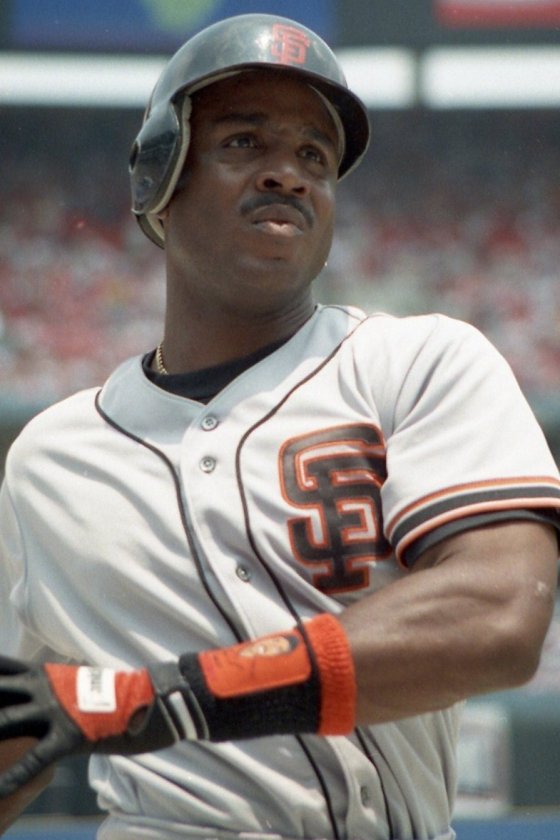
Player knowledge
Barry Bonds
LF 1986–2007
- Born
- July 24, 1964, in Riverside, California
- Bats / Throws
- L/L
- Height / Weight
- 6'1", 185 lbs
- Hometown
- San Carlos, California
- High School
- Junípero Serra High School
- Full Name
- Barry Lamar Bonds
- Family
- Son of Bobby Bonds, godson of Willie Mays, cousin of Reggie Jackson
- MLB Debut
- May 30, 1986, vs. the Dodgers at Three Rivers Stadium
- Final Game
- September 26, 2007, vs. the Padres at AT&T Park
- Uniform
- No. 7 and No. 24 (Pirates), No. 25 (Giants, retired 2018)
- Home Runs
- 762 career and 73 in 2001, both major-league records
- Walks
- 2,558 career and 688 intentional, both records; 232 in 2004
- MVP Awards
- Seven (1990, 1992, 1993, 2001–2004), the most in history
- Hall of Fame
- Not elected; 66.0% in his 10th and final BBWAA year (2022); fewer than 4 of 16 Era Committee votes in 2022 and fewer than 5 in 2025
The story
Bio
Barry Bonds hit more home runs than anyone in major-league history. He also drew more walks and won more MVP awards than anyone else, and pitchers feared him like no other hitter. In 2004 they walked him 232 times, 120 of them on purpose, and he still hit 45 homers.
The son of an All-Star and the godson of Willie Mays, Bonds broke in as a skinny leadoff man in Pittsburgh who could steal 50 bases and win a Gold Glove. He became the only member of the 500–500 club. Then, in his late 30s, he turned into the most dominant hitter since Babe Ruth: 73 homers in 2001, four straight MVP awards, and No. 756 in 2007. That late surge also put him at the center of baseball’s steroid era. He was linked to the BALCO investigation, indicted, convicted of obstruction of justice, and cleared on appeal. Hall of Fame voters have never elected him.
Here is the whole story, from his father’s clubhouse at Candlestick Park to the Pirates, the Giants, the courtroom, and the Hall of Fame ballot. When you’re done, see how much stuck with the Barry Bonds Giants quiz.
Barry Bonds
Bobby’s Boy
Barry Lamar Bonds was born July 24, 1964, in Riverside, California, to Bobby Bonds and Patricia Howard. Two weeks later, his father signed his first professional contract with the San Francisco Giants. Athletic talent ran deep in the family: Barry’s aunt Rosie Bonds ran the hurdles at the 1964 Olympics, and Reggie Jackson is a distant cousin.
Bobby reached the Giants in 1968 and became close with the team’s superstar center fielder, Willie Mays. He asked Mays to be Barry’s godfather. In 1969 the family moved to San Carlos, on the Peninsula south of San Francisco, and young Barry spent hours in the Giants’ clubhouse at Candlestick Park. The bat he carried around was too heavy for him, so he choked up on it. He never stopped choking up, even with 762 home runs.
At Junípero Serra High School in San Mateo, Bonds starred in baseball, basketball, and football, and hit .467 as a senior. The Giants drafted him in the second round in 1982 and offered $70,000. Bonds wanted $75,000. Neither side budged, so he went to college.
Barry Bonds
Sun Devil
Bonds started as a freshman at Arizona State, the same school where Reggie Jackson had played. In the 1984 College World Series he tied a record with seven straight hits. He was not popular with his teammates, and coach Jim Brock once let the players vote on whether he should stay on the team. They mostly voted no. Brock kept him anyway. As a junior in 1985 he hit .368 with 23 home runs.
That June the Pittsburgh Pirates took him with the sixth overall pick and paid a $150,000 bonus. He hit .299 with 13 homers for Class A Prince William, then started 1986 with the Triple-A Hawaii Islanders and batted .311 in 44 games. The Pirates were struggling, and they couldn’t wait any longer.
Barry Bonds
Leading Off in Pittsburgh
Bonds made his debut on May 30, 1986, against the Dodgers at Three Rivers Stadium. He played center field, wore No. 7, and went 0-for-5 with a walk. Manager Jim Leyland put him in the leadoff spot to use his speed, and he stayed there for four years. His first hit came the next day, a double off Rick Honeycutt. Honeycutt promptly picked him off second.
On June 4, 1986, in Atlanta, he hit his first home run, off Craig McMurtry, in the same ballpark where Hank Aaron had hit No. 715. As a rookie he led all National League rookies in homers (16), RBI, steals (36), and walks, yet finished only sixth in the Rookie of the Year voting.
In 1987 the Pirates traded for center fielder Andy Van Slyke, and Bonds moved to left field, where he would play for the rest of his career. When Van Slyke won a Gold Glove after the 1988 season, Bonds admired the trophy and announced that he would win one too. It took him two years. The Pittsburgh years get their own test in the Barry Bonds Pirates quiz.
Barry Bonds
Two MVPs and a Late Throw
In 1990 Leyland moved Bonds down to fifth in the order, behind Van Slyke and Bobby Bonilla, and the Pirates took off. Bonds hit .301 with 33 home runs, 114 RBI, and 52 steals, won his first Gold Glove and Silver Slugger, made his first All-Star team, and was named National League MVP. Pittsburgh won the NL East for the first time since 1979, then lost the NLCS to Cincinnati.
In 1991 he finished second in the MVP voting to Atlanta’s Terry Pendleton, and the Braves beat the Pirates in a seven-game NLCS. Bonds went 4-for-27. The next spring, Pittsburgh’s front office agreed to trade him to the Braves, but Leyland objected so strongly that the deal was called off. Bonds responded with another MVP season in 1992: .311, 34 homers, 103 RBI, and 127 walks.
The Pirates met Atlanta again in the NLCS, and Game 7 came down to the bottom of the ninth on October 14, 1992. Pittsburgh led 2–1 with the bases loaded and two outs when pinch hitter Francisco Cabrera singled to left. Bonds charged the ball and threw home, but slow-footed Sid Bream slid in just ahead of the tag with the pennant-winning run. It was Bonds’s last game as a Pirate. Pittsburgh would not reach the postseason again until 2013.
Barry Bonds
Coming Home
Bonds was the top free agent on the market that winter, and the Giants had new owners led by Peter Magowan who wanted to make a splash. In December 1992 they signed him for six years and $43.75 million, the largest contract in baseball history at the time. He was coming home to the team of his father and his godfather, and Bobby Bonds joined the coaching staff.
Bonds had worn No. 24 in Pittsburgh, but in San Francisco that was Mays’s retired number. Mays gave his blessing, but fans and media objected. So Bonds took No. 25, his father’s old Giants number.
In 1993 he hit .336 and led the league with 46 home runs and 123 RBI, the only RBI title of his career, and won his third MVP award in four years. The Giants won 103 games and still missed the playoffs, because Atlanta won 104 and there was no wild card yet. In the strike-shortened 1994 season he hit 37 homers in 112 games.
Barry Bonds
Forty-Forty
In 1996 Bonds hit 42 home runs and stole 40 bases, joining Jose Canseco as only the second member of the 40–40 club and the first in the National League. That April he had also joined the 300–300 club alongside Willie Mays, Andre Dawson, and his own father. In 1997 he posted his fifth 30–30 season, tying Bobby for the most ever.
On May 28, 1998, Arizona manager Buck Showalter paid him the ultimate compliment. With the Giants down 8–6 in the bottom of the ninth, two outs, and the bases loaded, Showalter ordered Bonds walked intentionally, forcing in a run. It was the first bases-loaded intentional walk in the majors since 1944. The gamble worked when Brent Mayne lined out to end the game. On August 23 that year, Bonds hit his 400th home run, off Florida’s Kirt Ojala, and became the first player with 400 homers and 400 steals.
By then he had won eight Gold Gloves in nine seasons. Bill James later ranked him the best player of the 1990s by a wide margin. Even so, he was left off baseball’s All-Century Team in 1999, while Ken Griffey Jr. made it.
Barry Bonds
A New Body
In 1998 Mark McGwire and Sammy Sosa captivated the country by chasing Roger Maris’s home run record. Around then, Bonds began working out with a personal trainer named Greg Anderson, and he reported to spring training in 1999 noticeably more muscular. In their 2006 book Game of Shadows, San Francisco Chronicle reporters Mark Fainaru-Wada and Lance Williams alleged that this was when Bonds began using steroids. Bonds has always denied knowingly using performance-enhancing drugs and credited his new strength to weight training, diet, and legal supplements.
In April 1999 he needed elbow surgery and missed nearly two months, but he still hit 34 homers in 102 games. In 2000, the Giants’ first season at the new Pac Bell Park, he hit a career-high 49 home runs. He finished second in the MVP voting to his teammate Jeff Kent, and the Giants won the NL West before losing to the Mets in the Division Series.
Barry Bonds
Seventy-Three
Then came 2001. On April 17, Bonds hit his 500th career home run, off the Dodgers’ Terry Adams, splashing it into San Francisco Bay. He hit 17 homers in May and a record 39 before the All-Star break. He had 63 on September 11, when the terrorist attacks halted the season for a week.
When play resumed, so did the chase. In Houston the Astros, fighting for a playoff spot, pitched around him for most of a three-game series. Finally, in the ninth inning on October 4, Wilfredo Rodríguez challenged him, and Bonds hit No. 70 to tie McGwire’s record. The next night at Pac Bell Park, he hit Nos. 71 and 72 off the Dodgers’ Chan Ho Park. On the final day of the season, October 7, he hit No. 73 off Dennis Springer.
The numbers around the homers were just as staggering: a then-record 177 walks, a .515 on-base percentage, and an .863 slugging percentage that broke Babe Ruth’s 81-year-old major-league record. He won the MVP with 30 of 32 first-place votes and became the first player ever to win four. The 73rd home run ball set off a court fight between two fans and was eventually sold for $450,000 to toy maker Todd McFarlane, who had also bought McGwire’s 70th.
Barry Bonds
The Most Feared Hitter Alive
In January 2002 the Giants signed the 37-year-old Bonds to a new five-year, $90 million contract, and he got even better. In 2002 he won his first batting title at .370, drew 198 walks, including 68 intentional walks (breaking Willie McCovey’s record of 45), and set a new on-base record of .582, breaking Ted Williams’s mark from 1941. On August 9, he hit his 600th home run, against his old team, the Pirates.
That October was the best of his career. The wild-card Giants beat Atlanta in the Division Series, with Bonds homering three times, and then beat St. Louis for the pennant. Against the Anaheim Angels in his only World Series, he homered in his first at-bat and in each of the first three games. Bonds batted .471 with four homers and a record 13 walks, seven of them intentional. In Game 6 the Giants led 5–0 in the seventh inning, eight outs from a championship, and lost 6–5. The Angels won Game 7, 4–1.
His father, Bobby, died of lung cancer and a brain tumor on August 23, 2003, at age 57. That June, Barry had stolen his 500th base to become the only member of the 500–500 club. He won the 2003 MVP, and in 2004 he hit .362 to win another batting title. He walked 232 times, including 120 intentional walks, and posted a .609 on-base percentage. Both totals and the OBP remain single-season records. He reached base 376 times despite having only 373 official at-bats. Along the way he passed Mays with home run No. 661 in April, broke Rickey Henderson’s career walks record on July 4, and hit No. 700 on September 17. At 40 he became the oldest MVP ever, and the only player to win the award four years in a row.
Barry Bonds
BALCO
In September 2003, federal agents raided the Bay Area Laboratory Co-Operative (BALCO), a Burlingame, California, supplement company run by Victor Conte. Investigators found that BALCO was supplying athletes with steroids designed to beat drug tests. Greg Anderson was among those charged.
On December 4, 2003, Bonds testified before a federal grand jury. He said Anderson had given him a clear substance and a cream, which he believed were flaxseed oil and an arthritis balm. Prosecutors believed the substances were designer steroids known as “the clear” and “the cream.” A year later, the San Francisco Chronicle published leaked transcripts of his testimony. In 2005, Conte and Anderson pleaded guilty to steroid-distribution charges. Anderson later spent about a year in prison for refusing to testify before a grand jury investigating Bonds.
Game of Shadows came out in March 2006. In January 2007, the New York Daily News reported that Bonds had failed a test for amphetamines in 2006, a first offense that carried no suspension under the rules then in place. In December 2007, the Mitchell Report on drug use in baseball also named him. Bonds was never suspended under Major League Baseball’s drug program, which began penalizing steroid use in 2004.
Barry Bonds
Passing Ruth, Passing Aaron
Knee surgeries limited Bonds to 14 games in 2005. In 2006, at 41, he hit No. 714 on May 20 in Oakland to tie Babe Ruth. Then he hit No. 715 on May 28 at home, off Colorado’s Byung-Hyun Kim, to pass him.
He opened 2007 needing 22 more to pass Hank Aaron. On August 4 in San Diego, he tied the record with No. 755 off Clay Hensley. Three days later, on August 7, 2007, at AT&T Park, he drove a full-count pitch from Washington’s Mike Bacsik into the right-center field seats for No. 756. Aaron, who chose not to attend, congratulated him in a video on the scoreboard, and Willie Mays stood at Bonds’s side as he thanked the crowd. Many fans outside San Francisco believed the record was tainted by the steroid allegations. Bonds insisted it was not. The record ball sold at auction for $752,467 to fashion designer Marc Ecko, who let fans vote on its fate. They chose to brand it with an asterisk, and he sent it to the Hall of Fame.
Bonds hit his last home run, No. 762, at Coors Field on September 5. On September 21 the Giants announced they would not bring him back, and he played his final game on September 26, 2007. At 43 he still led the majors in walks (132) and on-base percentage (.480). No team signed him, and in 2015 an arbitrator rejected his claim that owners had colluded to keep him out.
Barry Bonds
The Courtroom
On November 15, 2007, a federal grand jury indicted Bonds on four counts of perjury and one count of obstruction of justice, charging that he had lied in his 2003 testimony. He pleaded not guilty. Legal battles over evidence delayed the trial until March 2011, when it opened in San Francisco before U.S. District Judge Susan Illston. Greg Anderson again refused to testify.
On April 13, 2011, the jury convicted Bonds on the single obstruction count, based on a rambling answer he had given when asked whether Anderson ever gave him anything that required a syringe. Jurors deadlocked on three perjury counts, and the judge declared a mistrial on those charges, which prosecutors later dropped. In December 2011 he was sentenced to 30 days of home confinement, two years of probation, and 250 hours of community service, with the sentence put on hold pending appeal.
A three-judge appeals panel upheld the conviction in 2013. Then, on April 22, 2015, an 11-judge panel of the Ninth Circuit Court of Appeals overturned it by a 10–1 vote. The court found insufficient evidence that his answer had been material to the investigation, and he could not be retried. The government did not pursue the case further.
Barry Bonds
The Ballot and the Bay
Bonds first appeared on the Hall of Fame ballot in 2013 and received 36.2% of the vote from the Baseball Writers’ Association of America, far short of the 75% needed. His support grew every year after 2014, peaking at 66.0% (260 of 394 ballots) in 2022, his tenth and final year of eligibility. Some writers said publicly that they left him off because they believed he had used performance-enhancing drugs.
His case then moved to the 16-member Contemporary Baseball Era Committee, which needed 12 votes to elect. In December 2022 he received fewer than four votes, while Fred McGriff was elected unanimously. In December 2025 he received fewer than five, while his old teammate Jeff Kent was elected. Under the committee’s rules, falling below five votes keeps him off its next ballot.
San Francisco never wavered. Bonds returned as a roving spring training instructor in 2014 and received a ring when the Giants won the World Series that fall. He spent 2016 as the Miami Marlins’ hitting coach and rejoined the Giants as a special advisor in 2017. The Giants added him to their Wall of Fame and, on August 11, 2018, retired his No. 25 before a game against the Pirates. Pittsburgh inducted him into the Pirates Hall of Fame in 2024, and on February 5, 2025, the city of San Francisco celebrated “Barry Bonds Day” on the once-a-century date 2/5/25.
Barry Bonds
Records and Honors
- 762 home runs: the career record, passing Hank Aaron’s 755 on August 7, 2007
- 73 home runs in 2001: the single-season record
- 2,558 walks and 688 intentional walks: both career records; his 232 walks and 120 intentional walks in 2004 are single-season records
- .609 on-base percentage in 2004: the single-season record; his .863 slugging in 2001 broke Babe Ruth’s 1920 record
- Seven MVP awards (1990, 1992, 1993, 2001–2004): the most in history, and the only player to win four in a row
- 514 stolen bases: the only member of the 500–500 club, the first member of the 400–400 club, and a 40–40 season in 1996
- Eight Gold Gloves, 12 Silver Sluggers, and 14 All-Star selections
- Two batting titles (.370 in 2002, .362 in 2004) and two home run titles (1993, 2001)
- 2,227 runs (third all-time), 2,935 hits, and 162.8 career WAR, per Baseball-Reference
- No. 25 retired by the Giants (2018); Giants Wall of Fame (2017); Pirates Hall of Fame (2024)
Barry Bonds
Barry Bonds Fun Facts
- Officially, his first big-league hit came on April 20, 1986, more than a month before his debut. A suspended game from that date was finished in August, and the rules credit the stats to the day the game started.
- His first home run came at Atlanta–Fulton County Stadium, the same ballpark where Hank Aaron hit No. 715.
- He and his father, Bobby, each had five 30–30 seasons, and they are the only players who have done it five times.
- In 2004 he reached base 376 times despite only 373 official at-bats, the only time a player has had more times on base than at-bats in a season.
- He choked up on the bat for his whole career, a habit he picked up as a boy carrying a too-heavy bat around the Candlestick Park clubhouse.
- The ball from No. 756 is in the Hall of Fame with an asterisk branded into it.
- Toy maker Todd McFarlane owned both Mark McGwire’s 70th home run ball from 1998 and Bonds’s 73rd from 2001.
- His aunt Rosie Bonds was an Olympic hurdler, and Reggie Jackson is a distant cousin.
Think you know Barry Bonds now? Prove it with all ten quizzes in the Barry Bonds collection, take the Barry Bonds Giants quiz and the Barry Bonds Pirates quiz, meet his godfather on the Willie Mays page, compare the two men whose home run records he broke on the Hank Aaron and Babe Ruth pages, or browse the full San Francisco Giants and Pittsburgh Pirates quiz collections.
The postseason
October Accolades
| Year | Series | Result | G | H-AB | BA | HR | RBI |
|---|---|---|---|---|---|---|---|
| 1990 | NLCS | Reds def. Pirates, 4–2 Two steals but no extra-base hits in his first October | 6 | 3-18 | .167 | 0 | 1 |
| 1991 | NLCS | Braves def. Pirates, 4–3 Held to 4-for-27 as Atlanta won Games 6 and 7 in Pittsburgh | 7 | 4-27 | .148 | 0 | 0 |
| 1992 | NLCS | Braves def. Pirates, 4–3 Homered in a 13–4 Game 6 win; his Game 7 throw home was a step late on Sid Bream | 7 | 6-23 | .261 | 1 | 2 |
| 1997 | NLDS | Marlins def. Giants, 3–0 Swept by the wild-card Marlins, who went on to win the World Series | 3 | 3-12 | .250 | 0 | 2 |
| 2000 | NLDS | Mets def. Giants, 3–1 The Mets won three straight after a Giants win in Game 1 | 4 | 3-17 | .176 | 0 | 1 |
| 2002 | NLDS | Giants def. Braves, 3–2 Three homers, including one in the deciding Game 5 at Atlanta | 5 | 5-17 | .294 | 3 | 4 |
| 2002 | NLCS | Giants def. Cardinals, 4–1 Walked 10 times as the Giants won their first pennant since 1989 | 5 | 3-11 | .273 | 1 | 6 |
| 2002 | World Series | Angels def. Giants, 4–3 Hit .471 with four homers and a record 13 walks, seven of them intentional | 7 | 8-17 | .471 | 4 | 6 |
| 2003 | NLDS | Marlins def. Giants, 3–1 Walked eight times in four games, six of them intentionally | 4 | 2-9 | .222 | 0 | 2 |
| Postseason | 9 series | 48 | 37-151 | .245 | 9 | 24 | |
The clubs
Teams
-
San Francisco Giants
1993–2007
586 HR, a record 73 in 2001, five MVPs, and No. 756 at home
-
Pittsburgh Pirates
1986–1992
Two MVPs, three Gold Gloves, and three straight NL East titles
The numbers
Season Stats
| Season | Team | League | WAR | Games | PA | AB | Runs | Hits | RBI | 2B | 3B | HR | SB | BB | BA | OBP | SLG | OPS |
|---|---|---|---|---|---|---|---|---|---|---|---|---|---|---|---|---|---|---|
| 1986 | Pittsburgh Pirates | NL | 3.5 | 113 | 484 | 413 | 72 | 92 | 48 | 26 | 3 | 16 | 36 | 65 | .223 | .330 | .416 | .746 |
| 1987 | Pittsburgh Pirates | NL | 5.8 | 150 | 611 | 551 | 99 | 144 | 59 | 34 | 9 | 25 | 32 | 54 | .261 | .329 | .492 | .821 |
| 1988 | Pittsburgh Pirates | NL | 6.3 | 144 | 614 | 538 | 97 | 152 | 58 | 30 | 5 | 24 | 17 | 72 | .283 | .368 | .491 | .859 |
| 1989 | Pittsburgh Pirates | NL | 8.0 | 159 | 679 | 580 | 96 | 144 | 58 | 34 | 6 | 19 | 32 | 93 | .248 | .351 | .426 | .777 |
| 1990 | Pittsburgh Pirates | NL | 9.7 | 151 | 621 | 519 | 104 | 156 | 114 | 32 | 3 | 33 | 52 | 93 | .301 | .406 | .565 | .970 |
| 1991 | Pittsburgh Pirates | NL | 8.0 | 153 | 634 | 510 | 95 | 149 | 116 | 28 | 5 | 25 | 43 | 107 | .292 | .410 | .514 | .924 |
| 1992 | Pittsburgh Pirates | NL | 9.0 | 140 | 612 | 473 | 109 | 147 | 103 | 36 | 5 | 34 | 39 | 127 | .311 | .456 | .624 | 1.080 |
| 1993 | San Francisco Giants | NL | 9.9 | 159 | 674 | 539 | 129 | 181 | 123 | 38 | 4 | 46 | 29 | 126 | .336 | .458 | .677 | 1.136 |
| 1994 | San Francisco Giants | NL | 6.2 | 112 | 474 | 391 | 89 | 122 | 81 | 18 | 1 | 37 | 29 | 74 | .312 | .426 | .647 | 1.073 |
| 1995 | San Francisco Giants | NL | 7.5 | 144 | 635 | 506 | 109 | 149 | 104 | 30 | 7 | 33 | 31 | 120 | .294 | .431 | .577 | 1.009 |
| 1996 | San Francisco Giants | NL | 9.7 | 158 | 675 | 517 | 122 | 159 | 129 | 27 | 3 | 42 | 40 | 151 | .308 | .461 | .615 | 1.076 |
| 1997 | San Francisco Giants | NL | 8.2 | 159 | 690 | 532 | 123 | 155 | 101 | 26 | 5 | 40 | 37 | 145 | .291 | .446 | .585 | 1.031 |
| 1998 | San Francisco Giants | NL | 8.1 | 156 | 697 | 552 | 120 | 167 | 122 | 44 | 7 | 37 | 28 | 130 | .303 | .438 | .609 | 1.047 |
| 1999 | San Francisco Giants | NL | 3.8 | 102 | 434 | 355 | 91 | 93 | 83 | 20 | 2 | 34 | 15 | 73 | .262 | .389 | .617 | 1.006 |
| 2000 | San Francisco Giants | NL | 7.7 | 143 | 607 | 480 | 129 | 147 | 106 | 28 | 4 | 49 | 11 | 117 | .306 | .440 | .688 | 1.127 |
| 2001 | San Francisco Giants | NL | 11.9 | 153 | 664 | 476 | 129 | 156 | 137 | 32 | 2 | 73 | 13 | 177 | .328 | .515 | .863 | 1.379 |
| 2002 | San Francisco Giants | NL | 11.7 | 143 | 612 | 403 | 117 | 149 | 110 | 31 | 2 | 46 | 9 | 198 | .370 | .582 | .799 | 1.381 |
| 2003 | San Francisco Giants | NL | 9.2 | 130 | 550 | 390 | 111 | 133 | 90 | 22 | 1 | 45 | 7 | 148 | .341 | .529 | .749 | 1.278 |
| 2004 | San Francisco Giants | NL | 10.6 | 147 | 617 | 373 | 129 | 135 | 101 | 27 | 3 | 45 | 6 | 232 | .362 | .609 | .812 | 1.422 |
| 2005 | San Francisco Giants | NL | 0.6 | 14 | 52 | 42 | 8 | 12 | 10 | 1 | 0 | 5 | 0 | 9 | .286 | .404 | .667 | 1.071 |
| 2006 | San Francisco Giants | NL | 4.0 | 130 | 493 | 367 | 74 | 99 | 77 | 23 | 0 | 26 | 3 | 115 | .270 | .454 | .545 | .999 |
| 2007 | San Francisco Giants | NL | 3.4 | 126 | 477 | 340 | 75 | 94 | 66 | 14 | 0 | 28 | 5 | 132 | .276 | .480 | .565 | 1.045 |
| Career | 22 seasons | NL | 162.8 | 2,986 | 12,606 | 9,847 | 2,227 | 2,935 | 1,996 | 601 | 77 | 762 | 514 | 2,558 | .298 | .444 | .607 | 1.051 |