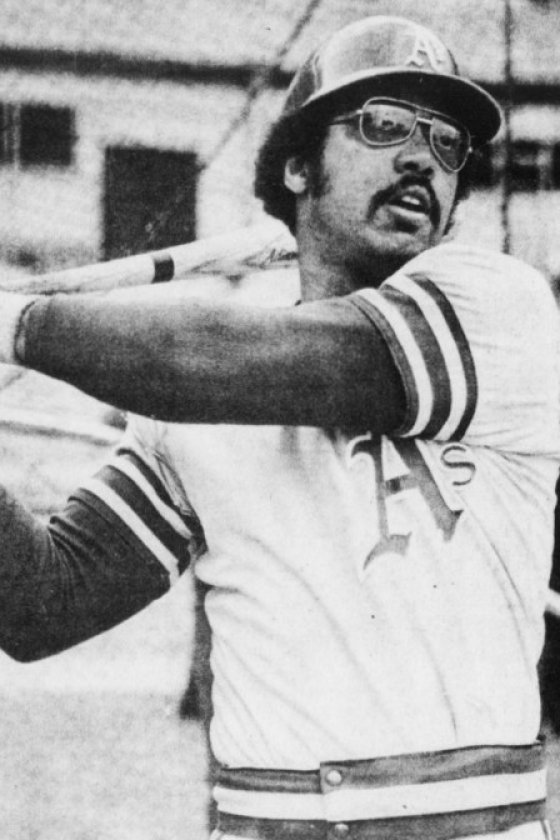
Player knowledge
Reggie Jackson
RF / DH 1967–1987 Hall of Fame
- Born
- May 18, 1946, in Abington, Pennsylvania
- Bats / Throws
- L/L
- Height / Weight
- 6'0", 195 lbs
- Hometown
- Wyncote, Pennsylvania
- High School
- Cheltenham High School
- Full Name
- Reginald Martinez Jackson
- Nicknames
- Mr. October; Jax and Buck in Oakland
- MLB Debut
- June 9, 1967, vs. Cleveland at Municipal Stadium, Kansas City
- Final Game
- October 4, 1987, at Comiskey Park, Chicago
- Uniform
- No. 44 (1977–1987), retired by the Yankees in 1993; No. 9 (1968–1976), retired by the A’s in 2004; No. 31 as a 1967 rookie
- 1977 World Series
- 5 HR, including three on three first pitches in Game 6
- Strikeouts
- 2,597, the most in major-league history
- Hall of Fame
- Class of 1993, first ballot, 93.6% of the vote
Test your knowledge
Reggie Jackson Quizzes
10 quizzes drawn from the story below. View the collection
The story
Bio
In 1976 Reggie Jackson announced that if he ever played in New York, they would name a candy bar after him. Two years later they did, and on the day it was handed out at Yankee Stadium, he homered. That was Reggie: brash, theatrical, and at his very best when the lights were brightest. He hit 563 home runs, won five World Series rings, and struck out more than any hitter who ever lived.
Reginald Martinez Jackson grew up in a Philadelphia suburb, starred at Arizona State, and went second overall in the 1966 draft. He won an MVP and three straight championships with Charlie Finley’s mustachioed Oakland A’s, spent one restless summer in Baltimore, and signed with the Yankees as one of baseball’s first big free agents. In the 1977 World Series he hit three home runs on three swings in the clinching game and became Mr. October forever. He finished with the Angels and back in Oakland, and went to Cooperstown on the first ballot.
Here is the whole story, from Wyncote to the Athletics, the Orioles, the Yankees, the Angels, and the Hall of Fame. When you’re done, see how much stuck with the Reggie Jackson Athletics quiz.
Reggie Jackson
Growing Up in Wyncote
Jackson was born May 18, 1946, in Abington, Pennsylvania, and grew up next door in Wyncote, a mostly white suburb just north of Philadelphia. His father, Martinez Jackson, ran a tailoring and dry-cleaning shop out of the two-story building where the family lived, and Reggie claimed for the rest of his life that he could still cuff a pair of slacks. Martinez had once played second base for the Newark Eagles of the Negro Leagues.
When Reggie was six, his parents split up. His mother, Clara, left with three of the children, and Reggie stayed in Wyncote with his father, in one of the few Black families in town.
At Cheltenham High School he starred in football, basketball, baseball, and track. As a junior tailback he cracked vertebrae in his neck, spent weeks in the hospital and in a neck cast, and was told he might never play again. He played anyway. Football powers came calling, and the hometown Phillies gave him a tryout and passed. Then, during his senior year, his father was arrested for making moonshine in the basement and went to jail. Reggie headed west to college without him.
Reggie Jackson
Sun Devil and the No. 2 Pick
Jackson went to Arizona State on a football scholarship, playing for the famously demanding coach Frank Kush. Baseball came almost by accident. He asked baseball coach Bobby Winkles for a look, and the next day, still in his football gear, he hit three home runs in five at-bats. Freshmen couldn’t play varsity then, so Winkles sent him to spend the summer with Leone’s, a Baltimore amateur club run by Orioles scout Walter Youse, to sharpen his raw skills.
In 1966, as a sophomore, he took over center field from Rick Monday, the first player ever chosen in the major-league draft. Jackson broke the school’s single-season home run record, made first-team All-American, and became the first college player to hit a ball out of Phoenix Municipal Stadium.
On June 7, 1966, the Kansas City Athletics took him with the second overall pick. The New York Mets, choosing first, took high school catcher Steve Chilcott, who never reached the majors. Jackson and his father, by then out of jail, hammered out a contract with A’s owner Charlie Finley at Finley’s farm in Indiana, the first of many tussles between the two.
He hit 21 home runs in 56 games for Modesto that summer, alongside future A’s mainstays Rollie Fingers, Joe Rudi, and Dave Duncan. In 1967 he moved up to the Double-A Birmingham A’s. Alabama was still deeply segregated, Jackson was one of the few Black players on the club, and he was turned away from restaurants and hotels. He always credited his manager, John McNamara, with helping a 21-year-old get through it.
Reggie Jackson
Kansas City, Oakland, and “Ruth Maris”
Jackson debuted on June 9, 1967, in a doubleheader against Cleveland at Kansas City’s Municipal Stadium. He went hitless in the opener and got his first big-league hit in the nightcap, a leadoff triple off Orlando Peña. His first home run came on September 17 at Anaheim. He batted just .178 in 35 games, and the demotion back to Birmingham stung.
Finley moved the club to Oakland for 1968, and Jackson became an everyday outfielder. He hit 29 homers and led the league with 171 strikeouts, the first of five strikeout titles. Nobody minded much, because of what came next.
By July 5, 1969, Jackson had 34 home runs and was running ahead of the record paces of both Babe Ruth and Roger Maris. He later joked that the writers had him dating a lady named “Ruth Maris.” On June 14 at Fenway Park he went 5-for-6 with two homers and 10 RBI in a 21–7 rout of the Red Sox. The attention wore him down. He hit just one home run in September and finished with 47, third behind Harmon Killebrew (49) and Frank Howard (48). He still led the league with 123 runs and a .608 slugging percentage, and 47 stood as his career high.
Reggie Jackson
Santurce and the Light Tower
Then 1970 went sideways. Jackson slumped early, Finley threatened to send him to the minors, and he finished at .237 with 23 homers. That winter he played for Santurce in Puerto Rico under manager Frank Robinson, who helped put his game and his life back in order. Jackson led the league in homers and RBI and came back steadier.
At the 1971 All-Star Game in Detroit’s Tiger Stadium, he pinch-hit against Pittsburgh’s Dock Ellis and launched a drive that was still climbing when it slammed into a transformer on a light tower atop the right-field roof. The American League won, 6–4. That fall Oakland won 101 games and the West Division, the franchise’s first title of any kind since the Philadelphia A’s of 1931. Jackson hit two homers in his first postseason series, but Baltimore swept.
Reggie Jackson
Mustaches and Hamstrings
Jackson reported to spring training in 1972 with a mustache. His teammates wanted him to shave it. Finley loved it, offered every player $300 to grow one, and staged a Mustache Day at the ballpark. The hairy, brawling, brilliant Mustache Gang was born.
In Game 5 of the ALCS at Detroit, with Jackson on third and Mike Epstein on first, manager Dick Williams called for a double steal. When catcher Bill Freehan threw to second, Jackson broke for home. He felt his hamstring tear about 20 feet from the plate and slid in anyway with the tying run. Oakland won, 2–1, and took the pennant, but Jackson was carried off the field with a torn hamstring. He watched the World Series on crutches as the A’s beat Cincinnati’s Big Red Machine in seven games, with Gene Tenace hitting four homers to win the Series MVP.
Reggie Jackson
1973: Most Valuable, Twice
In 1973 Williams moved him to right field for good, and Jackson had the season he had been promising. He led the American League with 32 home runs, 117 RBI, 99 runs, and a .531 slugging percentage, batted .293, stole 22 bases, and was the unanimous AL MVP.
October started badly. He hit just .143 in the ALCS, and it took a Game 5 shutout by Catfish Hunter to get past Baltimore. In the World Series against the New York Mets, Oakland trailed three games to two. In the third inning of Game 7, Bert Campaneris and then Jackson hit two-run homers off Jon Matlack, and the A’s won, 5–2, for back-to-back titles. Jackson hit .310 with six RBI and was named World Series MVP.
Finley ran his club on a shoestring; Jackson said each player got two caps and 24 bats to last the season. So the MVP took his owner to baseball’s new salary arbitration system and in February 1974 won $135,000, nearly double his 1973 salary of $70,000.
Reggie Jackson
Three Straight, Then Baltimore
The A’s fought each other almost as hard as their opponents. On June 5, 1974, in the visitors’ clubhouse at Tiger Stadium, Jackson and center fielder Bill North came to blows. Catcher Ray Fosse tried to break it up and suffered a neck injury that cost him three months. Oakland won the division anyway, beat Baltimore again in the ALCS, and met the Los Angeles Dodgers in the World Series. In the eighth inning of Game 5, Bill Buckner singled and raced for third when the ball got past North. Jackson, backing up the play, fired to Dick Green, whose relay to Sal Bando nailed Buckner. The A’s won, 3–2, for a third straight championship, something only the Yankees had done before.
That winter an arbitrator declared Catfish Hunter a free agent because Finley had missed a payment owed under his contract, and Hunter signed with New York. Jackson tied George Scott for the 1975 home run crown with 36, and Oakland won a fifth straight division title, but Boston swept the A’s in the ALCS even though Jackson hit .417.
With free agency on the way, Finley wasn’t going to pay him. On April 2, 1976, he traded Jackson and pitcher Ken Holtzman to Baltimore in a deal headlined by Don Baylor and Mike Torrez. Jackson, who called his Oakland years the best of his baseball life, refused to report without a new contract and didn’t play until May 2. He started slowly, then finished with 27 homers, a league-leading .502 slugging percentage, and a career-high 28 stolen bases. That June, a fire at his Oakland home destroyed his 1973 MVP trophy.
Reggie Jackson
The Straw That Stirs the Drink
On November 29, 1976, Jackson signed with George Steinbrenner’s Yankees for five years and $2.96 million. His old No. 9 belonged to Graig Nettles. He asked for No. 42 in memory of Jackie Robinson, but it went to pitching coach Art Fowler, so he took No. 44 as a tribute to Hank Aaron, who had just retired. He wore it for the rest of his career.
The trouble started before the season did. In a spring-training bar interview with SPORT magazine writer Robert Ward, published in June, Jackson was quoted calling himself “the straw that stirs the drink” and taking a shot at captain Thurman Munson. Jackson always said he had been misquoted and taken out of context. Munson’s teammates were not convinced.
On June 18, 1977, at Fenway Park, Jim Rice’s hit fell in front of Jackson in right field. Manager Billy Martin, convinced he had loafed, pulled him in the middle of the inning. In the dugout the two men screamed at each other, and Martin lunged before coaches Yogi Berra and Elston Howard held him back, all of it on national television. The Yankees patched it over, and Steinbrenner pushed Martin to bat Jackson cleanup. Jackson hit 13 homers with 49 RBI over his next 50 games, finished with 32 and 110, and New York won the East.
Reggie Jackson
Mr. October
Jackson slumped against Kansas City in the ALCS, and Martin benched him for the deciding Game 5. He came off the bench anyway to deliver a pinch-hit RBI single, and the Yankees rallied in the ninth for the pennant. In the World Series against the Dodgers, he homered in Game 4 and again in his last at-bat of Game 5, off Don Sutton.
Then came Game 6 at Yankee Stadium on October 18, 1977. In the second inning he walked on four pitches. In the fourth, with Munson aboard, he hit the first pitch from Burt Hooton into the right-field seats. In the fifth he lined the first pitch from Elías Sosa into the same area. In the eighth, with the crowd chanting “Reg-gie! Reg-gie!,” he drove the first pitch from knuckleballer Charlie Hough an estimated 475 feet into the center-field bleachers. Three swings, three home runs, and with his last swing of Game 5, four homers on four consecutive swings. The Yankees won, 8–4, for their first title since 1962.
Only Babe Ruth had ever hit three homers in a World Series game. Jackson’s five homers set a single-Series record, later tied by Chase Utley (2009) and George Springer (2017), and his 25 total bases broke Ruth’s Series record of 22. He became the first player to win World Series MVP with two teams. During the Series, Munson had told reporters to “go ask Mister October,” and now the name stuck for good. Even the other dugout was impressed. “When Reggie hit his third home run and I was sure nobody was looking,” Dodgers first baseman Steve Garvey said, “I applauded in my glove.”
Reggie Jackson
The Bronx Zoo
At the 1978 home opener on April 13, fans were handed the brand-new Reggie! bar, a round lump of peanuts, caramel, and chocolate. Jackson homered, and when he went back out to right field, the fans showered the field with candy bars.
The rest of the summer was chaos. On July 17 Jackson kept bunting against Martin’s orders and was suspended. On July 23 Martin said of Jackson and Steinbrenner, “One’s a born liar, the other’s convicted,” a reference to Steinbrenner’s guilty plea over illegal campaign contributions. Martin resigned the next day, and Bob Lemon took over a team that had been 14 games behind Boston on July 18. The Yankees caught the Red Sox, and in the one-game playoff at Fenway on October 2, Bucky Dent hit the famous three-run homer in the seventh. Jackson’s homer in the eighth provided the fifth run in a 5–4 win.
He hit .462 in the ALCS, including a homer off Al Hrabosky. In Game 2 of the World Series, rookie Bob Welch struck him out with two men on to end the game, a duel that left the Yankees down two games to none. In Game 4 a relay throw caromed off Jackson’s hip on the basepaths, the Dodgers screamed interference, and the run counted. In Game 6 he got his revenge with a two-run homer off Welch, and the Yankees won, 7–2, for back-to-back titles.
Munson died in a plane crash on August 2, 1979; Jackson had long since made peace with him and had flown with him days earlier. In 1980 Jackson batted .300 for the only time in his career, tied Ben Oglivie for the home run lead with 41, and finished second to George Brett in the MVP vote. In the strike year of 1981, Steinbrenner ordered him to take a full physical, and Jackson answered with an upper-deck homer in Game 5 of the Division Series. He was hurt in the ALCS, missed the first three games of the World Series, homered in Game 4, and watched the Dodgers win in six. His Yankees contract was up.
Reggie Jackson
Anaheim, No. 500, and One Last Lap
Wanting to get back to California, Jackson signed a five-year deal with Gene Autry’s California Angels. On April 27, 1982, in his first game back at Yankee Stadium, he broke out of an early slump with a homer off his old teammate Ron Guidry as the crowd chanted his name and then turned its anger on Steinbrenner. Steinbrenner later called letting him go his biggest mistake as an owner. Jackson tied Gorman Thomas for the league lead with 39 homers, the Angels won the West, and they lost the ALCS to Milwaukee after taking the first two games.
In 1983, at 37, he hit just .194, the worst season of his career. He bounced back, and on September 17, 1984, at Anaheim Stadium, he hit his 500th home run off Kansas City’s Bud Black, 17 years to the day after his first. He was the 13th member of the 500 club. In 1986 he passed Mickey Mantle’s 536 for sixth place on the all-time list, and the Angels came within one strike of the pennant in Game 5 of the ALCS before Boston won in seven.
For 1987 he went home to Oakland on a one-year deal, wearing No. 44 because Mike Gallego had No. 9. Rookie Mark McGwire hit 49 homers that year, and ballparks around the league held Reggie Jackson days for the 41-year-old. His final game came on October 4, 1987, at Comiskey Park in Chicago: 2-for-3 with a double and an RBI in a 5–2 loss. He was the last active player who had suited up for the Kansas City A’s.
Reggie Jackson
Cooperstown and Beyond
On January 5, 1993, Jackson was elected to the Hall of Fame on the first ballot, named on 396 of 423 ballots (93.6 percent). His plaque shows him in a Yankees cap. That August 14 the Yankees retired his No. 44, and on May 22, 2004, the A’s retired his No. 9, making him one of the few players with different numbers retired by two teams. The Yankees dedicated his plaque in Monument Park in 2002, with Willie Mays, Hank Aaron, and Ernie Banks there at his invitation, and the A’s put him in their team Hall of Fame in 2018.
He spent years as a special advisor to the Yankees, then served the Houston Astros in the same role from 2021 to 2024. Along the way he built a business in classic cars and car dealerships and kept popping up on screen, most memorably in The Naked Gun (1988) as an Angels outfielder hypnotized into trying to assassinate Queen Elizabeth II. In 1991 the Oakland hills firestorm burned his home again and destroyed more of his memorabilia.
Reggie Jackson
Records and Honors
- 563 home runs: sixth on the all-time list when he retired
- 2,597 strikeouts: the most in major-league history
- 1973 AL MVP, by unanimous vote
- Two World Series MVPs (1973 A’s, 1977 Yankees): the first player to win it with two teams
- Five World Series titles (1972, 1973, 1974, 1977, 1978), six pennants, and 11 trips to the postseason
- 10 home runs, 24 RBI, and a .357 average in 27 World Series games, with a .755 slugging percentage
- Five home runs in the 1977 World Series: a single-Series record, since tied by Chase Utley and George Springer
- Four home run titles (1973, 1975, 1980, 1982), the 1973 RBI title, and three slugging titles (1969, 1973, 1976)
- 14 All-Star selections and two Silver Slugger Awards (1980, 1982)
- The first player to hit 100 home runs for three clubs: 269 for the A’s, 144 for the Yankees, 123 for the Angels
- Hall of Fame class of 1993; No. 44 retired by the Yankees (1993) and No. 9 by the A’s (2004)
Reggie Jackson
Mr. October Fun Facts
- He struck out 2,597 times and had 2,584 hits, exactly 13 more strikeouts than hits.
- For all that power, he never hit 30 or more homers in back-to-back seasons.
- He wore three numbers: No. 31 as a 1967 rookie, No. 9 for the A’s and Orioles, and No. 44 from 1977 on.
- His 500th home run came on September 17, 1984, exactly 17 years after his first.
- The Reggie! bar was a reworked version of a candy first sold as the Wayne Bun, made in Fort Wayne, Indiana.
- All three of his Game 6 home runs in 1977 came on the first pitch he saw.
- He is a distant cousin of Barry Bonds.
- When he retired in 1987, he was the last active player who had played for the Kansas City Athletics.
Think you know Mr. October now? Prove it with all ten quizzes in the Reggie Jackson collection, take the Reggie Jackson Athletics quiz, compare notes with the Yankee legends on the Mickey Mantle, Babe Ruth, and Yogi Berra pages, or browse the full Oakland Athletics, New York Yankees, Los Angeles Angels, and Baltimore Orioles quiz collections.
The postseason
October Accolades
| Year | Series | Result | G | H-AB | BA | HR | RBI |
|---|---|---|---|---|---|---|---|
| 1971 | ALCS | Orioles def. Athletics, 3–0 Two home runs in his first postseason, but Baltimore swept | 3 | 4-12 | .333 | 2 | 2 |
| 1972 | ALCS | Athletics def. Tigers, 3–2 Scored the tying run on a double steal in Game 5 and tore his hamstring; missed the World Series | 5 | 5-18 | .278 | 0 | 2 |
| 1973 | ALCS | Athletics def. Orioles, 3–2 Held to .143; Catfish Hunter’s Game 5 shutout won the pennant | 5 | 3-21 | .143 | 0 | 0 |
| 1973 | World Series | Athletics def. Mets, 4–3 World Series MVP; two-run homer off Jon Matlack in Game 7 | 7 | 9-29 | .310 | 1 | 6 |
| 1974 | ALCS | Athletics def. Orioles, 3–1 Walked five times as Oakland won a third straight pennant | 4 | 2-12 | .167 | 0 | 1 |
| 1974 | World Series | Athletics def. Dodgers, 4–1 Homered in Game 1; his relay helped cut down Bill Buckner at third in the Game 5 clincher | 5 | 4-14 | .286 | 1 | 1 |
| 1975 | ALCS | Red Sox def. Athletics, 3–0 Hit .417, but Boston swept | 3 | 5-12 | .417 | 1 | 3 |
| 1977 | ALCS | Yankees def. Royals, 3–2 Benched for Game 5, he delivered a pinch-hit RBI single | 5 | 2-16 | .125 | 0 | 1 |
| 1977 | World Series | Yankees def. Dodgers, 4–2 Mr. October: three first-pitch homers in Game 6 and a record-tying five in the Series | 6 | 9-20 | .450 | 5 | 8 |
| 1978 | ALCS | Yankees def. Royals, 3–1 Hit .462 and homered off Al Hrabosky in Game 1 | 4 | 6-13 | .462 | 2 | 6 |
| 1978 | World Series | Yankees def. Dodgers, 4–2 Struck out by Bob Welch to end Game 2, then homered off him in the Game 6 clincher | 6 | 9-23 | .391 | 2 | 8 |
| 1980 | ALCS | Royals def. Yankees, 3–0 Kansas City swept the Yankees | 3 | 3-11 | .273 | 0 | 0 |
| 1981 | ALDS | Yankees def. Brewers, 3–2 Upper-deck homer in the deciding Game 5 | 5 | 6-20 | .300 | 2 | 4 |
| 1981 | ALCS | Yankees def. Athletics, 3–0 Hurt running the bases in Game 2 against his old team | 2 | 0-4 | .000 | 0 | 1 |
| 1981 | World Series | Dodgers def. Yankees, 4–2 Missed the first three games, then homered in Game 4 | 3 | 4-12 | .333 | 1 | 1 |
| 1982 | ALCS | Brewers def. Angels, 3–2 California won the first two games and lost the next three | 5 | 2-18 | .111 | 1 | 2 |
| 1986 | ALCS | Red Sox def. Angels, 4–3 The Angels were one strike from the pennant in Game 5 | 6 | 5-26 | .192 | 0 | 2 |
| Postseason | 17 series | 77 | 78-281 | .278 | 18 | 48 | |
The clubs
Teams
-
Oakland Athletics
1967–1975, 1987
Kansas City 1967, Oakland 1968–75 and ’87 · 269 HR, the 1973 MVP, and three straight World Series titles
-
New York Yankees
1977–1981
Became Mr. October with three homers in Game 6 of 1977 and won back-to-back titles
-
Los Angeles Angels
1982–1986
California Angels · a share of the 1982 home run crown, No. 500, and two AL West titles
-
Baltimore Orioles
1976
One summer in Baltimore: 27 HR, a career-high 28 steals, and the AL slugging title
The numbers
Season Stats
| Season | Team | League | WAR | Games | PA | AB | Runs | Hits | RBI | 2B | 3B | HR | SB | BB | BA | OBP | SLG | OPS |
|---|---|---|---|---|---|---|---|---|---|---|---|---|---|---|---|---|---|---|
| 1967 | Kansas City Athletics | AL | -0.5 | 35 | 135 | 118 | 13 | 21 | 6 | 4 | 4 | 1 | 1 | 10 | .178 | .269 | .305 | .574 |
| 1968 | Oakland Athletics | AL | 5.2 | 154 | 614 | 553 | 82 | 138 | 74 | 13 | 6 | 29 | 14 | 50 | .250 | .316 | .452 | .768 |
| 1969 | Oakland Athletics | AL | 9.3 | 152 | 678 | 549 | 123 | 151 | 118 | 36 | 3 | 47 | 13 | 114 | .275 | .410 | .608 | 1.018 |
| 1970 | Oakland Athletics | AL | 2.2 | 149 | 514 | 426 | 57 | 101 | 66 | 21 | 2 | 23 | 26 | 75 | .237 | .359 | .458 | .817 |
| 1971 | Oakland Athletics | AL | 6.4 | 150 | 642 | 567 | 87 | 157 | 80 | 29 | 3 | 32 | 16 | 63 | .277 | .352 | .508 | .860 |
| 1972 | Oakland Athletics | AL | 5.6 | 135 | 573 | 499 | 72 | 132 | 75 | 25 | 2 | 25 | 9 | 59 | .265 | .350 | .473 | .823 |
| 1973 | Oakland Athletics | AL | 7.8 | 151 | 629 | 539 | 99 | 158 | 117 | 28 | 2 | 32 | 22 | 76 | .293 | .383 | .531 | .914 |
| 1974 | Oakland Athletics | AL | 5.7 | 148 | 604 | 506 | 90 | 146 | 93 | 25 | 1 | 29 | 25 | 86 | .289 | .391 | .514 | .905 |
| 1975 | Oakland Athletics | AL | 6.7 | 157 | 669 | 593 | 91 | 150 | 104 | 39 | 3 | 36 | 17 | 67 | .253 | .329 | .511 | .840 |
| 1976 | Baltimore Orioles | AL | 5.3 | 134 | 558 | 498 | 84 | 138 | 91 | 27 | 2 | 27 | 28 | 54 | .277 | .351 | .502 | .853 |
| 1977 | New York Yankees | AL | 4.5 | 146 | 606 | 525 | 93 | 150 | 110 | 39 | 2 | 32 | 17 | 74 | .286 | .375 | .550 | .925 |
| 1978 | New York Yankees | AL | 3.5 | 139 | 581 | 511 | 82 | 140 | 97 | 13 | 5 | 27 | 14 | 58 | .274 | .356 | .477 | .834 |
| 1979 | New York Yankees | AL | 3.5 | 131 | 537 | 465 | 78 | 138 | 89 | 24 | 2 | 29 | 9 | 65 | .297 | .382 | .544 | .926 |
| 1980 | New York Yankees | AL | 4.8 | 143 | 601 | 514 | 94 | 154 | 111 | 22 | 4 | 41 | 1 | 83 | .300 | .398 | .597 | .995 |
| 1981 | New York Yankees | AL | 1.0 | 94 | 382 | 334 | 33 | 79 | 54 | 17 | 1 | 15 | 0 | 46 | .237 | .330 | .428 | .758 |
| 1982 | California Angels | AL | 3.1 | 153 | 621 | 530 | 92 | 146 | 101 | 17 | 1 | 39 | 4 | 85 | .275 | .375 | .532 | .907 |
| 1983 | California Angels | AL | -1.8 | 116 | 458 | 397 | 43 | 77 | 49 | 14 | 1 | 14 | 0 | 52 | .194 | .290 | .340 | .630 |
| 1984 | California Angels | AL | -0.2 | 143 | 584 | 525 | 67 | 117 | 81 | 17 | 2 | 25 | 8 | 55 | .223 | .300 | .406 | .706 |
| 1985 | California Angels | AL | 1.1 | 143 | 541 | 460 | 64 | 116 | 85 | 27 | 0 | 27 | 1 | 78 | .252 | .360 | .487 | .847 |
| 1986 | California Angels | AL | 1.2 | 132 | 517 | 419 | 65 | 101 | 58 | 12 | 2 | 18 | 1 | 92 | .241 | .379 | .408 | .787 |
| 1987 | Oakland Athletics | AL | -0.4 | 115 | 374 | 336 | 42 | 74 | 43 | 14 | 1 | 15 | 2 | 33 | .220 | .297 | .402 | .699 |
| Career | 21 seasons | AL | 74.0 | 2,820 | 11,418 | 9,864 | 1,551 | 2,584 | 1,702 | 463 | 49 | 563 | 228 | 1,375 | .262 | .356 | .490 | .846 |