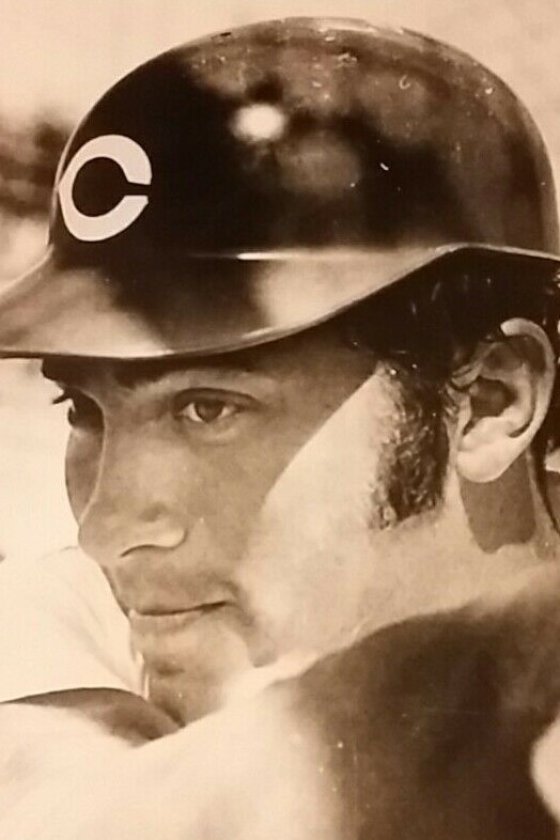
Player knowledge
Johnny Bench
C 1967–1983 Hall of Fame
- Born
- December 7, 1947, in Oklahoma City, Oklahoma
- Bats / Throws
- R/R
- Height / Weight
- 6'1", 197 lbs
- Hometown
- Binger, Oklahoma
- High School
- Binger High School
- Full Name
- Johnny Lee Bench
- Nickname
- The Little General
- MLB Debut
- August 28, 1967, vs. Philadelphia (Crosley Field)
- Final Game
- September 29, 1983, vs. San Francisco (Riverfront Stadium)
- Uniform
- No. 5 (1967–1983), retired by the Reds in 1984
- Gold Gloves
- 10 in a row at catcher (1968–1977)
- Games Caught
- 1,742, with 100 or more in 13 straight seasons (1968–1980)
- Hall of Fame
- Class of 1989, first ballot, 96.4% of the vote
The story
Bio
Johnny Bench changed what a catcher could be. He caught with one hand, tucked the other safely behind his back, and threw out base runners with an arm one writer compared to a recoilless rifle. He also hit 45 home runs and drove in 148 runs in a single season, numbers nobody expected from the man behind the mask. For a decade he was the heartbeat of the Big Red Machine, and most experts still call him the greatest catcher who ever lived.
Johnny Lee Bench grew up in the tiny farm town of Binger, Oklahoma, where his father told him catching was the fastest road to the majors. The Reds drafted him at 17 and made him their starting catcher at 20. He won Rookie of the Year, two MVP awards, and 10 straight Gold Gloves. He came back from lung surgery, won two World Series, and was named MVP of the second one. When catching finally wore him down, he moved to the infield, homered on his own night in Cincinnati, and went into Cooperstown on the first ballot with 96.4 percent of the vote.
Here is the whole story, from the ballfields of Binger to Crosley Field, Riverfront Stadium, and Cooperstown. He spent all 17 of his big-league seasons with the Cincinnati Reds. When you’re done, see how much stuck with the Johnny Bench Reds quiz.
Johnny Bench
The Kid from Binger
Bench was born December 7, 1947, in Oklahoma City, the son of Ted and Katy Bench. Ted drove a truck. When Johnny was about five, the family settled in Binger, a farm town roughly 60 miles west of the city. He had two older brothers, Teddy and William, and a younger sister, Marilyn. The boys played with balls and bats held together with electrical tape.
Ted had played ball in high school and in the Army, and he poured his dreams into his sons. He started a boys’ team when Johnny was six, bought the uniforms, and drove the players to games in his truck. He put Johnny behind the plate right away. Catching, he told his son, was the quickest way to the big leagues. Johnny’s hero was another Oklahoman, Mickey Mantle. By second grade he was telling his teacher he would be a major leaguer, and soon he was practicing his autograph to be ready.
At Binger High School he made All-State in both baseball and basketball and graduated as class valedictorian. He also picked cotton, worked in the peanut fields, and mowed lawns. Then came a day he never forgot. The bus carrying his baseball team lost its brakes and rolled down a 50-foot ravine. Two of his friends and teammates were killed. Bench was knocked unconscious but otherwise escaped unhurt.
Johnny Bench
Drafted at Seventeen
In June 1965, baseball held its first draft of amateur players, and the Reds took Bench in the second round, 36th overall. He thought about a college scholarship, then signed with Reds scout Tony Robello for $6,000 plus college tuition. Playing for Tampa in the Florida State League, he hit .248 with two homers and drew strong reviews for his defense.
In 1966 the Reds sent the 18-year-old to the Peninsula Grays of the Class A Carolina League in Hampton, Virginia. He hit .294 with 22 home runs and was named the league’s Player of the Year. Before he left for Triple-A, Peninsula retired his uniform number, 8. His first stay in Buffalo lasted about an inning. A foul tip broke his right thumb and ended his season. Driving home to Oklahoma in the Ford Fairlane he had bought with his bonus money, he was hit by a drunk driver and needed 27 stitches in his scalp.
He went back to Buffalo in 1967, still just 19, and hit .259 with 23 home runs on a club full of former big-leaguers in their 30s. His roommate, Steve Boros, taught him how to stay focused away from home. One of his homers that summer was a grand slam off Rochester’s Jim Palmer, a future Hall of Famer who would never give up a grand slam in the majors. After the season The Sporting News named Bench its Minor League Player of the Year.
Johnny Bench
A Rookie in Charge
The Reds called him up in late August 1967. He debuted on August 28 against the Phillies at Crosley Field and got his first hit two days later off Chris Short. He batted only .163 in 26 games, but Cincinnati had seen enough. That winter the club traded its All-Star catcher, Johnny Edwards, to St. Louis to clear the way. Early in Bench’s career, as the story is usually told, Ted Williams signed a baseball for him with a prediction: “Hall of Famer for sure.”
The kid acted like he owned the place. At 19 he walked out and told veteran shortstop Leo Cárdenas where to stand. Cárdenas yelled at him and stayed put. At 20 he told staff ace Jim Maloney to bear down. Maloney glared, and manager Dave Bristol waved Bench back behind the plate, then turned to the pitcher and said, “You know, he’s right.” Maloney came around. “So help me, this kid coaches me,” he said. “And I like it.” The nickname that stuck was the Little General.
In 1968 Bench caught 154 games, a record for a rookie catcher, and hit .275 with 15 homers, 82 RBI, and 40 doubles. He made his first All-Star team and became the first catcher ever named Rookie of the Year, edging the Mets’ Jerry Koosman by a single vote, 10½ to 9½. He was also the first rookie catcher to win a Gold Glove.
Johnny Bench
One Hand, Seven Baseballs
Bench’s hands were enormous. He could palm a basketball in high school and hold seven baseballs in his right hand, a trick photographers loved. Behind the plate he used them in a new way. Most catchers of the day wore a round, pillow-style mitt and caught with two hands. Bench wore a hinged mitt that folded shut around the ball, caught with his glove hand alone, and kept his throwing hand tucked behind his back, safe from foul tips. After the broken thumb in Buffalo, he had good reason.
He did not invent the style. Cubs catcher Randy Hundley introduced the hinged mitt. Bench made it famous, and within a few years young catchers everywhere were copying him. Scooping pitches in the dirt with one hand instead of dropping to both knees became part of his signature, too.
Then there was the arm. Writer Roy Blount Jr. said it worked “like a recoilless rifle.” Bench led the league in caught-stealing percentage three times and won the Gold Glove in each of his first 10 seasons, 1968 through 1977. On April 30, 1969, he caught Jim Maloney’s no-hitter against Houston.
Johnny Bench
MVP at 22
In 1969 Bench hit .293 with 26 homers and 90 RBI and started his first All-Star Game. He homered at RFK Stadium in Washington before Carl Yastrzemski robbed him of a second with a leaping catch at the wall. After the season the Reds hired a new manager, Sparky Anderson, and the Big Red Machine started to roll.
1970 was his masterpiece. The Reds moved into Riverfront Stadium on June 30 and won 102 games. On July 26, playing left field to rest his legs, Bench homered three times off the Cardinals’ Steve Carlton. He led the majors with 45 home runs and 148 RBI and won the NL MVP in a landslide, with 22 of the 24 first-place votes. He was 22 years old.
The Reds swept the Pirates in the NLCS, with Bench homering in the clincher, then lost the World Series to Baltimore in five games. That winter he seemed to be everywhere. He toured Vietnam with Bob Hope’s USO show, golfed with Arnold Palmer, sang on talk shows, appeared on Mission: Impossible, and hosted his own weekly TV show in Cincinnati.
Johnny Bench
The Big Red Machine
1971 was a step back. The Reds fell to fourth place, and Bench hit .238 with 27 homers and just 61 RBI. Then Cincinnati traded for second baseman Joe Morgan, and the machine was complete. Bench, Morgan, Tony Pérez, and Pete Rose became the core of a lineup that would win three pennants in five years.
In 1972 Bench led the league again with 40 homers and 125 RBI, drew 100 walks, and won his second MVP. In Game 5 of the NLCS, the Reds trailed Pittsburgh 3–2 going to the bottom of the ninth. Bench led off against reliever Dave Giusti and drove an opposite-field homer over the right-field wall to tie it. Later that inning a wild pitch by Bob Moose brought home George Foster with the pennant.
The World Series against Oakland gave him a moment he’d rather forget. In Game 3, with runners on second and third and a full count, A’s manager Dick Williams walked to the mound and pointed to first base. Catcher Gene Tenace stood and held out his arm for an intentional ball, then crouched back down as Rollie Fingers threw a slider over the outside corner. Bench took it for strike three. The Reds still won that game, 1–0, but Oakland won the Series in seven.
Johnny Bench
The Spot on His Lung
Late in the 1972 season, a routine physical turned up a growth on Bench’s lung that doctors could not identify. He told only close friends and the Reds’ front office and played through the pennant race and the World Series with the worry hanging over him. In December 1972 surgeons made a long incision under his right arm, broke a rib to get inside, and removed the growth. It was a benign lesion, most likely caused by breathing in a fungus.
The news was good, but the price was real. “They cut the ribs, they cut the bones, they cut the nerves,” Bench said years later, “and so I never was the same player afterwards.” He never hit 40 home runs in a season again.
He was still very good. In 1973 he drove in 104 runs for a team that won 99 games. In Game 1 of the NLCS against the Mets, Rose tied the score with an eighth-inning homer off Tom Seaver, and Bench won it 2–1 with a walk-off homer off Seaver in the ninth. New York, an 82-win team, took the series in five games anyway. In 1974 Bench scored 108 runs and led the league with 129 RBI, but the Reds finished four games behind the Dodgers.
Johnny Bench
Champions at Last
In February 1975 Bench married Vickie Chesser, a model and former Miss South Carolina USA, after a whirlwind courtship. The tabloids followed every turn. The couple separated by the end of the season and divorced the next year.
On the field, he hurt his shoulder in a collision at the plate in April and played through the pain, hitting .283 with 28 homers and 110 RBI. The Reds won 108 games, swept the Pirates, and met the Boston Red Sox in a World Series still ranked among the best ever played.
Bench left his fingerprints all over it. In Game 2 at Fenway Park, with Cincinnati trailing 2–1 in the ninth, he led off with a double to right off Bill Lee and later scored the tying run. Ken Griffey’s double won it. In Game 3 he hit a two-run homer off Rick Wise. The Reds won Game 7, 4–3, and when reliever Will McEnaney got the final out, Bench wrapped him in a hug that landed on the cover of Sports Illustrated.
Johnny Bench
The 1976 Sweep
Back spasms and a sore shoulder made 1976 the worst season of his prime: .234, 16 homers, 74 RBI. The Reds won 102 games anyway. Then October arrived, and Bench came alive. In Game 3 of the NLCS, Cincinnati trailed the Phillies 6–4 in the bottom of the ninth when George Foster and Bench hit back-to-back homers off Ron Reed to tie it. Griffey’s single later won the pennant.
The World Series against the Yankees turned into a duel of catchers. New York’s Thurman Munson hit .529. Bench hit .533, with two hits in every game. In Game 4 at Yankee Stadium he slugged a two-run homer and a three-run homer to finish the sweep, 7–2. He was named World Series MVP, only the second catcher to win the award, and the Reds went 7–0 that October.
Asked afterward to compare Munson with his own catcher, Sparky Anderson didn’t hesitate. “I don’t want to embarrass any other catchers by comparing him with Johnny Bench,” he said.
Johnny Bench
The Toll of Catching
Bench bounced back in 1977 with 31 homers, 109 RBI, and his 10th straight Gold Glove. Then the machine came apart. Pérez had already been traded, Anderson was fired after 1978, Rose left as a free agent, and Morgan was gone after 1979. Bench stayed. After the 1977 season he signed a five-year contract for $400,000 a year, less than he might have gotten elsewhere.
Every day behind the plate cost him something. He broke his thumb twice, battled back and shoulder trouble from collisions, and after his playing days needed both hips replaced. “Are there times I wish I hadn’t caught? Sure,” he said. “But then I wouldn’t have been Johnny Bench.”
He still had milestones left. On August 22, 1979, he hit his 325th homer, passing Frank Robinson for the Reds’ franchise record. That fall he homered off Bert Blyleven in his last postseason series, a three-game NLCS loss to Pittsburgh. He homered in nine of the 10 postseason series he played. On July 15, 1980, against Montreal at Riverfront, he hit his 314th home run as a catcher, breaking Yogi Berra’s record. He leaped as he left the batter’s box, kissed his mother in the stands, and got a 90-second standing ovation. Berra sent a telegram the next day: “I always thought the record would stand until it was broken.”
Johnny Bench
Leaving the Plate
1980 was his last season as the regular catcher, and he still hit 24 homers in 114 games. Over his final three seasons he caught only 13 more games. In the strike-shortened 1981 season he played mostly first base and hit .309 in 52 games. In 1982 the Reds made him their everyday third baseman, a hard switch at 34, and the team lost 101 games.
He announced that 1983 would be his final season and spent the summer taking bows in National League parks. On September 17, 1983, the Reds held Johnny Bench Night at Riverfront Stadium in front of 53,790 fans. In the third inning he lined a two-run homer to left off Houston’s Mike Madden. It was the 389th and last of his career.
His final at-bat came on September 29, 1983, at home against the Giants. He pinch-hit and singled home two runs off Mark Calvert. Gary Redus came in to run for him, and the career was over.
Johnny Bench
Cooperstown and Beyond
Bench never really left the game. In 1982 he had started hosting The Baseball Bunch, a syndicated kids’ show that taught the fundamentals with big-league guests, the San Diego Chicken, and Tommy Lasorda as “the Dugout Wizard.” He called games for ABC in 1986 and worked World Series broadcasts on CBS Radio with Jack Buck and Vin Scully. The Reds retired his No. 5 on August 11, 1984, and put him in their own Hall of Fame in 1986.
On January 9, 1989, he was elected to the National Baseball Hall of Fame on his first ballot, named on 431 of 447 ballots. His 96.4 percent was the third-highest share in history at the time. He went in that summer alongside Carl Yastrzemski, a rival from the 1975 World Series. In 1999 fans voted him the top catcher on baseball’s All-Century Team. On September 17, 2011, the Reds unveiled a bronze statue by Tom Tsuchiya at Great American Ball Park that shows him throwing out a base runner. Bench called it his greatest moment.
Since 2000 his name has also been on the Johnny Bench Award. It began in Wichita, Kansas, as an honor for the top catcher in Division I college baseball. In 2019 it moved to the Reds Hall of Fame in Cincinnati and grew to include college softball catchers and the best high school catchers in Ohio, Kentucky, Indiana, and West Virginia. The original Wichita award carries on as the Buster Posey Award. Bench-award winners since the move include Adley Rutschman and Reese Atwood.
Not every headline was kind. On July 15, 2023, at a Reds Hall of Fame event honoring former general manager Gabe Paul, who was Jewish, Bench made an antisemitic remark with Paul’s daughter in the audience. He apologized publicly soon after. Away from the ballpark he has played celebrity and Senior PGA Tour golf events, married for the fifth time in 2024, and raised three sons. As of 2026 he remains a familiar face around the Reds, from the Opening Day parade to the Johnny Bench Awards luncheon at Great American Ball Park each summer.
Johnny Bench
Records and Honors
- 2 NL MVP awards (1970, 1972)
- 1968 NL Rookie of the Year: the first catcher to win the award
- 10 consecutive Gold Gloves (1968–1977)
- 14 All-Star selections
- 1976 World Series MVP and two World Series titles (1975, 1976)
- 389 home runs and 1,376 RBI: both Reds franchise records
- Led the NL in home runs twice (1970, 1972) and in RBI three times (1970, 1972, 1974)
- 1,742 games caught, with 100 or more in 13 straight seasons (1968–1980)
- Retired as the career home run leader among catchers
- 75.1 career WAR, per Baseball-Reference
- National Baseball Hall of Fame, class of 1989 (first ballot, 96.4%)
- No. 5 retired by the Reds (1984), Reds Hall of Fame (1986), and MLB All-Century Team (1999)
Johnny Bench
Johnny Bench Fun Facts
- He could hold seven baseballs in his right hand at once.
- He graduated as valedictorian of his class at Binger High School.
- His Class A team, the Peninsula Grays, retired his No. 8 after a single season.
- All three of his homers on July 26, 1970, came off Steve Carlton, and he hit them while playing left field.
- He homered in nine of the 10 postseason series he played.
- In 1973, while still an active player, he made a cameo as a poolside waiter on The Partridge Family.
- In 1985 he starred as Joe Hardy in a Cincinnati stage production of Damn Yankees.
- After turning 50 he played in several events on the Senior PGA Tour.
Think you know the Little General now? Prove it with all ten quizzes in the Johnny Bench collection, take the Johnny Bench Reds quiz, catch up with his Big Red Machine teammate on the Pete Rose page, compare him with another all-time great catcher on the Yogi Berra page, or browse the full Cincinnati Reds quiz collection.
The postseason
October Accolades
| Year | Series | Result | G | H-AB | BA | HR | RBI |
|---|---|---|---|---|---|---|---|
| 1970 | NLCS | Reds def. Pirates, 3–0 Went back-to-back with Tony Pérez off Bob Moose in the first inning of the Game 3 clincher | 3 | 2-9 | .222 | 1 | 1 |
| 1970 | World Series | Orioles def. Reds, 4–1 Homered off Moe Drabowsky in Game 2, but Baltimore won in five | 5 | 4-19 | .211 | 1 | 3 |
| 1972 | NLCS | Reds def. Pirates, 3–2 His leadoff homer off Dave Giusti tied Game 5 in the ninth; a wild pitch won the pennant | 5 | 6-18 | .333 | 1 | 2 |
| 1972 | World Series | Athletics def. Reds, 4–3 Fooled by the fake intentional walk in Game 3; homered off Vida Blue in Game 6 | 7 | 6-23 | .261 | 1 | 1 |
| 1973 | NLCS | Mets def. Reds, 3–2 His walk-off homer off Tom Seaver won Game 1, 2–1 | 5 | 5-19 | .263 | 1 | 1 |
| 1975 | NLCS | Reds def. Pirates, 3–0 Just one hit, but the Reds swept their way to the World Series | 3 | 1-13 | .077 | 0 | 0 |
| 1975 | World Series | Reds def. Red Sox, 4–3 His leadoff double sparked the ninth-inning comeback in Game 2; two-run homer off Rick Wise in Game 3 | 7 | 6-29 | .207 | 1 | 4 |
| 1976 | NLCS | Reds def. Phillies, 3–0 Went back-to-back with George Foster off Ron Reed to tie the ninth inning of the Game 3 clincher | 3 | 4-12 | .333 | 1 | 1 |
| 1976 | World Series | Reds def. Yankees, 4–0 World Series MVP; hit .533 and homered twice with five RBI in the Game 4 clincher | 4 | 8-15 | .533 | 2 | 6 |
| 1979 | NLCS | Pirates def. Reds, 3–0 Homered off Bert Blyleven in Game 3 of his final postseason series | 3 | 3-12 | .250 | 1 | 1 |
| Postseason | 10 series | 45 | 45-169 | .266 | 10 | 20 | |
The clubs
Teams
-
Cincinnati Reds
1967–1983
Two MVPs, 10 straight Gold Gloves, the 1975 and 1976 titles, 389 HR, and No. 5 retired
The numbers
Season Stats
| Season | Team | League | WAR | Games | PA | AB | Runs | Hits | RBI | 2B | 3B | HR | SB | BB | BA | OBP | SLG | OPS |
|---|---|---|---|---|---|---|---|---|---|---|---|---|---|---|---|---|---|---|
| 1967 | Cincinnati Reds | NL | -0.5 | 26 | 93 | 86 | 7 | 14 | 6 | 3 | 1 | 1 | 0 | 5 | .163 | .207 | .256 | .462 |
| 1968 | Cincinnati Reds | NL | 5.0 | 154 | 607 | 564 | 67 | 155 | 82 | 40 | 2 | 15 | 1 | 31 | .275 | .311 | .433 | .743 |
| 1969 | Cincinnati Reds | NL | 6.2 | 148 | 592 | 532 | 83 | 156 | 90 | 23 | 1 | 26 | 6 | 49 | .293 | .353 | .487 | .840 |
| 1970 | Cincinnati Reds | NL | 7.4 | 158 | 671 | 605 | 97 | 177 | 148 | 35 | 4 | 45 | 5 | 54 | .293 | .345 | .587 | .932 |
| 1971 | Cincinnati Reds | NL | 4.0 | 149 | 613 | 562 | 80 | 134 | 61 | 19 | 2 | 27 | 2 | 49 | .238 | .299 | .423 | .722 |
| 1972 | Cincinnati Reds | NL | 8.6 | 147 | 653 | 538 | 87 | 145 | 125 | 22 | 2 | 40 | 6 | 100 | .270 | .379 | .541 | .920 |
| 1973 | Cincinnati Reds | NL | 4.7 | 152 | 651 | 557 | 83 | 141 | 104 | 17 | 3 | 25 | 4 | 83 | .253 | .345 | .429 | .774 |
| 1974 | Cincinnati Reds | NL | 7.9 | 160 | 708 | 621 | 108 | 174 | 129 | 38 | 2 | 33 | 5 | 80 | .280 | .363 | .507 | .870 |
| 1975 | Cincinnati Reds | NL | 6.6 | 142 | 606 | 530 | 83 | 150 | 110 | 39 | 1 | 28 | 11 | 65 | .283 | .359 | .519 | .878 |
| 1976 | Cincinnati Reds | NL | 4.6 | 135 | 552 | 465 | 62 | 109 | 74 | 24 | 1 | 16 | 13 | 81 | .234 | .348 | .394 | .741 |
| 1977 | Cincinnati Reds | NL | 5.0 | 142 | 563 | 494 | 67 | 136 | 109 | 34 | 2 | 31 | 2 | 58 | .275 | .348 | .540 | .889 |
| 1978 | Cincinnati Reds | NL | 4.5 | 120 | 451 | 393 | 52 | 102 | 73 | 17 | 1 | 23 | 4 | 50 | .260 | .340 | .483 | .823 |
| 1979 | Cincinnati Reds | NL | 5.6 | 130 | 538 | 464 | 73 | 128 | 80 | 19 | 0 | 22 | 4 | 67 | .276 | .364 | .459 | .824 |
| 1980 | Cincinnati Reds | NL | 3.4 | 114 | 407 | 360 | 52 | 90 | 68 | 12 | 0 | 24 | 4 | 41 | .250 | .327 | .483 | .810 |
| 1981 | Cincinnati Reds | NL | 1.2 | 52 | 196 | 178 | 14 | 55 | 25 | 8 | 0 | 8 | 0 | 17 | .309 | .369 | .489 | .858 |
| 1982 | Cincinnati Reds | NL | 0.0 | 119 | 439 | 399 | 44 | 103 | 38 | 16 | 0 | 13 | 1 | 37 | .258 | .320 | .396 | .716 |
| 1983 | Cincinnati Reds | NL | 1.1 | 110 | 334 | 310 | 32 | 79 | 54 | 15 | 2 | 12 | 0 | 24 | .255 | .308 | .432 | .741 |
| Career | 17 seasons | NL | 75.3 | 2,158 | 8,674 | 7,658 | 1,091 | 2,048 | 1,376 | 381 | 24 | 389 | 68 | 891 | .267 | .342 | .476 | .817 |