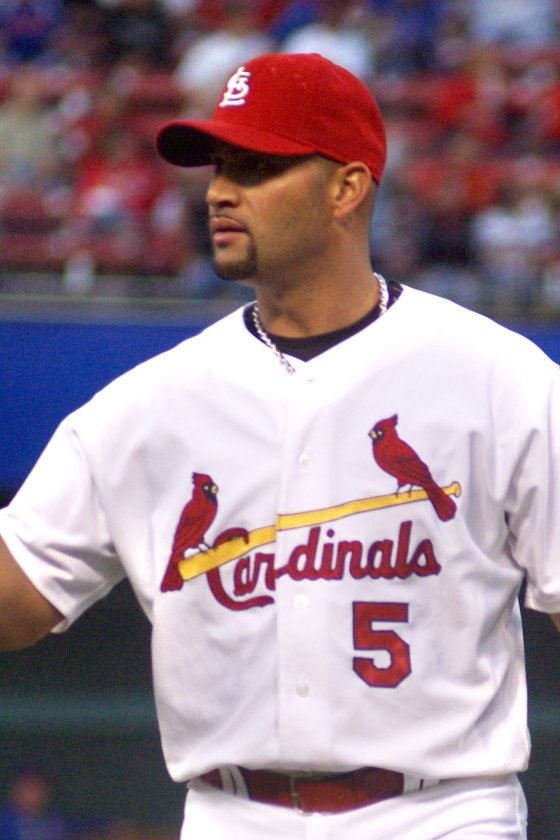
Player knowledge
Albert Pujols
1B 2001–2022
- Born
- January 16, 1980, in Santo Domingo, Dominican Republic
- Bats / Throws
- R/R
- Height / Weight
- 6'3", 235 lbs
- Hometown
- Independence, Missouri
- High School
- Fort Osage High School
- Full Name
- José Alberto Pujols Alcántara
- Nicknames
- The Machine (La Máquina), Prince Albert, Tío Albert
- MLB Debut
- April 2, 2001, at Colorado (Coors Field)
- Final Game
- October 4, 2022, at Pittsburgh (PNC Park)
- Uniform
- No. 5 with the Cardinals and Angels, No. 55 with the Dodgers
- 700 Club
- 703 home runs, fourth all time; No. 700 came on September 23, 2022
- RBI
- 2,218, second only to Hank Aaron
- Hall of Fame
- First eligible on the 2028 ballot; Cardinals Hall of Fame, 2026
Test your knowledge
Albert Pujols Quizzes
10 quizzes drawn from the story below. View the collection
The story
Bio
For a decade, Albert Pujols was the closest thing baseball had to a sure thing. Every spring he showed up in St. Louis, and every fall the back of his baseball card read the same way: a .300 average, 30 home runs, and 100 RBI, ten years in a row from the day he arrived. Big-league managers voted him the most feared hitter in the game. Everybody else just called him The Machine.
José Alberto Pujols Alcántara learned the game with limes and a milk carton in Santo Domingo, moved to Missouri at 16 speaking almost no English, and lasted until the 13th round of the draft. Less than two years later he was starting for the Cardinals. He won three MVP awards and two World Series with the Cardinals, signed a 10-year megadeal with the Angels, took a detour to the Dodgers, and came home to St. Louis for one last season that ended with his 700th home run. He retired with 703 homers, 3,384 hits, and 2,218 RBI. He and Hank Aaron are the only players with 3,000 hits, 700 home runs, and 2,200 RBI.
Here is the whole story, from the streets of Santo Domingo to the Cardinals, the Angels, the Dodgers, and back again. When you’re done, see how much stuck with the Albert Pujols Cardinals quiz.
Albert Pujols
Limes and a Milk Carton
Pujols was born January 16, 1980, in Santo Domingo, the capital of the Dominican Republic. He was an only child. His parents split up when he was three, and he was raised mostly by his paternal grandmother, America, with help from her 10 children. He grew up calling those uncles and aunts his brothers and sisters. Money was tight, but he remembered a happy house.
His father, Bienvenido, worked as a painter, took odd jobs, and was a standout softball pitcher. Albert wore his dad’s jersey around the neighborhood and begged him to hit ground balls between games. Like most kids around him, he played with whatever was handy: limes for baseballs and a milk carton for a glove. Bienvenido also struggled with alcohol, and young Albert sometimes helped carry him home after games. Pujols has said those nights are the reason he never drank or smoked.
Albert Pujols
Independence, Missouri
In 1996, when Albert was 16, he moved to the United States with his father and grandmother. They landed first in Washington Heights in New York City, where he witnessed a shooting at a neighborhood bodega. About two months later the family moved to Independence, Missouri, just east of Kansas City, where relatives were already living.
He enrolled at Fort Osage High School speaking almost no English. An English teacher, Portia Stanke, who spoke no Spanish herself, worked with him, and he picked up the language quickly. A cousin introduced him to baseball coach David Fry, who later said he had no idea what had just walked into his classroom. In the spring of 1997, playing shortstop in his first American season, Pujols hit 11 home runs and led Fort Osage to the Missouri Class 4A state championship.
By 1998 opponents had mostly stopped pitching to him. Some coaches also doubted he was really 18, a suspicion that followed him for years. He drew 55 walks and still hit 8 home runs in just 33 at-bats, one of them measured at 450 feet. He was named all-state twice and graduated a semester early, in December 1998.
Albert Pujols
The 402nd Pick
Pujols took a scholarship to Maple Woods Community College in Kansas City for the spring of 1999. His first college game was a preview of coming attractions. He hit a grand slam off Mark Buehrle, a future big-league All-Star, and turned an unassisted triple play at shortstop. He hit 22 home runs that season and was named a junior-college All-American.
Scouts still hesitated. They questioned his age, his thick build, and which position he could play. The Tampa Bay Devil Rays worked him out on the advice of area scout Fernando Arango, then passed, and Arango was so frustrated he quit. In the June 1999 draft the Cardinals finally took Pujols in the 13th round, the 402nd player chosen. He turned down their $10,000 offer and spent the summer with the Hays Larks of the Jayhawk League in Kansas. When St. Louis raised the bonus to $60,000, he signed.
On January 1, 2000, he married Deidre Corona, a Kansas City woman he had met at a Latin dance club. On their first date she told him she had a baby daughter, Isabella, who was born with Down syndrome. Pujols adopted Isabella after the wedding. Then he went out and conquered the minors in one season. He hit .324 with 17 homers for the Class A Peoria Chiefs and was named Midwest League MVP, moved up to High-A Potomac, and finished at Triple-A Memphis, where his 13th-inning walk-off homer won the Pacific Coast League championship. He was named MVP of those playoffs.
Albert Pujols
The Rookie Who Stayed
St. Louis invited Pujols to big-league camp in 2001 as a non-roster player, expecting him to start the year in Triple-A. He hit .349 that spring and played everywhere: first base, third base, shortstop, and all three outfield spots. Slugger Mark McGwire told manager Tony La Russa that sending the kid down might be one of the worst moves of his career. The popular version of the story says an injury to veteran Bobby Bonilla opened the last roster spot. La Russa and team officials later called that a myth and said Pujols had already won the job.
He started in left field on Opening Day, April 2, 2001, at Coors Field in Denver and singled off Mike Hampton for his first hit, becoming the first major-leaguer born in the 1980s. Four days later he homered for the first time, off Arizona’s Armando Reynoso. On April 9, in his first game at Busch Stadium, he homered in his first at-bat.
He never cooled off. Pujols hit .329 with 37 homers, 112 runs, and 130 RBI, a National League rookie record, while bouncing between third base, first base, and both outfield corners. He made the All-Star team, won a Silver Slugger, finished fourth in the MVP voting, and was the unanimous NL Rookie of the Year. In the Division Series against Arizona, his two-run homer off Randy Johnson won Game 2.
Albert Pujols
The Machine
The sequel matched the original. In 2002 Pujols hit .314 with 34 homers and 127 RBI, becoming the first player to hit .300 with 30 home runs, 100 runs, and 100 RBI in each of his first two seasons. He finished second in the MVP race to Barry Bonds, and he would do it again the next year.
That next year, 2003, may have been his best. Playing through ligament damage in his right elbow, he put together a 30-game hitting streak in July and August, then collected two hits on the final day to win the batting title at .359, edging Colorado’s Todd Helton by a fraction of a point. He also led the league with 212 hits, 51 doubles, and 137 runs, and hit 43 homers. His steadiness earned a nickname that stuck: The Machine, or La Máquina in Spanish.
On February 20, 2004, the Cardinals signed him to a seven-year, $100 million contract, and he moved to first base for good. With Jim Edmonds and Scott Rolen he formed the “MV3” heart of a lineup that won 105 games. Pujols hit 46 homers, then destroyed Houston in the NLCS, batting .500 with four home runs and nine RBI to win NLCS MVP. His first World Series ended in a four-game sweep by the Boston Red Sox, who won their first title since 1918.
Albert Pujols
Lidge and the Train Tracks
With Bonds sidelined by a knee injury for most of 2005, Pujols finally broke through. He hit .330 with 41 homers and 117 RBI, led the league with 129 runs, and won his first NL MVP award as the Cardinals won 100 games. That spring he and Deidre launched the Pujols Family Foundation, which promotes awareness and support for people with Down syndrome and their families and helps poor children in the Dominican Republic. He had already become the face of the Cardinals’ annual Buddy Walk game, which brings children with Down syndrome onto the field, and in 2009 the Albert Pujols Wellness Center for Adults with Down Syndrome opened in Chesterfield, Missouri.
The Cardinals swept San Diego in the Division Series and met Houston again in the NLCS. On October 17, 2005, in Game 5 at Minute Maid Park, the Astros led 4–2 with two outs in the ninth and their closer, Brad Lidge, on the mound, one out from the World Series. David Eckstein singled. Jim Edmonds walked. Then Pujols crushed a Lidge pitch for a three-run homer that landed on the train tracks high beyond left field, and St. Louis won 5–4. Houston still won Game 6 two days later, in the final game ever played at the old Busch Stadium, but the swing became one of the most famous in Cardinals history.
Albert Pujols
A Ring in 2006
The Cardinals opened a new Busch Stadium in 2006, and Pujols hit the first Cardinals home run in it. He kept going: 14 homers in April, a big-league record for the month at the time, including home runs in four straight plate appearances. A strained oblique sent him to the disabled list for the first time in June, and he still finished with career highs of 49 homers and 137 RBI, plus his first Gold Glove. He was runner-up for MVP to Philadelphia’s Ryan Howard.
St. Louis won its division with only 83 victories, then got hot. Pujols’ two-run homer off Jake Peavy won Game 1 of the Division Series against San Diego. The Cardinals beat the Mets in a seven-game NLCS, and in Game 1 of the World Series against Detroit, Pujols took rookie Justin Verlander deep in a 7–2 win. The Cardinals finished off the Tigers in five games on October 27, 2006, and Pujols had his first championship ring.
Albert Pujols
Back-to-Back MVPs
Elbow pain nagged him through 2007, and he “slipped” to .327 with 32 homers and 103 RBI. That year he also became a United States citizen and scored a perfect 100 on his citizenship test. In 2008 he hit .357 with 37 homers and 116 RBI and won his second MVP. He also received the Roberto Clemente Award for his community work, then had surgery on the ulnar nerve in his right elbow that fall.
He came back better. In 2009 Pujols led the league with 47 homers and 124 runs, drove in 135, and was a unanimous MVP for his third award, tying Stan Musial for the most by a Cardinal. The prospect scouts once doubted had a position had also become an elite first baseman. That season he made 185 assists, the most ever by a first baseman in one season.
In 2010 he led the league in homers (42) and RBI (118), won his second Gold Glove, and hit his 400th home run on August 26 in Washington. He finished second for MVP to Cincinnati’s Joey Votto. It was his 10th straight season with a .300 average, 30 homers, and 100 RBI. He had done it every year of his career, and nobody had ever started a career like that.
Albert Pujols
Three Homers in Arlington
The 2011 season was the last year of his contract, and talks on an extension broke off before spring training. Pujols started slowly, then hit extra-inning walk-off homers against the Cubs on back-to-back days, June 4 and 5. On June 19 he broke his left wrist in a collision at first base. Doctors expected him to miss up to six weeks. He was back on July 5. He finished at .299 with 37 homers and 99 RBI, missing an 11th straight .300/30/100 season by one point and one RBI.
The Cardinals were 10½ games out of the wild card in late August, with newcomer Lance Berkman playing right field. They went on a tear and clinched on the final night of the season when Atlanta lost to Philadelphia in 13 innings. Then they beat the 102-win Phillies in five games and Milwaukee in six, with Pujols hitting .478 in the NLCS.
Game 3 of the World Series, on October 22, 2011, at Texas, was his masterpiece. He grounded out in the first inning, singled in the fourth and fifth, and homered in the sixth, seventh, and ninth. He finished 5-for-6 with three home runs, six RBI, and a World Series record 14 total bases in a 16–7 win. Only Babe Ruth and Reggie Jackson had hit three homers in a World Series game before him. Five nights later, in Game 6, David Freese’s two-out triple in the ninth and Berkman’s two-out single in the tenth kept the Cardinals alive before Freese’s walk-off homer in the 11th. St. Louis won Game 7, 6–2, on October 28, and Pujols had his second ring.
Then he became a free agent for the first time. The Cardinals’ offer was reported at about $210 million over 10 years. On December 8, 2011, Pujols instead signed with the Los Angeles Angels for 10 years and $240 million, plus a 10-year personal services deal to begin after his playing days.
Albert Pujols
Ten Years in Anaheim
His Angels career started with a thud. Pujols did not hit his first home run in an Angels uniform until May 6, 2012, and still finished with 30 homers, 105 RBI, and 50 doubles. In 2013 plantar fasciitis in his left foot limited him to 99 games. That August, former Cardinals slugger Jack Clark said on a St. Louis radio show that Pujols had used performance-enhancing drugs. Pujols denied it flatly, pointed out that he had never failed a test, and filed a defamation suit in October. In February 2014 Clark publicly retracted the claim, said he had no knowledge that Pujols ever used PEDs, and apologized. Pujols dropped the suit.
On April 22, 2014, at Nationals Park, he hit his 499th and 500th home runs in the same game, both off Taylor Jordan, the only time anyone has reached 500 that way. Alongside Mike Trout, he helped the Angels win the AL West that fall, but Kansas City swept them in the Division Series. It was the only postseason trip of his Angels decade. He hit 40 homers in 2015 and made his first All-Star team as an Angel.
The milestones kept coming even as his feet and knees slowed him down. On June 3, 2017, he hit a grand slam off Minnesota’s Ervin Santana for his 600th home run, the first player to reach 600 with a slam. On May 4, 2018, in Seattle, he singled off Mike Leake to become the 32nd player with 3,000 hits. On May 9, 2019, a solo homer at Detroit’s Comerica Park was his 2,000th RBI. That June he returned to Busch Stadium for the first time since leaving, drew standing ovations every time up, and homered off Dakota Hudson. In August 2020 he passed Alex Rodriguez for second place on MLB’s official RBI list. By then defensive shifts and his lack of speed were turning many of his hard-hit balls into outs, and he hit .224 in the short 2020 season. On May 6, 2021, batting .198, he was designated for assignment.
Albert Pujols
Dodger Blue
The crosstown Dodgers signed him on May 17, 2021, and he started at first base that same night. Corey Seager already wore No. 5, so Pujols chose No. 55, a nod to his number with both of his old teams and, he explained, to the Bible: “double grace.” He hit .254 with 12 homers in 85 games, punished left-handed pitching, and became one of only three players to homer for both the Angels and the Dodgers in the same season.
His first October in seven years began against the team that made him. In the NL Wild Card Game he pinch-hit against the Cardinals, and Chris Taylor’s walk-off homer sent the Dodgers on. They beat the 107-win Giants in the Division Series before losing to Atlanta in a six-game NLCS.
Albert Pujols
Seven Hundred
On March 28, 2022, Pujols signed a one-year, $2.5 million deal to come home to St. Louis and announced it would be his final season. He rejoined catcher Yadier Molina, who was also playing his last year, and pitcher Adam Wainwright. On May 15, with the Cardinals routing the Giants, he even pitched the ninth inning and gave up four runs, two of them on homers.
He began the year 21 home runs short of 700, and by early August he had only seven. Commissioner Rob Manfred named him to the All-Star team as a special “legacy” selection, and he reached the second round of the Home Run Derby. Then he got hot. He hit 17 homers in his final 136 at-bats and passed Musial for second place all time in total bases.
On September 23, 2022, at Dodger Stadium, he homered off Andrew Heaney for No. 699 and, in his next at-bat, off Phil Bickford for No. 700. He became the fourth member of the 700 club, after Babe Ruth, Hank Aaron, and Barry Bonds. On October 2, in his last regular-season game at Busch Stadium, he homered in his final at-bat there, 21 years after homering in his first. The next night in Pittsburgh he hit No. 703 off Mitch Keller, the record 458th different pitcher to allow a homer to him, and his two RBI pushed him past Ruth’s total of 2,214 into second place behind Aaron. He was named NL Comeback Player of the Year.
The Cardinals won the NL Central, but Philadelphia swept them in the Wild Card Series. On October 8, 2022, at Busch Stadium, Pujols singled in his last two at-bats. Then he was done.
Albert Pujols
After the Machine
“There are no perfect endings, but I think I had one,” Pujols said the next spring. He had filed for divorce from Deidre in April 2022, and in 2023 he married Nicole Fernández, daughter of former Dominican president Leonel Fernández. His personal services deal with the Angels began in 2023, and he joined MLB Network as an analyst.
He also tried managing, which few all-time greats ever do. He took over the Leones del Escogido in the Dominican winter league in 2024 and won the league title and the 2025 Caribbean Series in his first season. At the end of 2025 he moved to the front office of the Estrellas Orientales, where he is president of baseball operations for the 2026–27 season.
On September 12, 2026, the Cardinals inducted Pujols into the Cardinals Hall of Fame alongside Molina, and he pulled on the red jacket at Busch Stadium. Players must wait five years after retiring to reach the National Baseball Hall of Fame ballot, so Pujols will be eligible for the first time on the 2028 ballot. As of 2026 he has not yet appeared on one. He once said he wanted to be remembered less for his numbers than as “a great guy who loved the Lord, loved to serve the community and who gave back.”
Albert Pujols
Records and Honors
- 703 home runs: fourth all time, behind Barry Bonds, Hank Aaron, and Babe Ruth
- 2,218 RBI and 6,211 total bases: second only to Hank Aaron in both
- 3,384 hits and 686 doubles (fifth all time) over 22 seasons
- Three NL MVP awards: 2005, 2008, and 2009 (unanimous)
- 2001 NL Rookie of the Year, unanimous, with a league rookie-record 130 RBI
- 11 All-Star selections, 6 Silver Sluggers, and 2 Gold Gloves (2006, 2010)
- 2003 NL batting title (.359); NL home run leader in 2009 and 2010
- World Series champion in 2006 and 2011, and 2004 NLCS MVP
- 185 assists in 2009: the single-season record for a first baseman
- 101.3 career WAR, per Baseball-Reference
- 2008 Roberto Clemente Award and 2022 NL Comeback Player of the Year
- Cardinals Hall of Fame, class of 2026
Albert Pujols
Machine Fun Facts
- He was the first major-league player born in the 1980s.
- In his first college game he hit a grand slam off future All-Star Mark Buehrle and turned an unassisted triple play.
- He never struck out 100 times in a season. His career high was 93.
- He grounded into 426 double plays, the most in major-league history.
- His 499th and 500th home runs came in the same game, the only time that has happened.
- He homered off 458 different pitchers, a big-league record.
- He scored a perfect 100 on his U.S. citizenship test in 2007.
- At 42, he pitched an inning for the Cardinals in 2022.
Think you know The Machine now? Prove it with all ten quizzes in the Albert Pujols collection, take the Albert Pujols Cardinals quiz, compare him with the Cardinals’ first franchise icon on the Stan Musial page, meet his fellow 700-homer men on the Hank Aaron and Babe Ruth pages, or browse the full St. Louis Cardinals, Los Angeles Angels, and Los Angeles Dodgers quiz collections.
The postseason
October Accolades
| Year | Series | Result | G | H-AB | BA | HR | RBI |
|---|---|---|---|---|---|---|---|
| 2001 | NLDS | Diamondbacks def. Cardinals, 3–2 His two-run homer off Randy Johnson won Game 2, 4–1 | 5 | 2-18 | .111 | 1 | 2 |
| 2002 | NLDS | Cardinals def. Diamondbacks, 3–0 Drove in two runs in the 12–2 Game 1 rout that started the sweep | 3 | 3-10 | .300 | 0 | 3 |
| 2002 | NLCS | Giants def. Cardinals, 4–1 Homered in Game 1, but Barry Bonds’ Giants took the pennant in five | 5 | 5-19 | .263 | 1 | 2 |
| 2004 | NLDS | Cardinals def. Dodgers, 3–1 His three-run homer off Wilson Álvarez clinched the series in Game 4 | 4 | 5-15 | .333 | 2 | 5 |
| 2004 | NLCS | Cardinals def. Astros, 4–3 NLCS MVP: hit .500 with four homers and scored the winning run in Game 6 | 7 | 14-28 | .500 | 4 | 9 |
| 2004 | World Series | Red Sox def. Cardinals, 4–0 Hit .333 with two doubles in Game 2 as Boston ended its 86-year wait | 4 | 5-15 | .333 | 0 | 0 |
| 2005 | NLDS | Cardinals def. Padres, 3–0 Hit .556 and doubled twice in the Game 3 clincher in San Diego | 3 | 5-9 | .556 | 0 | 2 |
| 2005 | NLCS | Astros def. Cardinals, 4–2 His two-out, three-run homer off Brad Lidge stunned Houston in Game 5 | 6 | 7-23 | .304 | 2 | 6 |
| 2006 | NLDS | Cardinals def. Padres, 3–1 His two-run homer off Jake Peavy won Game 1, 5–1 | 4 | 5-15 | .333 | 1 | 3 |
| 2006 | NLCS | Cardinals def. Mets, 4–3 Homered in Game 5 and drew seven walks in a seven-game classic | 7 | 7-22 | .318 | 1 | 1 |
| 2006 | World Series | Cardinals def. Tigers, 4–1 His two-run homer off Justin Verlander powered a 7–2 win in Game 1 | 5 | 3-15 | .200 | 1 | 2 |
| 2009 | NLDS | Dodgers def. Cardinals, 3–0 The reigning MVP hit .300, but Los Angeles swept | 3 | 3-10 | .300 | 0 | 1 |
| 2011 | NLDS | Cardinals def. Phillies, 3–2 His RBI single off Cliff Lee put Game 2 ahead to stay | 5 | 7-20 | .350 | 0 | 1 |
| 2011 | NLCS | Cardinals def. Brewers, 4–2 Hit .478; four hits, a homer, and five RBI in a 12–3 Game 2 win | 6 | 11-23 | .478 | 2 | 9 |
| 2011 | World Series | Cardinals def. Rangers, 4–3 Five hits, three homers, and six RBI in Game 3, a 16–7 rout in Arlington | 7 | 6-25 | .240 | 3 | 6 |
| 2014 | ALDS | Royals def. Angels, 3–0 Homered in Game 3 of the only postseason trip of his Angels decade | 3 | 2-12 | .167 | 1 | 2 |
| 2021 | NL Wild Card | Dodgers def. Cardinals, 1–0 Pinch-hit against his old team; Chris Taylor’s walk-off homer won it | 1 | 0-1 | .000 | 0 | 0 |
| 2021 | NLDS | Dodgers def. Giants, 3–2 Two singles in Game 3 as Los Angeles outlasted 107-win San Francisco | 2 | 2-3 | .667 | 0 | 0 |
| 2021 | NLCS | Braves def. Dodgers, 4–2 Used mostly as a pinch-hitter; singled twice in an 11–2 Game 5 win | 6 | 3-13 | .231 | 0 | 0 |
| 2022 | NL Wild Card | Phillies def. Cardinals, 2–0 Singled in his last two at-bats on October 8, the final game of his career | 2 | 2-8 | .250 | 0 | 0 |
| Postseason | 20 series | 88 | 97-304 | .319 | 19 | 54 | |
The clubs
Teams
-
St. Louis Cardinals
2001–2011, 2022
Rookie of the Year, three MVPs, two World Series titles, and a farewell season capped by No. 700
-
Los Angeles Angels
2012–2021
A 10-year megadeal that produced home runs No. 500 and 600, hit No. 3,000, and RBI No. 2,000
-
Los Angeles Dodgers
2021
A 12-homer second wind in No. 55 and an October run that began against his old Cardinals
The numbers
Season Stats
| Season | Team | League | WAR | Games | PA | AB | Runs | Hits | RBI | 2B | 3B | HR | SB | BB | BA | OBP | SLG | OPS |
|---|---|---|---|---|---|---|---|---|---|---|---|---|---|---|---|---|---|---|
| 2001 | St. Louis Cardinals | NL | 6.6 | 161 | 676 | 590 | 112 | 194 | 130 | 47 | 4 | 37 | 1 | 69 | .329 | .403 | .610 | 1.013 |
| 2002 | St. Louis Cardinals | NL | 5.5 | 157 | 675 | 590 | 118 | 185 | 127 | 40 | 2 | 34 | 2 | 72 | .314 | .394 | .561 | .955 |
| 2003 | St. Louis Cardinals | NL | 8.7 | 157 | 685 | 591 | 137 | 212 | 124 | 51 | 1 | 43 | 5 | 79 | .359 | .439 | .667 | 1.106 |
| 2004 | St. Louis Cardinals | NL | 8.5 | 154 | 692 | 592 | 133 | 196 | 123 | 51 | 2 | 46 | 5 | 84 | .331 | .415 | .657 | 1.072 |
| 2005 | St. Louis Cardinals | NL | 8.4 | 161 | 700 | 591 | 129 | 195 | 117 | 38 | 2 | 41 | 16 | 97 | .330 | .430 | .609 | 1.039 |
| 2006 | St. Louis Cardinals | NL | 8.5 | 143 | 634 | 535 | 119 | 177 | 137 | 33 | 1 | 49 | 7 | 92 | .331 | .431 | .671 | 1.102 |
| 2007 | St. Louis Cardinals | NL | 8.7 | 158 | 679 | 565 | 99 | 185 | 103 | 38 | 1 | 32 | 2 | 99 | .327 | .429 | .568 | .997 |
| 2008 | St. Louis Cardinals | NL | 9.2 | 148 | 641 | 524 | 100 | 187 | 116 | 44 | 0 | 37 | 7 | 104 | .357 | .462 | .653 | 1.114 |
| 2009 | St. Louis Cardinals | NL | 9.7 | 160 | 700 | 568 | 124 | 186 | 135 | 45 | 1 | 47 | 16 | 115 | .327 | .443 | .658 | 1.101 |
| 2010 | St. Louis Cardinals | NL | 7.5 | 159 | 700 | 587 | 115 | 183 | 118 | 39 | 1 | 42 | 14 | 103 | .312 | .414 | .596 | 1.011 |
| 2011 | St. Louis Cardinals | NL | 5.3 | 147 | 651 | 579 | 105 | 173 | 99 | 29 | 0 | 37 | 9 | 61 | .299 | .366 | .541 | .906 |
| 2012 | Los Angeles Angels of Anaheim | AL | 4.8 | 154 | 670 | 607 | 85 | 173 | 105 | 50 | 0 | 30 | 8 | 52 | .285 | .343 | .516 | .859 |
| 2013 | Los Angeles Angels of Anaheim | AL | 1.6 | 99 | 443 | 391 | 49 | 101 | 64 | 19 | 0 | 17 | 1 | 40 | .258 | .330 | .437 | .767 |
| 2014 | Los Angeles Angels of Anaheim | AL | 3.9 | 159 | 695 | 633 | 89 | 172 | 105 | 37 | 1 | 28 | 5 | 48 | .272 | .324 | .466 | .790 |
| 2015 | Los Angeles Angels of Anaheim | AL | 3.1 | 157 | 661 | 602 | 85 | 147 | 95 | 22 | 0 | 40 | 5 | 50 | .244 | .307 | .480 | .787 |
| 2016 | Los Angeles Angels | AL | 1.5 | 152 | 650 | 593 | 71 | 159 | 119 | 19 | 0 | 31 | 4 | 49 | .268 | .323 | .457 | .780 |
| 2017 | Los Angeles Angels | AL | -2.0 | 149 | 636 | 593 | 53 | 143 | 101 | 17 | 0 | 23 | 3 | 37 | .241 | .286 | .386 | .672 |
| 2018 | Los Angeles Angels | AL | 0.2 | 117 | 498 | 465 | 50 | 114 | 64 | 20 | 0 | 19 | 1 | 28 | .245 | .289 | .411 | .700 |
| 2019 | Los Angeles Angels | AL | 0.2 | 131 | 545 | 491 | 55 | 120 | 93 | 22 | 0 | 23 | 3 | 43 | .244 | .305 | .430 | .734 |
| 2020 | Los Angeles Angels | AL | -0.1 | 39 | 163 | 152 | 15 | 34 | 25 | 8 | 0 | 6 | 0 | 9 | .224 | .270 | .395 | .665 |
| 2021 | Los Angeles Angels | AL | -0.7 | 24 | 92 | 86 | 9 | 17 | 12 | 0 | 0 | 5 | 1 | 3 | .198 | .250 | .372 | .622 |
| 2021 | Los Angeles Dodgers | NL | 0.1 | 85 | 204 | 189 | 20 | 48 | 38 | 3 | 0 | 12 | 1 | 11 | .254 | .299 | .460 | .759 |
| 2022 | St. Louis Cardinals | NL | 2.1 | 109 | 351 | 307 | 42 | 83 | 68 | 14 | 0 | 24 | 1 | 28 | .270 | .345 | .550 | .895 |
| Career | 22 seasons | NL/AL | 101.3 | 3,080 | 13,041 | 11,421 | 1,914 | 3,384 | 2,218 | 686 | 16 | 703 | 117 | 1,373 | .296 | .374 | .544 | .918 |