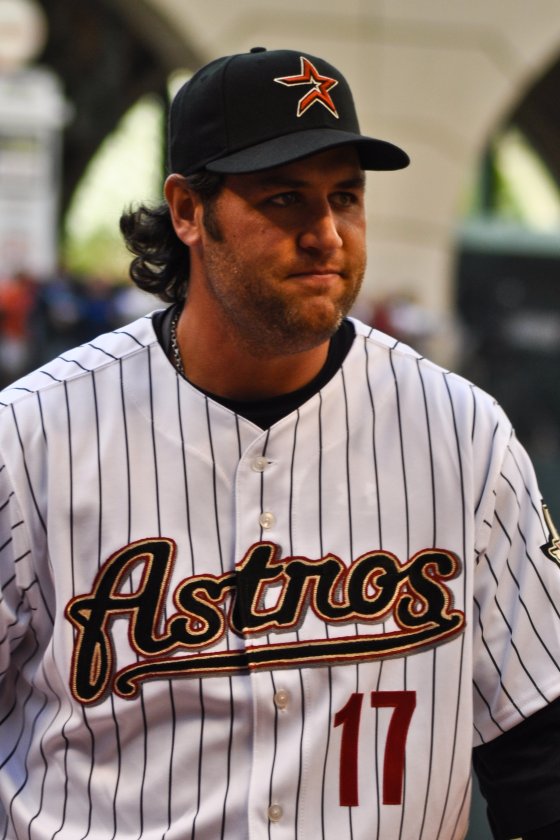
Player knowledge
Lance Berkman
OF / 1B 1999–2013
- Born
- February 10, 1976, in Waco, Texas
- Bats / Throws
- S/L
- Height / Weight
- 6'1", 220 lbs
- Hometown
- New Braunfels, Texas
- High School
- Canyon High School
- Full Name
- William Lance Berkman
- Nicknames
- Big Puma, Fat Elvis
- MLB Debut
- July 16, 1999, vs. Detroit at the Astrodome
- Final Game
- September 17, 2013, for Texas at Tampa Bay
- Uniform
- No. 17 with Houston (2000–2010) and the Yankees; No. 12 in St. Louis
- Draft
- First round, 16th overall, by Houston in 1997 out of Rice
- Switch-Hitter
- .943 career OPS, second only to Mickey Mantle among switch-hitters with 5,000 PA
- Hall of Fame
- Not elected; 1.2% (5 votes) on his only BBWAA ballot, in 2019
Test your knowledge
Lance Berkman Quizzes
10 quizzes drawn from the story below. View the collection
The story
Bio
On the night of October 27, 2011, the St. Louis Cardinals were one strike from losing the World Series for the second time in two innings. Lance Berkman stepped in with two outs in the 10th, fell behind two strikes, and lined a single into center field to tie Game 6. The next night he was a world champion. It was the loudest hit of a career built on quiet, relentless excellence from both sides of the plate.
William Lance Berkman was born in Waco, learned to switch-hit because his father insisted, and became the most feared college slugger in the country at Rice. In Houston he joined Jeff Bagwell and Craig Biggio as the third of the Killer B’s, made five All-Star teams, and helped carry the Astros to their first World Series in 2005. A trade sent him to the Yankees, a comeback season in St. Louis brought him a ring, and a last year with Texas brought him home. He finished with a .293 average, a .406 on-base percentage, 366 home runs, and a .943 OPS that only Mickey Mantle has topped among switch-hitters with 5,000 plate appearances.
Here is the whole story, from the ballfields of Central Texas to the Astros, the Yankees, the Cardinals, and the Rangers. When you’re done, see how much stuck with the Killer B’s Astros quiz.
Lance Berkman
Waco to New Braunfels
Berkman was born February 10, 1976, in Waco, Texas. His father, Larry, was an attorney who had played baseball at the University of Texas. His mother, Cynthia, taught elementary school and had been a varsity sprinter in high school. Lance grew up with two sisters, and he later said he had a bat in his hands from the time he could walk.
He was a natural right-handed hitter, but his father had other plans. From Lance’s first youth league until high school, Larry made him alternate sides of the plate every at-bat, no matter who was pitching or what the score was. In tight games his teammates begged him to bat righty. His dad would not budge.
Berkman spent most of his childhood in Austin and went to Austin High before his family moved to New Braunfels during his junior year. At Canyon High School he was an honor student and the star of the baseball team. As a senior in 1994 he hit .539 with eight home runs and 30 RBI. Rice University offered a scholarship early that year, and on his father’s advice he accepted right away so he could relax and enjoy his senior season.
Lance Berkman
Rice Owls Slugger
At Rice he played for the demanding coach Wayne Graham. As a freshman in 1995 he hit .328 and was named Southwest Conference Newcomer of the Year. That summer he was MVP of the National Baseball Congress World Series in Wichita, where he tied the tournament record with 25 RBI in eight games.
In 1996 he once hit six home runs in a doubleheader and nine in a single week, a binge the editor of Collegiate Baseball said he had never heard of in 26 years of keeping statistics. Berkman hit .398, made the All-SWC first team, and spent the summer winning the Cape Cod League batting title for the Wareham Gatemen.
His junior year was one for the record books. In 1997 Berkman hit .431 and led the nation with 41 home runs and 134 RBI, averaging 2.13 RBI a game, an NCAA record. The Owls went 47–14 and reached the College World Series for the first time in school history, and the National Collegiate Baseball Writers Association named him National Player of the Year. On June 3, 1997, the Houston Astros made him the 16th overall pick of the draft and signed him for a $1 million bonus. General manager Gerry Hunsicker called a switch-hitter with power a rare commodity you just can’t pass up.
Lance Berkman
Down on the Farm
Berkman had been a first baseman almost his whole life, but Houston already had Jeff Bagwell there, so the Astros sent him to the outfield. He hit .293 with 12 homers in 53 games for the Class A Kissimmee Cobras in 1997. In 1998 he hit .306 with 24 home runs for the Double-A Jackson Generals, made the Texas League All-Star team, and then hit three homers in his very first game for Triple-A New Orleans.
A torn meniscus in his left knee slowed him in April 1999, but he came back strong, and on July 16, 1999, the Astros called him up to replace the injured Carl Everett. He debuted that night against Detroit at the Astrodome, which was in its final season as Houston’s home. Wearing No. 22, he hit .237 with four homers in 34 games. That year Houston used eight different players whose last names started with B.
He opened 2000 back in Triple-A, bounced up and down once, and then stuck for good in May after Roger Cedeño got hurt. Now wearing No. 17, he hit .297 with 21 home runs and 67 RBI in 114 games and drew a single Rookie of the Year vote.
Lance Berkman
The Third Killer B
The nickname Killer B’s was first pinned on Bagwell, Biggio, Derek Bell, and Sean Berry in 1996. Bell and Berry moved on, and Berkman became the third core B beside Bagwell and Biggio. In 2001 he announced himself. He hit .331 with 34 homers, 126 RBI, 110 runs, and a major-league-leading 55 doubles, the first switch-hitter ever with 50 doubles and 30 homers in one season. He made his first All-Star team and finished fifth in the MVP vote. Manager Larry Dierker said Berkman simply understood the art of hitting.
The Astros won the NL Central at 93–69 but were swept by Atlanta in the Division Series, and Berkman went 2-for-12. That January the club signed him to a three-year, $10.5 million deal before he was even eligible for arbitration, a reward for his bat and for Berkman’s Bunch, his program that brought local kids to Astros games. In 2002 he hit 42 homers and led the National League with 128 RBI, made his second All-Star team, and finished third in the MVP race.
The 2003 season was a dip by his standards, with 25 homers and 93 RBI. It still had its moments. On June 1 at Wrigley Field, Cubs fans waved Twinkies at him in left field. Berkman motioned for them to toss some his way, caught two, ate one, and stuck the other in his pocket. Then he homered the next inning. That year he also admitted he was so much better from the left side that he had briefly thought about giving up hitting right-handed.
Lance Berkman
October Breakthrough
Berkman roared through May 2004 and won his first NL Player of the Month award. He finished at .316 with 30 homers, 106 RBI, 127 walks, and a career-best .450 on-base percentage. The All-Star Game came to Houston that July, and in the Home Run Derby at Minute Maid Park he chose to bat right-handed to aim at the short left-field porch. He reached the final, lost to Miguel Tejada, and hit the longest drive of the night, a 497-foot blast.
On August 26 the Astros were 64–63. They went 28–7 the rest of the way, won the wild card by one game over the Giants, and then beat Atlanta in five games for the first playoff series win in franchise history. Berkman hit .409 in that series, and Houston clinched with a 12–3 rout in Game 5. In the NLCS against St. Louis he hit three homers and drove in nine, but after the Astros took a 3–2 lead, the Cardinals won the last two games at Busch Stadium.
A week after the season, on October 28, 2004, Berkman tore the ACL in his right knee playing flag football. He admitted he had no business being out there. Surgery followed, and so did a long winter.
Lance Berkman
Houston’s First Pennant
In March 2005 the Astros showed their faith with a six-year, $85 million contract. Berkman returned on May 6 and soon moved to first base with Bagwell’s shoulder failing. His knee took a few weeks to come around. Then he hit .337 over the next two months. On May 24 Houston was 15–30. It went 74–43 from there and won the wild card on the final weekend, one game ahead of the Phillies.
Game 4 of the Division Series against Atlanta, on October 9, 2005, became an all-timer. With Houston down 6–1 in the eighth, Berkman hit a grand slam off Kyle Farnsworth. Brad Ausmus tied it with a homer in the ninth. In the 10th Berkman doubled and was lifted for a pinch-runner, Chris Burke, who stayed in the game and won it with a homer in the 18th inning, ending what was then the longest game in postseason history.
In Game 5 of the NLCS, Berkman’s three-run homer off Chris Carpenter gave Houston a 4–2 lead and put the Astros one out from the pennant, until Albert Pujols crushed a three-run shot off Brad Lidge in the ninth. Houston won Game 6 in St. Louis anyway and reached the World Series in its 44th season. The Chicago White Sox swept the Series, but Berkman hit .385 and led the Astros with six RBI.
Lance Berkman
Enter the Big Puma
Berkman already had one nickname, “Fat Elvis,” and he wasn’t sure why. Before the 2006 season, on a Houston sports radio show hosted by John Granato and Lance Zierlein, he joked that he was really more like a puma. The hosts ran with it, fans followed, and he became the Big Puma. Asked to explain, Berkman kept a straight face: agile, athletic, sleek, all the things that described his game.
After a January knee cleanup, he played every bit like a big cat in 2006. He hit .315 with 45 homers and 136 RBI, breaking Bagwell’s club record of 135 and setting a National League mark for switch-hitters. He became the second switch-hitter after Mantle with more than one 40-homer season, made the All-Star team, and finished third in the MVP vote behind Ryan Howard and Pujols. He also took over first base for good, since Bagwell never played again after 2005.
The 2007 season was a slog until a hot August and September. Then he exploded in 2008. He was the NL Player of the Month for May and was hitting .366 at the halfway mark. He cooled off but still hit .312 with 29 homers, 106 RBI, a career-high 18 steals, and a league-leading 46 doubles, and finished fifth in the MVP voting. Fans in puma costumes, the Little Pumas, became regulars at Minute Maid Park. On June 13, 2009, he hit his 300th home run, off Arizona’s Jon Garland.
Lance Berkman
The Bronx Detour
Knee surgery in the spring of 2010 cost Berkman the first 12 games of the season, and the Astros started 9–18. He admitted it was hard, at 34, to keep playing for a losing club. On July 31, 2010, Houston traded him to the New York Yankees for pitcher Mark Melancon and infielder Jimmy Paredes. When he left, he ranked first in Astros history in on-base percentage (.410), slugging (.549), and OPS (.959).
In New York he kept No. 17 and served as a designated hitter and backup first baseman, hitting .255 with one homer in 37 games. October went better. In Game 2 of the Division Series at Minnesota he homered and then hit a go-ahead double off Carl Pavano, and New York swept the Twins. When Mark Teixeira hurt his hamstring in the ALCS, Berkman took over at first base, but Texas won the pennant in six games.
The Yankees declined his option. Berkman hoped to go home to Houston, but the Astros told him they weren’t interested. “It wasn’t a long conversation,” he said.
Lance Berkman
Comeback in St. Louis
In December 2010 Berkman signed a one-year, $8 million deal with the St. Louis Cardinals, wore No. 12, and went back to right field. Coming off the worst season of his career, he looked like a gamble. Instead he hit .301 with 31 home runs, 94 RBI, and a .959 OPS. He made his sixth All-Star team, finished seventh in the MVP vote, and was named NL Comeback Player of the Year.
The Cardinals looked dead in late August, 10½ games behind Atlanta in the wild-card race. They charged back, Berkman hit .413 over the final 21 games, and St. Louis won the wild card on the last day of the season. In the first inning of Game 1 of the Division Series, Berkman crushed a three-run homer off Philadelphia’s Roy Halladay. The Cardinals beat the 102-win Phillies in five games, then took the pennant from Milwaukee in six.
Lance Berkman
Two Strikes in Game 6
Texas led the World Series three games to two when Game 6 began at Busch Stadium. In the first inning Berkman hit a two-run homer off Colby Lewis, his first in a World Series, to give St. Louis a 2–1 lead. He scored the tying run in the fourth and again in the sixth. The game seesawed until Texas led 7–5 in the ninth.
In the ninth, Pujols doubled and Berkman walked. With two outs, David Freese, down to his last strike, tripled over the right fielder’s head, and Berkman raced home with the tying run. In the 10th Josh Hamilton’s two-run homer put Texas ahead 9–7. The Cardinals got one run back, and with two outs, runners at the corners, and the count at two strikes, Berkman lined a single to center off Scott Feldman. Jon Jay scored, and the game was tied at 9–9. Freese won it with a homer in the 11th. Berkman finished 3-for-5 with four runs scored and three RBI.
The next night the Cardinals won Game 7, 6–2, and Berkman scored twice. He hit .423 in the Series with 11 hits, and at 35 he finally had his World Series ring.
Lance Berkman
Final Innings
His body would not let him repeat it. In 2012 a calf strain and two surgeries on his right knee limited him to 32 games, and he missed the postseason. In January 2013 he signed a one-year deal with the Texas Rangers, the team he had beaten in the World Series, and became their regular designated hitter in No. 27. He hit .242 with six homers in 73 games and played his last game on September 17, 2013, at Tampa Bay.
That summer he bought a fire truck, had it refurbished, and donated it to West, Texas, a small town near Waco devastated by a fertilizer plant explosion in April 2013. Its doors carried his name and the No. 17. Berkman announced his retirement on January 29, 2014. On April 5, 2014, he and his old teammate Roy Oswalt signed one-day contracts so they could retire as Astros, and Houston fans gave them standing ovations before the game.
Lance Berkman
Coach Berkman
Berkman went back to Rice in 2014 to finish his degree, then took over the baseball program at Second Baptist School in Houston, with former teammate Andy Pettitte on his staff. In 2016 they won a state championship. He hoped to succeed Wayne Graham at Rice when Graham retired in 2018, but the school went another way, and Berkman left Second Baptist in 2019.
His one turn on the Hall of Fame ballot came in 2019. His rate stats were elite, but his 1,905 hits and lack of batting or home-run titles left traditional voters cold. On the 2019 ballot he received 5 votes, or 1.2 percent, below the 5 percent needed to stay on, and he dropped off after one year. The Astros inducted him into their own team Hall of Fame in 2020.
After a season as an assistant at the University of St. Thomas, Berkman was named head coach at Houston Baptist University on May 31, 2021. The school became Houston Christian University in 2022. He went 47–104 in three seasons and stepped down on May 24, 2024. A devout Christian, he has been outspoken about his faith and his conservative views, including a 2015 ad against a Houston equal-rights ordinance that drew criticism. He and his wife, Cara, live in Houston and have four daughters, and in 2012 Forbes listed them among the most generous celebrities for their giving through their family foundation.
Lance Berkman
Records and Honors
- .943 career OPS: second among switch-hitters with 5,000 plate appearances, behind only Mickey Mantle
- .293 average, .406 on-base percentage, .537 slugging over 15 seasons
- 366 home runs, 1,234 RBI, 1,905 hits, and 1,201 walks
- 52.0 career WAR, per Baseball-Reference
- 136 RBI in 2006: the Astros’ single-season record and the National League record for a switch-hitter
- 6 All-Star selections: 2001, 2002, 2004, 2006, 2008, and 2011
- NL RBI leader in 2002 (128) and doubles leader in 2001 (55) and 2008 (46)
- Six top-10 MVP finishes, including third in 2002 and 2006
- 2011 World Series champion and 2011 NL Comeback Player of the Year
- .317 postseason average with 9 homers and 41 RBI in 52 games
- 1997 National Player of the Year at Rice
- Houston Astros Hall of Fame, class of 2020
Lance Berkman
Big Puma Fun Facts
- His father made him switch sides of the plate every at-bat as a kid, even when his teammates begged him to bat righty.
- He homered on September 21 in seven straight seasons (2001–2007), tying Lou Gehrig’s record for homering on the same date in consecutive years.
- At Wrigley Field in 2003 he caught and ate a Twinkie tossed by a Cubs fan, then homered the next inning.
- The pinch-runner who replaced him in the 10th inning of the 18-inning 2005 playoff game, Chris Burke, hit the walk-off homer.
- He is one of four players with at least 90 walks in nine straight seasons, along with Lou Gehrig, Mickey Mantle, and Joe Morgan.
- He tore his ACL in a game of flag football a week after the 2004 NLCS.
- He batted right-handed in the 2004 Home Run Derby and hit the longest homer of the night, 497 feet.
- The fire truck he gave West, Texas, in 2013 carries his old Astros number, 17.
Think you know the Big Puma now? Prove it with all ten quizzes in the Lance Berkman collection, take the Killer B’s Astros quiz, meet his 2011 Cardinals teammate on the Albert Pujols page, or browse the full Houston Astros and St. Louis Cardinals quiz collections.
The postseason
October Accolades
| Year | Series | Result | G | H-AB | BA | HR | RBI |
|---|---|---|---|---|---|---|---|
| 2001 | NLDS | Braves def. Astros, 3–0 Two singles in 12 at-bats in his first October, a three-game sweep | 3 | 2-12 | .167 | 0 | 0 |
| 2004 | NLDS | Astros def. Braves, 3–2 Hit .409 as Houston won the first postseason series in franchise history | 5 | 9-22 | .409 | 1 | 3 |
| 2004 | NLCS | Cardinals def. Astros, 4–3 Three homers and nine RBI, but St. Louis won Games 6 and 7 at home | 7 | 7-24 | .292 | 3 | 9 |
| 2005 | NLDS | Astros def. Braves, 3–1 His eighth-inning grand slam off Kyle Farnsworth started the 18-inning Game 4 comeback | 4 | 5-14 | .357 | 1 | 5 |
| 2005 | NLCS | Astros def. Cardinals, 4–2 His three-run homer off Chris Carpenter put Game 5 ahead before Albert Pujols answered | 6 | 6-21 | .286 | 1 | 3 |
| 2005 | World Series | White Sox def. Astros, 4–0 Hit .385 and led Houston with six RBI in the franchise’s first World Series | 4 | 5-13 | .385 | 0 | 6 |
| 2010 | ALDS | Yankees def. Twins, 3–0 A homer and a go-ahead double off Carl Pavano in his only game, Game 2 | 1 | 2-4 | .500 | 1 | 2 |
| 2010 | ALCS | Rangers def. Yankees, 4–2 Took over at first base after Mark Teixeira hurt his hamstring | 4 | 3-12 | .250 | 0 | 2 |
| 2011 | NLDS | Cardinals def. Phillies, 3–2 Three-run homer off Roy Halladay in the first inning of Game 1 | 5 | 3-18 | .167 | 1 | 4 |
| 2011 | NLCS | Cardinals def. Brewers, 4–2 Hit .300 as St. Louis took the pennant from Milwaukee | 6 | 6-20 | .300 | 0 | 2 |
| 2011 | World Series | Cardinals def. Rangers, 4–3 Hit .423; homered in Game 6 and tied it with two outs and two strikes in the 10th | 7 | 11-26 | .423 | 1 | 5 |
| Postseason | 11 series | 52 | 59-186 | .317 | 9 | 41 | |
The clubs
Teams
-
Houston Astros
1999–2010
A Killer B for 12 seasons: five All-Star teams, a club-record 136 RBI, and the 2005 pennant
-
St. Louis Cardinals
2011–2012
Comeback Player of the Year, a two-strike, two-out tying hit in Game 6, and a 2011 ring
-
New York Yankees
2010
A deadline deal, an ALDS homer and go-ahead double, and first base in the ALCS
-
Texas Rangers
2013
One last season at home in Texas, mostly as the designated hitter
The numbers
Season Stats
| Season | Team | League | WAR | Games | PA | AB | Runs | Hits | RBI | 2B | 3B | HR | SB | BB | BA | OBP | SLG | OPS |
|---|---|---|---|---|---|---|---|---|---|---|---|---|---|---|---|---|---|---|
| 1999 | Houston Astros | NL | 0.2 | 34 | 106 | 93 | 10 | 22 | 15 | 2 | 0 | 4 | 5 | 12 | .237 | .321 | .387 | .708 |
| 2000 | Houston Astros | NL | 2.0 | 114 | 417 | 353 | 76 | 105 | 67 | 28 | 1 | 21 | 6 | 56 | .297 | .388 | .561 | .949 |
| 2001 | Houston Astros | NL | 6.5 | 156 | 688 | 577 | 110 | 191 | 126 | 55 | 5 | 34 | 7 | 92 | .331 | .430 | .620 | 1.051 |
| 2002 | Houston Astros | NL | 4.8 | 158 | 692 | 578 | 106 | 169 | 128 | 35 | 2 | 42 | 8 | 107 | .292 | .405 | .578 | .982 |
| 2003 | Houston Astros | NL | 5.3 | 153 | 658 | 538 | 110 | 155 | 93 | 35 | 6 | 25 | 5 | 107 | .288 | .412 | .515 | .927 |
| 2004 | Houston Astros | NL | 6.0 | 160 | 687 | 544 | 104 | 172 | 106 | 40 | 3 | 30 | 9 | 127 | .316 | .450 | .566 | 1.016 |
| 2005 | Houston Astros | NL | 3.2 | 132 | 565 | 468 | 76 | 137 | 82 | 34 | 1 | 24 | 4 | 91 | .293 | .411 | .524 | .934 |
| 2006 | Houston Astros | NL | 6.0 | 152 | 646 | 536 | 95 | 169 | 136 | 29 | 0 | 45 | 3 | 98 | .315 | .420 | .621 | 1.041 |
| 2007 | Houston Astros | NL | 2.2 | 153 | 668 | 561 | 95 | 156 | 102 | 24 | 2 | 34 | 7 | 94 | .278 | .386 | .510 | .896 |
| 2008 | Houston Astros | NL | 6.9 | 159 | 665 | 554 | 114 | 173 | 106 | 46 | 4 | 29 | 18 | 99 | .312 | .420 | .567 | .986 |
| 2009 | Houston Astros | NL | 3.5 | 136 | 563 | 460 | 73 | 126 | 80 | 31 | 1 | 25 | 7 | 97 | .274 | .399 | .509 | .907 |
| 2010 | Houston Astros | NL | 1.7 | 85 | 358 | 298 | 39 | 73 | 49 | 16 | 1 | 13 | 3 | 60 | .245 | .372 | .436 | .808 |
| 2010 | New York Yankees | AL | -0.3 | 37 | 123 | 106 | 9 | 27 | 9 | 7 | 0 | 1 | 0 | 17 | .255 | .358 | .349 | .707 |
| 2011 | St. Louis Cardinals | NL | 3.8 | 145 | 587 | 488 | 90 | 147 | 94 | 23 | 2 | 31 | 2 | 92 | .301 | .412 | .547 | .959 |
| 2012 | St. Louis Cardinals | NL | 0.5 | 32 | 97 | 81 | 12 | 21 | 7 | 7 | 1 | 2 | 2 | 14 | .259 | .381 | .444 | .826 |
| 2013 | Texas Rangers | AL | -0.1 | 73 | 294 | 256 | 27 | 62 | 34 | 10 | 1 | 6 | 0 | 38 | .242 | .340 | .359 | .700 |
| Career | 15 seasons | NL/AL | 52.2 | 1,879 | 7,814 | 6,491 | 1,146 | 1,905 | 1,234 | 422 | 30 | 366 | 86 | 1,201 | .293 | .406 | .537 | .943 |