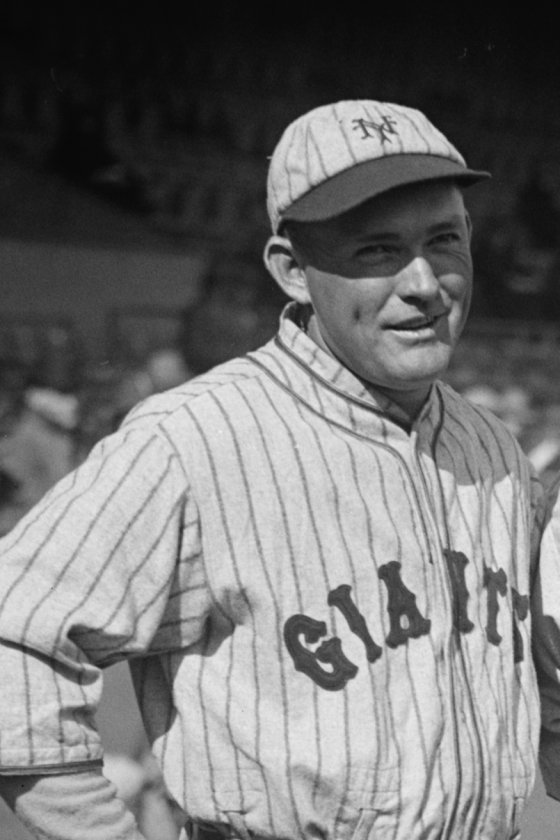
Player knowledge
Rogers Hornsby
2B 1915–1937 Hall of Fame
- Born
- April 27, 1896, in Winters, Texas
- Bats / Throws
- R/R
- Height / Weight
- 5'11", 175 lbs
- Hometown
- Fort Worth, Texas
- High School
- North Side High School
- Full Name
- Rogers Hornsby
- Died
- January 5, 1963, in Chicago, Illinois (age 66)
- Nickname
- The Rajah
- MLB Debut
- September 10, 1915, vs. Cincinnati (Robison Field)
- Final Game
- July 20, 1937, vs. New York Yankees (Sportsman’s Park)
- Uniform
- No. 4 with the Cardinals and Browns; honored by name on the Cardinals’ retired numbers display (1997)
- Batting Titles
- 7 in the NL (1920–1925, 1928), including six in a row
- Managing
- 701–812 over 14 seasons with six franchises, including the 1926 World Series title
- Hall of Fame
- Class of 1942, named on 182 of 233 ballots (78.1%)
Test your knowledge
Rogers Hornsby Quizzes
10 quizzes drawn from the story below. View the collection
The story
Bio
Rogers Hornsby hit a baseball hard, and he hit it hard more often than almost anyone who ever lived. In 1924 he batted .424, and in the century since, no big-leaguer has matched it. He won six straight batting titles, two Triple Crowns, and two MVP awards with a short, level swing from the back corner of the batter’s box. He was also famously blunt. Owners, managers, and teammates always heard exactly what he thought, and that habit cost him nearly as many jobs as his bat won him.
Hornsby was born in 1896 near Winters, Texas, and grew up on the sandlots of Fort Worth. The Cardinals bought him from a Class D club in 1915 for $600, and five years later he was the best hitter in the National League. From 1920 through 1925 he won the batting title every season, and over the last five of those years he hit .402. As player-manager he led St. Louis to its first World Series title in 1926, then was traded within weeks. He played for four more clubs, won another batting title in Boston and another MVP in Chicago, managed into the 1950s, and finished 23 seasons with a .358 career average, among the highest in history.
Here is the whole story, from Fort Worth to Cooperstown. Hornsby starred for the St. Louis Cardinals and Chicago Cubs, spent a season each with the New York Giants (today’s San Francisco Giants) and the Boston Braves (today’s Atlanta Braves), and finished as player-manager of the St. Louis Browns, the club that became the Baltimore Orioles. When you’re done, test yourself with the Cardinals and Cubs quiz collections.
Rogers Hornsby
Fort Worth Sandlots
Hornsby was born April 27, 1896, on a farm a couple of miles outside Winters, a small town in Runnels County, Texas. The family moved to a farm near Austin and then, in the winter of 1902–03, to Fort Worth, where the stockyards and meatpacking plants meant steady work.
Baseball took over early. By age nine he was leading a neighborhood team that rode the trolley to games, and he loved his blue flannel uniform so much that he wore it around the yard. At 10 he worked summers as a messenger boy at the Swift & Company packing plant, served as a batboy for a men’s team, and sometimes filled in as an infielder. By 15 he was playing with grown men in the Fort Worth City League and hiring himself out to town teams. Granbury paid him $2 a game. After one win there, when the manager praised his play at second base, the teenager answered, “Yeah, and there are eight other positions I can play just as good.”
He entered Fort Worth’s new North Side High School in 1909 and played baseball and football, sharing a backfield with future college football Hall of Famer Bo McMillin. After two years he left school for a full-time job at Swift. In 1912 he answered a newspaper ad and joined the Boston Bloomer Girls, a barnstorming team touring Texas. The job came with a wig and bloomers, but it also came with games and a paycheck, so he took it. He was nearly six feet tall and rail thin: a slick fielder, but a weak hitter.
Rogers Hornsby
Class D Shortstop
In the spring of 1914, at 17, Hornsby got a tryout with the Dallas Steers of the Class B Texas League, arranged by his older brother Everett, a longtime minor leaguer. Dallas signed him, then released him two weeks into the season without using him in a game. He headed north and made the Hugo Scouts of the Class D Texas-Oklahoma League as their shortstop for $75 a month. When Hugo folded in June, his contract went to the Denison club in the same league for $125.
It was a rough start. Hornsby weighed about 135 pounds, hit .232, and made 45 errors in 113 games. A teammate remembered him pleading, “Won’t somebody teach me how to hit?”
In 1915 Denison, renamed the Railroaders, moved to the Class D Western Association. That spring a Cardinals split squad came through town for three exhibition games, and the club’s only scout, Bob Connery, liked the way the skinny shortstop handled bad hops. He even bought Hornsby new spikes and a glove with his own money. Hornsby hit .277 in 119 games, still made 58 errors, and helped Denison win the pennant. Near the end of the season the Cardinals bought his contract for $600. It helped that the rival Federal League had thinned out big-league rosters.
Rogers Hornsby
A Little Light
Hornsby had never been north of Tulsa when he reported to the Cardinals in Cincinnati on September 3, 1915, after a 1,200-mile ride in a day coach. Manager Miller Huggins first used him on September 10 at home against the Reds, late in a 7–1 loss. He went 0-for-2. Four days later he got his first hit, a single off Brooklyn’s Rube Marquard. Huggins had him choke up about six inches on the bat, and he finished at .246 in 18 games, nearly all singles.
After the season Huggins told him, “Kid, you’re a little light, but you’ve got the makings. I think I’ll farm you out for a year.” As the story is usually told, Hornsby took him literally. He spent the winter on his uncle’s farm near Lockhart, Texas, doing farm work and eating and drinking everything in sight, especially milk. He reported to spring training in 1916 about 30 pounds heavier, and his hustle earned him the nickname “Pep.” He stopped choking up, stood deep in the box, and started lining the ball all over the field.
On Opening Day 1916, against Honus Wagner’s Pirates, he drove in both runs in a 2–1 win. He finished at .313, fourth in the league. In 1917 he hit .327 and led the National League in slugging and total bases. Branch Rickey had arrived as club president, and the two men’s careers would be tangled together for two decades. Things soured in 1918 under new manager Jack Hendricks, whom Hornsby called “a boob” in public. Rickey took over as manager in 1919, Hornsby hit .318, and John McGraw of the Giants offered big money for him. The Cardinals said no.
Rogers Hornsby
Six Straight Titles
In 1920 Rickey moved Hornsby to second base, and he stayed there for the rest of his career. That season he won his first batting title at .370, led the league in hits, doubles, and slugging, and tied for the RBI lead. The ball was livelier now, and his power grew. In 1921 he hit .397 with 21 homers and 126 RBI.
It was the start of one of the great runs in baseball history. From 1920 through 1925 he won six straight National League batting titles, and he led the league in on-base percentage and slugging in all six of those seasons too. From 1921 through 1925 his averages were .397, .401, .384, .424, and .403, a combined .402 over five full seasons.
Around this time he picked up the nickname that stuck. After Rudolph Valentino’s 1921 film The Sheik set off a craze for desert romance, Babe Ruth became the “Sultan of Swat” and Hornsby the “Rajah of Swat,” soon shortened to the Rajah. Umpires respected his eye. In one oft-repeated story, possibly a legend, a rookie pitcher complained about a close ball call, and umpire Bill Klem told him, “Son, when you pitch a strike, Mr. Hornsby will let you know.”
Rogers Hornsby
The 1922 Triple Crown
1922 was perhaps the most dominant season of his career. Hornsby won the Triple Crown with a .401 average, 42 home runs, and 152 RBI. He also led the league with 250 hits, 46 doubles, 141 runs, a .459 on-base percentage, and a .722 slugging percentage. From August 13 to September 19 he hit safely in 33 straight games.
The gaps were enormous. His average beat runner-up Ray Grimes by almost 50 points. His 42 homers were 16 more than anyone else and set a National League record at the time. His 450 total bases topped the next-best hitter, Irish Meusel, by 136, and they are still the National League single-season record. He remains the only player ever to bat .400 and hit 40 home runs in the same season.
Rogers Hornsby
Hitting .424
1923 brought trouble. Hornsby hurt his left knee in May and missed weeks. Late in the season the Cardinals decided another injury was not serious enough to keep him out, fined him $500, and suspended him for the final five games. He still won his fourth straight batting title, at .384 in 107 games. That summer he and Rickey even fought in the clubhouse before teammates pulled them apart.
Then came 1924. Hornsby batted .424, with 227 hits in 536 at-bats, and led the league with 89 walks and a .507 on-base percentage. He went hitless in only 24 of his 143 games and never more than two games in a row. In August he hit .509. No major leaguer has hit for a higher average since. The National League’s MVP award still went to Brooklyn pitcher Dazzy Vance. One voter left Hornsby off his ballot entirely, judging him a great hitter but not a team player.
His habits were nearly as famous as his swing. He did not drink or smoke, slept 12 hours a night, ate plenty of red meat, and finished most evenings with ice cream. By his own account he stayed away from movies and read little beyond the sports pages, because he believed both strained the eyes a hitter needed. On the road he sat in hotel lobbies for hours, just watching people go by. His conversation ran mostly to baseball and horse racing.
Rogers Hornsby
Player-Manager
In 1925 the Cardinals started 13–25, and owner Sam Breadon replaced Rickey as field manager while keeping him in the front office. The new manager was the 29-year-old Hornsby, who would keep playing second base. The team went 64–51 the rest of the way.
Managing did not slow him down at the plate. He hit .403 with 39 homers and 143 RBI for his second Triple Crown and sixth straight batting title, and he won the National League’s MVP award. His .756 slugging percentage stood as the National League record until 2001.
As a manager he was all business. He rarely argued with umpires, ran a strict clubhouse, and expected players to approach the game the way he did. He also said whatever crossed his mind, to anyone, including the men who signed his checks. Breadon later compared listening to him to having a rock crusher emptied over his head.
Rogers Hornsby
Champions in 1926
Nagging injuries dropped Hornsby to .317 in 1926, but his managing carried the club. During the season he added outfielder Billy Southworth and 39-year-old pitcher Grover Cleveland Alexander, and the Cardinals won their first National League pennant by two games over Cincinnati. Their World Series opponent was the powerful New York Yankees.
The Series swung back and forth. Alexander struck out 10 in a complete-game win in Game 2. Babe Ruth hit three homers in Game 4. The Yankees won Game 5 in extra innings, and Alexander answered with a 10–2 win in Game 6 at Yankee Stadium. In Game 7, St. Louis led 3–2 in the seventh when the Yankees loaded the bases with two outs. Hornsby waved Alexander in from the bullpen. Tony Lazzeri hit a long drive that hooked foul, then struck out.
Alexander held on into the ninth. With two outs he walked Ruth, and then, to everyone’s surprise, Ruth broke for second. Catcher Bob O’Farrell threw to Hornsby, who put the tag on Ruth for the final out of the World Series. For the rest of his life Hornsby called that tag the biggest thrill of his career. It was the only championship he ever won. He hit .250 in the Series with four RBI.
Rogers Hornsby
Traded After the Title
The thrill lasted less than two months. Hornsby wanted a new three-year contract at $50,000 a season. Breadon offered one year at that price, on the condition that Hornsby stay away from the racetrack. Hornsby blew up, and Breadon, who had already lined up a deal, made it. On December 20, 1926, the Cardinals traded their champion player-manager to the Giants for second baseman Frankie Frisch and pitcher Jimmy Ring. St. Louis fans were stunned. Hornsby called it the biggest disappointment of his life.
He hit .361 for New York in 1927 with 26 homers and 125 RBI, and led the league in runs, walks, and on-base percentage. When John McGraw was sidelined by illness, Hornsby ran the team and went 22–10. But he clashed with McGraw, with star Freddie Lindstrom, and with the front office, and his horse-race betting annoyed owner Charles Stoneham. When a reporter asked at dinner whether the Giants could win the pennant, Hornsby, sitting with young shortstop Doc Farrell, answered, “Not with Farrell playing shortstop.” In January 1928 the Giants traded him to the Boston Braves for Jimmy Welsh and Shanty Hogan.
Boston was a weak, cash-poor club, but Hornsby kept hitting. When manager Jack Slattery resigned in May, Hornsby took over. The Braves lost 103 games, and he hit .387 to win his seventh batting title, also leading the league in on-base percentage, slugging, and walks. Late in the race Pittsburgh’s Paul Waner, who had chased him all summer, conceded, “It looks like you’re gonna beat me.” Hornsby answered, “You didn’t doubt for a minute that I would, did you?” On November 7, 1928, owner Emil Fuchs sent him to the Chicago Cubs for five players and $200,000. It was his fourth team in four seasons.
Rogers Hornsby
The Cubs Years
Hornsby got along well with Cubs manager Joe McCarthy, and he joined a lineup with Hack Wilson, Kiki Cuyler, and Riggs Stephenson. In 1929 he played all 156 games despite a painful heel, hit .380 with 39 homers and 149 RBI, and led the league with 156 runs, still a Cubs record. He won his second MVP award, and the Cubs took the pennant by 10½ games.
The World Series against Connie Mack’s Philadelphia Athletics went badly. In Game 4 the Cubs led 8–0 in the seventh inning before the A’s scored 10 runs in that one inning. Philadelphia won in five games. Hornsby, hobbled by the heel, hit .238 and struck out eight times. After the season surgeons removed bone spurs from his heel. Around then, asked what he did in the winter, he gave his most famous answer: “I stare out the window and wait for spring.”
The heel still hurt in 1930, and in late May he broke his ankle on the bases. He played only 42 games. With four games left in the season, owner William Wrigley Jr. replaced McCarthy with Hornsby. In 1931 he hit .331 in 100 games, including three homers and eight RBI in one April game at Pittsburgh, but the Cubs finished third. His hard-driving style wore on players like Gabby Hartnett, Hack Wilson, and Billy Herman, and on club president William Veeck Sr., who fired him on August 2, 1932, with the team in second place. Under Charlie Grimm the Cubs won the pennant, and the players voted Hornsby no share of their World Series money.
Rogers Hornsby
Back in St. Louis
Breadon brought him back to the Cardinals for 1933, figuring he could still hit. He could, batting .325 in 46 games, mostly as a pinch-hitter because his feet and legs would not let him play every day. In late July the Cardinals put him on waivers, and the crosstown St. Louis Browns of the American League claimed him and made him their player-manager.
The Browns were short on money and talent. In Hornsby’s three full seasons they finished sixth, seventh, and seventh, and one year they drew barely 81,000 fans. He played rarely, but at 41 he hit .321 in 20 games in 1937. His last big-league appearance came on July 20, 1937, a pinch-hit at-bat at Sportsman’s Park against the Yankees.
The next day the Browns fired him. Accounts differ on the details, but both main versions tie the firing to his betting on horse races. Hornsby always said his betting was legal and hurt no one but himself. It had already strained his relations with Breadon, with the Giants, and with Commissioner Kenesaw Mountain Landis.
Rogers Hornsby
The Long Road Back
With no big-league club waiting, Hornsby went to the minors. He coached and managed for the International League’s Baltimore Orioles, managed Chattanooga and Oklahoma City, and in 1942 took over his hometown Fort Worth Cats. He was in Fort Worth in January 1942 when the baseball writers elected him to the National Baseball Hall of Fame, naming him on 182 of 233 ballots. He called it a “mighty nice honor” and went back to selling season tickets.
In 1944 he lasted nine days managing Veracruz in the Mexican League before quitting in a dispute with owner Jorge Pasquel. “I finally decided I’d rather be a lamppost in America than a general down there,” he said. He taught hitting in spring training for the White Sox and Indians, ran a youth program in Chicago and a baseball school in Hot Springs, Arkansas, and returned to managing in 1950. He won a Texas League pennant with Beaumont that year and the 1951 Pacific Coast League title with the Seattle Rainiers. He banned alcohol from the clubhouse, and when the Rainiers asked to celebrate with champagne, he told them, “Not till I’m out of here.”
Those wins earned him one more shot in the majors. In 1952 he chose the Browns, now owned by Bill Veeck, son of the man who had fired him in Chicago. Veeck fired him after 51 games, and the players gave their owner a trophy to celebrate. Hornsby called it a publicity stunt. Weeks later the Cincinnati Reds hired him, and he went 27–24 the rest of the way. His bluntness soon wore thin again. When pitcher Bubba Church came back to the dugout after giving up a homer on a 3-and-2 curveball, Hornsby asked loudly why he had thrown it. “Because I wanted him to hit a home run,” Church replied. Late in 1953 the Reds announced he would not return. His big-league managing record was 701–812.
Rogers Hornsby
The Rajah’s Legacy
Hornsby never managed again, but he never left the game. He taught hitting and scouted for the Cubs, scouted for the expansion Mets, and in 1962 coached for Casey Stengel’s first Mets team, which lost 120 games. Late in 1962 he entered a Chicago hospital for cataract surgery and suffered a stroke. He died there of a heart attack on January 5, 1963, at 66.
For decades his .358 career average trailed only Ty Cobb’s in the record books. Since Major League Baseball added Negro Leagues statistics in 2024, Baseball-Reference ranks him third, behind Cobb and Oscar Charleston. Ted Williams called him the greatest hitter for power and average the game had seen. Frankie Frisch, the man he was traded for, said Hornsby was “the only guy I know who could hit .350 in the dark.”
He led the National League in slugging nine times, more than anyone in league history, and he was named to MLB’s All-Century Team in 1999. The Cardinals added his name to their retired numbers display in 1997 and put him in the inaugural class of the Cardinals Hall of Fame in 2014. Only Stan Musial rivals him as the greatest hitter in Cardinals history.
Rogers Hornsby
Records and Honors
- 7 NL batting titles (1920–1925, 1928), including six in a row
- .424 in 1924: no major leaguer has hit higher since
- 2 Triple Crowns: 1922 (.401, 42 HR, 152 RBI) and 1925 (.403, 39 HR, 143 RBI)
- 2 NL MVP awards (1925, 1929)
- Three .400 seasons (1922, 1924, 1925) and a combined .402 from 1921 through 1925
- .358 career average, third all-time on Baseball-Reference’s list
- 2,930 hits, 541 doubles, 301 home runs, and 1,584 RBI
- 450 total bases in 1922: still the National League single-season record
- Led the NL in slugging nine times and in on-base percentage every year from 1920 to 1925
- 127.4 career WAR, per Baseball-Reference
- 1926 World Series champion as the Cardinals’ player-manager
- National Baseball Hall of Fame, class of 1942 (182 of 233 ballots, 78.1%)
- MLB All-Century Team (1999) and St. Louis Cardinals Hall of Fame (2014)
Rogers Hornsby
Rajah Fun Facts
- As a teenager he played for the Boston Bloomer Girls, a barnstorming team, in a wig and bloomers.
- He is the only player to bat .400 and hit 40 home runs in the same season (1922).
- In 1924 he went hitless in only 24 of his 143 games.
- He hit .424 in 1924 and still lost the MVP award to Dazzy Vance.
- Branch Rickey talked him into nine holes of golf in the spring of 1925. He shot 39 and never played again.
- By his own account he skipped movies and read little beyond the sports pages to protect his batting eye.
- He made the last putout of the 1926 World Series, tagging Babe Ruth on a steal attempt.
- In his final season, at 41, he hit .321.
Think you know the Rajah now? Prove it with all ten quizzes in the Rogers Hornsby collection, compare career averages on the Ty Cobb page, relive the 1926 World Series from the other dugout on the Babe Ruth page, meet another Cardinals legend on the Stan Musial page, or browse the full St. Louis Cardinals and Chicago Cubs quiz collections.
The postseason
October Accolades
| Year | Series | Result | G | H-AB | BA | HR | RBI |
|---|---|---|---|---|---|---|---|
| 1926 | World Series | Cardinals def. Yankees, 4–3 As player-manager, called in Grover Cleveland Alexander in Game 7, then tagged Babe Ruth out stealing for the final out | 7 | 7-28 | .250 | 0 | 4 |
| 1929 | World Series | Athletics def. Cubs, 4–1 Struck out eight times on a sore heel; the A’s erased an 8–0 deficit with a 10-run seventh in Game 4 | 5 | 5-21 | .238 | 0 | 1 |
| Postseason | 2 series | 12 | 12-49 | .245 | 0 | 5 | |
The clubs
Teams
-
St. Louis Cardinals
1915–1926, 1933
Six straight batting titles, two Triple Crowns, the .424 season, and the 1926 title as player-manager
-
Chicago Cubs
1929–1932
1929 MVP and pennant with a club-record 156 runs, then player-manager from 1930 to 1932
-
San Francisco Giants
1927
New York Giants 1927 · hit .361, led the NL in runs and walks, and filled in as manager for John McGraw
-
Atlanta Braves
1928
Boston Braves 1928 · won his seventh batting title at .387 while managing the club
-
Baltimore Orioles
1933–1937
St. Louis Browns 1933–37 · player-manager for five seasons, still hitting .321 at age 41
The numbers
Season Stats
| Season | Team | League | WAR | Games | PA | AB | Runs | Hits | RBI | 2B | 3B | HR | SB | BB | BA | OBP | SLG | OPS |
|---|---|---|---|---|---|---|---|---|---|---|---|---|---|---|---|---|---|---|
| 1915 | St. Louis Cardinals | NL | -0.3 | 18 | 61 | 57 | 5 | 14 | 4 | 2 | 0 | 0 | 0 | 2 | .246 | .271 | .281 | .552 |
| 1916 | St. Louis Cardinals | NL | 5.0 | 139 | 550 | 495 | 63 | 155 | 65 | 17 | 15 | 6 | 17 | 40 | .313 | .369 | .444 | .814 |
| 1917 | St. Louis Cardinals | NL | 10.0 | 145 | 589 | 523 | 86 | 171 | 66 | 24 | 17 | 8 | 17 | 45 | .327 | .385 | .484 | .868 |
| 1918 | St. Louis Cardinals | NL | 5.4 | 115 | 466 | 416 | 51 | 117 | 60 | 19 | 11 | 5 | 8 | 40 | .281 | .349 | .416 | .764 |
| 1919 | St. Louis Cardinals | NL | 6.5 | 138 | 577 | 512 | 68 | 163 | 71 | 15 | 9 | 8 | 17 | 48 | .318 | .384 | .430 | .814 |
| 1920 | St. Louis Cardinals | NL | 9.7 | 149 | 660 | 589 | 96 | 218 | 94 | 44 | 20 | 9 | 12 | 60 | .370 | .431 | .559 | .990 |
| 1921 | St. Louis Cardinals | NL | 10.9 | 154 | 674 | 592 | 131 | 235 | 126 | 44 | 18 | 21 | 13 | 60 | .397 | .458 | .639 | 1.097 |
| 1922 | St. Louis Cardinals | NL | 10.1 | 154 | 704 | 623 | 141 | 250 | 152 | 46 | 14 | 42 | 17 | 65 | .401 | .459 | .722 | 1.181 |
| 1923 | St. Louis Cardinals | NL | 6.8 | 107 | 487 | 424 | 89 | 163 | 83 | 32 | 10 | 17 | 3 | 55 | .384 | .459 | .627 | 1.086 |
| 1924 | St. Louis Cardinals | NL | 12.1 | 143 | 642 | 536 | 121 | 227 | 94 | 43 | 14 | 25 | 5 | 89 | .424 | .507 | .696 | 1.203 |
| 1925 | St. Louis Cardinals | NL | 10.2 | 138 | 606 | 504 | 133 | 203 | 143 | 41 | 10 | 39 | 5 | 83 | .403 | .489 | .756 | 1.245 |
| 1926 | St. Louis Cardinals | NL | 4.4 | 134 | 604 | 527 | 96 | 167 | 93 | 34 | 5 | 11 | 3 | 61 | .317 | .388 | .463 | .851 |
| 1927 | New York Giants | NL | 10.2 | 155 | 684 | 568 | 133 | 205 | 125 | 32 | 9 | 26 | 9 | 86 | .361 | .448 | .586 | 1.035 |
| 1928 | Boston Braves | NL | 8.9 | 140 | 621 | 486 | 99 | 188 | 94 | 42 | 7 | 21 | 5 | 107 | .387 | .498 | .632 | 1.130 |
| 1929 | Chicago Cubs | NL | 10.6 | 156 | 712 | 602 | 156 | 229 | 149 | 47 | 8 | 39 | 2 | 87 | .380 | .459 | .679 | 1.139 |
| 1930 | Chicago Cubs | NL | 0.4 | 42 | 120 | 104 | 15 | 32 | 18 | 5 | 1 | 2 | 0 | 12 | .308 | .385 | .433 | .817 |
| 1931 | Chicago Cubs | NL | 5.2 | 100 | 419 | 357 | 64 | 118 | 90 | 37 | 1 | 16 | 1 | 56 | .331 | .421 | .574 | .996 |
| 1932 | Chicago Cubs | NL | 0.0 | 19 | 70 | 58 | 10 | 13 | 7 | 2 | 0 | 1 | 0 | 10 | .224 | .357 | .310 | .667 |
| 1933 | St. Louis Cardinals | NL | 0.9 | 46 | 97 | 83 | 9 | 27 | 21 | 6 | 0 | 2 | 1 | 12 | .325 | .423 | .470 | .893 |
| 1933 | St. Louis Browns | AL | 0.2 | 11 | 11 | 9 | 2 | 3 | 2 | 1 | 0 | 1 | 0 | 2 | .333 | .455 | .778 | 1.232 |
| 1934 | St. Louis Browns | AL | 0.3 | 24 | 31 | 23 | 2 | 7 | 11 | 2 | 0 | 1 | 0 | 7 | .304 | .484 | .522 | 1.006 |
| 1935 | St. Louis Browns | AL | -0.1 | 10 | 27 | 24 | 1 | 5 | 3 | 3 | 0 | 0 | 0 | 3 | .208 | .296 | .333 | .630 |
| 1936 | St. Louis Browns | AL | 0.1 | 2 | 6 | 5 | 1 | 2 | 2 | 0 | 0 | 0 | 0 | 1 | .400 | .500 | .400 | .900 |
| 1937 | St. Louis Browns | AL | 0.1 | 20 | 63 | 56 | 7 | 18 | 11 | 3 | 0 | 1 | 0 | 7 | .321 | .397 | .429 | .825 |
| Career | 23 seasons | NL/AL | 127.6 | 2,259 | 9,481 | 8,173 | 1,579 | 2,930 | 1,584 | 541 | 169 | 301 | 135 | 1,038 | .358 | .434 | .577 | 1.010 |