Player knowledge
Rod Carew
2B / 1B 1967–1985 Hall of Fame
- Born
- October 1, 1945, in Gatún, Panama Canal Zone
- Bats / Throws
- L/R
- Height / Weight
- 6'0", 170 lbs
- Hometown
- Washington Heights (New York City), New York
- High School
- George Washington High School
- Full Name
- Rodney Cline Carew
- Born
- October 1, 1945, aboard a train in Gatún, Panama Canal Zone
- MLB Debut
- April 11, 1967, at Baltimore (Memorial Stadium)
- Final Game
- October 5, 1985, vs. Texas
- Uniform
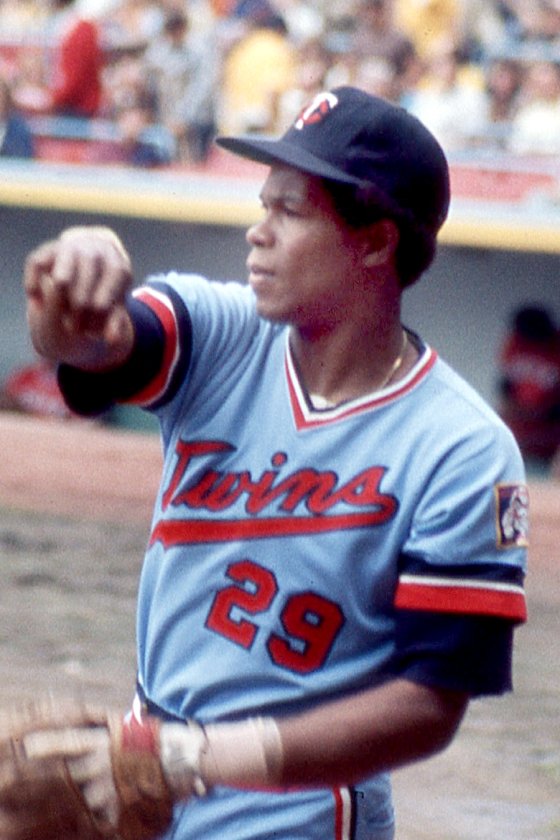
- No. 29, retired by the Angels (1986) and the Twins (1987)
- Batting Titles
- Seven, all with the Twins (1969, 1972–1975, 1977, 1978)
- All-Star Games
- 18 straight selections (1967–1984)
- Hall of Fame
- Class of 1991, first ballot, 90.5% of the vote
The story
Bio
Rod Carew could put a baseball almost anywhere he wanted. He crouched low in the box, held the bat loosely, and slapped, bunted, and lined hits to every corner of the field. Pitchers tried inside, outside, hard, and soft. “He has no weakness as a hitter,” Catfish Hunter said. For a generation of American League fans, his name simply meant “batting champion.”
Rodney Cline Carew was born on a train in the Panama Canal Zone, grew up in Panama and in Washington Heights, and never played a game of high school baseball. A Twins scout found him on the New York sandlots. He became Rookie of the Year, stole home seven times in one season, won seven batting titles, and chased .400 deep into the summer of 1977 on his way to the MVP award. He collected 3,053 hits, made 18 straight All-Star teams, and walked into Cooperstown on his first try. Decades later, a donated heart gave him a second life.
Here is the whole story, from a segregated rail car in Panama to the Twins, the Angels, and the Hall of Fame. When you’re done, see how much stuck with the Rod Carew Twins quiz.
Rod Carew
Born on a Train
On October 1, 1945, Olga Carew went into labor on a train in Gatún, in the Panama Canal Zone, while riding toward the hospital in Ancón. She was seated in the rear car, the section set aside for non-white passengers. A nurse named Margaret Allen came to help, and a doctor on board, Dr. Rodney Cline, finished the delivery. Olga named her son after him: Rodney Cline Carew. The nurse became his godmother.
Home was not easy. His father, Eric, was a painter who drank heavily and beat his sons. In his 2020 memoir, One Tough Out, Carew wrote that baseball was what kept him from turning on his father. His mother and his uncle Joseph French, a gym teacher, steered him toward the game. French got him into Little League in Gamboa. Before that, the boy hit bottle caps with a broomstick.
Rod Carew
The Washington Heights Sandlots
Olga left Panama for New York City to build a better life and to get her children away from Eric. As a teenager, Rod followed her to Washington Heights in upper Manhattan. He enrolled at George Washington High School, worked as a stock clerk at a grocery store, and fought to master English. He did not play for the high school team. Books and work came first.
In 1964 he joined the Cavaliers, a sandlot club in the Bronx Federation League. Every ball he hit seemed to be a line drive. Monroe Katz, whose son Steve played on the team, was a bird-dog scout for the Minnesota Twins, and he tipped off Herb Stein, the club’s New York scout, who worked full time as a New York City Transit Police officer. Stein told Carew his wrists exploded through the ball. The Twins brought him to a tryout at Yankee Stadium when they were in town, and he sprayed hits all over the field. As the story goes, manager Sam Mele ended the session early so the Yankees wouldn’t notice. On June 24, 1964, after he graduated, Carew signed with Minnesota for $400 a month.
Rod Carew
Marines and the Minors
Carew began his pro career with the Melbourne Twins in the Cocoa Rookie League and hit .325 over 37 games. In 1965 he hit .303 and stole 52 bases for Class A Orlando, and in 1966 he played second base for the Wilson Tobs in North Carolina.
He also served six years in the U.S. Marine Corps Reserve as a combat engineer, even though he was not yet an American citizen. He later said the Marines cured his temper. After two weeks of war games every summer, he realized baseball was not life or death, and that discipline made him the player he became.
Rod Carew
Rookie of the Year
Carew made his debut on April 11, 1967, at Baltimore’s Memorial Stadium. In his first at-bat he singled off Dave McNally, and he finished 2-for-4. The Twins, he said later, expected him to hit .240 and play second base. He hit .292, started the All-Star Game at second base in Anaheim, and won the AL Rookie of the Year award with 19 of 20 first-place votes. It was the first of 18 straight All-Star selections.
Minnesota spent that summer in one of the wildest pennant races ever. The Twins went into the final weekend at Fenway Park with a one-game lead, lost both games to Boston, and the Red Sox took the pennant.
Rod Carew
Stealing Home
In 1969 the Twins hired Billy Martin as manager, and Martin wanted his hitters to run. He drilled Carew on stealing home, and Carew did it seven times that season, five of them in the first inning. Only Ty Cobb, with eight in 1912, had ever done it more often in one year. On May 18, 1969, against Detroit, Carew stole second, third, and home in the same inning. He also won his first batting title at .332, and Minnesota won the first AL West crown before Baltimore swept them in the playoffs. Martin was fired after the season, but Carew always called him a friend who gave him fatherly advice.
On May 20, 1970, at Kansas City, Carew hit for the first cycle in Twins history. He was hitting well above .350 on June 22 when Milwaukee’s Mike Hegan slid hard into him at second base on a double-play ball. Carew’s left knee buckled. He needed surgery for torn ligaments and came back only to pinch-hit in September. Minnesota won the division again, and Baltimore swept them again.
That October, on the 24th, Carew married Marilynn Levy. Some people objected to an interracial marriage between an Episcopalian and a Jewish woman, and the couple received death threats. Carew brushed them off.
Rod Carew
Batting Champion
Carew’s method looked simple. He studied pitchers, changed his stance from one pitcher to the next, and could bunt for a hit almost at will. In 1972 he won the batting title at .318 without hitting a single home run, the first batting champion with no homers since Zack Wheat in 1918. Then he won it again at .350 in 1973, .364 in 1974, and .359 in 1975, four titles in a row.
Late in 1975 he moved from second base to first, and the next spring new manager Gene Mauch made the switch permanent to save wear on his body. In 1976 the batting race came down to the last day, with the Twins playing in Kansas City. The Royals’ George Brett went 3-for-4 to finish at .333, his teammate Hal McRae ended at .332, and Carew, who had a career-high 49 steals, settled for .331.
Rod Carew
Chasing .400
1977 was the summer everybody watched Rod Carew. He was hitting over .400 from late June until July 10, and in the week of July 18 he was on the covers of both Sports Illustrated and Time, which called him “Baseball’s Best Hitter.” Twins manager Gene Mauch said Carew had nothing left to prove and could retire and wait for the Hall of Fame to call.
The heat and the long season wore him down a little, but only a little. Carew finished at .388, the highest average since Ted Williams hit the same mark in 1957. He also set career highs with 239 hits, the most by any player since 1930, plus 128 runs, 100 RBI, and 16 triples. He won the AL MVP award with 12 first-place votes, and he also received the Roberto Clemente Award for his work with young people in the Twin Cities.
Rod Carew
Leaving Minnesota
Carew won his seventh and final batting title at .333 in 1978, but his relationship with owner Calvin Griffith was falling apart. In September 1978, speaking to a Lions Club in Waseca, Minnesota, Griffith made racist remarks about why he had moved the franchise to Minnesota and called Carew a “damn fool” for playing for $170,000 a year. A reporter was in the room. Carew answered that he would never sign another contract with Griffith’s club and would not play for a bigot.
Carew could veto any trade, and several clubs bid. A deal with the Yankees fell apart, and on February 3, 1979, Minnesota sent him to the California Angels for outfielder Ken Landreaux, utility man Dave Engle, and pitchers Paul Hartzell and Brad Havens. The Angels made him, by his own account, the highest-paid player in baseball. Years later Carew softened. He phoned Griffith to thank him after his Hall of Fame election, and in 2020 he said that Griffith’s words were wrong and hurtful but that he had forgiven him.
Rod Carew
Halo Years
In Anaheim, Carew joined a lineup that already had Don Baylor, Bobby Grich, and Brian Downing. In 1979 the Angels won their first division title, and in their first postseason series ever Carew hit .412 against Baltimore. The Orioles still won, three games to one.
He kept hitting .300 or better every year through 1983, which stretched his streak to 15 straight .300 seasons (1969–1983). In 1982 the Angels added Reggie Jackson and won the West again. They beat Milwaukee in the first two games of the ALCS, then lost three in a row, and Carew made the last out of Game 5 on a ground ball to shortstop Robin Yount.
Rod Carew
Hit No. 3,000
On August 4, 1985, at Anaheim Stadium, Carew lined a single to left field off Minnesota’s Frank Viola for his 3,000th hit. Of all the teams to do it against, it was his old one. He became the 16th player to reach 3,000, on the same afternoon that Tom Seaver won his 300th game in New York. “If you stay around long enough,” Carew said, “good things happen to you.”
It was his last season. The Angels did not re-sign him, and the only offer to keep playing in 1986 came from the San Francisco Giants. He turned it down and retired at 40 with a .328 career average. Carew suspected the owners had shut him out, and in January 1995 an arbitrator ruled in the collusion cases that he had been harmed and awarded him $782,035.71.
Rod Carew
Cooperstown and Coaching
The Angels retired his No. 29 in 1986, and the Twins followed on July 19, 1987. In January 1991 Carew was elected to the Hall of Fame on his first ballot, named on 401 of 443 ballots, or 90.5 percent. He went in that summer alongside pitchers Gaylord Perry and Ferguson Jenkins, wearing a Twins cap on his plaque, and became the first Hall of Famer from Panama. In 2004 Panama City renamed its national stadium Estadio Rod Carew.
He was never far from a batting cage. Carew was the Angels’ hitting coach from 1992 through 1999 and helped develop young hitters such as Tim Salmon, Jim Edmonds, and Garret Anderson. He spent 2000 and 2001 in the same job with the Milwaukee Brewers.
His hardest fight came in between. In September 1995 his youngest daughter, Michelle, was diagnosed with leukemia. Her mixed heritage made a bone-marrow match hard to find, so Carew, long a private man, went public and pleaded for donors, especially from minority communities. No match was found. Michelle died on April 17, 1996, at 18.
Rod Carew
A Heart of 29
In September 2015 Carew suffered a massive heart attack on a California golf course. He spent more than six weeks in the hospital, and doctors implanted a mechanical pump to keep his heart working. In 2016 he teamed with the American Heart Association on the Heart of 29 campaign, named for his uniform number, to raise awareness of heart disease, and the Twins greeted him at spring training wearing Heart of 29 shirts. That July, before the All-Star Game in San Diego, the American League batting title was renamed in his honor, and the National League’s for Tony Gwynn.
In December 2016 Carew received a new heart and a new kidney. Months later the donor was revealed: Konrad Reuland, a former NFL tight end who had played for the Jets and Ravens, died on December 12, 2016, after a brain aneurysm. He was 29, the same number Carew wore for 19 seasons. Reuland had gone to middle school with Carew’s children and met him there at age 11, then went home telling his mother he wanted to be a pro athlete too. On New Year’s Day 2018, Carew rode the Donate Life float in the Rose Parade in Konrad’s honor.
On August 23, 2024, at 78, Carew became a United States citizen. In September 2026 he was still dropping by ballparks, paying the Twins a clubhouse visit in Anaheim, and on October 1, 2026, he turned 81.
Rod Carew
Records and Honors
- Seven AL batting titles (1969, 1972–1975, 1977, 1978): second only to Ty Cobb in American League history
- 1977 AL MVP: .388 average, 239 hits, 128 runs, and 100 RBI
- 3,053 hits and a .328 career average over 19 seasons
- 15 straight .300 seasons (1969–1983)
- 18 consecutive All-Star selections (1967–1984)
- 1967 AL Rookie of the Year
- 7 steals of home in 1969, one shy of Ty Cobb’s single-season record
- 81.2 career WAR, per Baseball-Reference
- 1977 Roberto Clemente Award
- National Baseball Hall of Fame, class of 1991 (first ballot, 90.5%), the first Hall of Famer from Panama
- No. 29 retired by the Angels (1986) and the Twins (1987); the AL batting title has carried his name since 2016
Rod Carew
Carew Fun Facts
- He is named for Dr. Rodney Cline, the physician who delivered him on the train.
- His first bat was a broomstick, and his first baseballs were bottle caps.
- He never played a game of high school baseball.
- He won the 1972 batting title without hitting a home run.
- On May 18, 1969, he stole second, third, and home in the same inning.
- Adam Sandler’s 1994 “The Chanukah Song” claimed he had converted to Judaism. He never did, though he raised his daughters in their mother’s Jewish faith, and he wrote Sandler to say he found the song pretty funny.
- His 3,000th hit came on the same day Tom Seaver won his 300th game.
- His heart donor died at 29, the uniform number Carew wore his whole career.
Think you know Rod Carew now? Prove it with all ten quizzes in the Rod Carew collection, take the Rod Carew Twins quiz and the Rod Carew Angels quiz, compare him with the only man to win more AL batting titles on the Ty Cobb page, meet the NL batting king who shares his award on the Tony Gwynn page, or browse the full Minnesota Twins and Los Angeles Angels quiz collections.
The postseason
October Accolades
| Year | Series | Result | G | H-AB | BA | HR | RBI |
|---|---|---|---|---|---|---|---|
| 1969 | ALCS | Orioles def. Twins, 3–0 A 1-for-14 series; Baltimore won the first two games in extra innings | 3 | 1-14 | .071 | 0 | 0 |
| 1970 | ALCS | Orioles def. Twins, 3–0 Back from knee surgery, he went hitless in two pinch-hit at-bats | 2 | 0-2 | .000 | 0 | 0 |
| 1979 | ALCS | Orioles def. Angels, 3–1 Hit .412 with three doubles in the first postseason series in Angels history | 4 | 7-17 | .412 | 0 | 1 |
| 1982 | ALCS | Brewers def. Angels, 3–2 The Angels won the first two games, then lost three straight; he made the final out | 5 | 3-17 | .176 | 0 | 0 |
| Postseason | 4 series | 14 | 11-50 | .220 | 0 | 1 | |
The clubs
Teams
-
Minnesota Twins
1967–1978
Rookie of the Year, all seven batting titles, the .388 MVP season of 1977, and No. 29 retired
-
Los Angeles Angels
1979–1985
The club’s first two division titles, hit No. 3,000, and No. 29 retired in Anaheim
The numbers
Season Stats
| Season | Team | League | WAR | Games | PA | AB | Runs | Hits | RBI | 2B | 3B | HR | SB | BB | BA | OBP | SLG | OPS |
|---|---|---|---|---|---|---|---|---|---|---|---|---|---|---|---|---|---|---|
| 1967 | Minnesota Twins | AL | 2.8 | 137 | 561 | 514 | 66 | 150 | 51 | 22 | 7 | 8 | 5 | 37 | .292 | .341 | .409 | .750 |
| 1968 | Minnesota Twins | AL | 1.8 | 127 | 492 | 461 | 46 | 126 | 42 | 27 | 2 | 1 | 12 | 26 | .273 | .312 | .347 | .659 |
| 1969 | Minnesota Twins | AL | 5.5 | 123 | 504 | 458 | 79 | 152 | 56 | 30 | 4 | 8 | 19 | 37 | .332 | .386 | .467 | .853 |
| 1970 | Minnesota Twins | AL | 2.1 | 51 | 204 | 191 | 27 | 70 | 28 | 12 | 3 | 4 | 4 | 11 | .366 | .407 | .524 | .930 |
| 1971 | Minnesota Twins | AL | 2.4 | 147 | 632 | 577 | 88 | 177 | 48 | 16 | 10 | 2 | 6 | 45 | .307 | .356 | .380 | .736 |
| 1972 | Minnesota Twins | AL | 5.4 | 142 | 591 | 535 | 61 | 170 | 51 | 21 | 6 | 0 | 12 | 43 | .318 | .369 | .379 | .749 |
| 1973 | Minnesota Twins | AL | 7.0 | 149 | 657 | 580 | 98 | 203 | 62 | 30 | 11 | 6 | 41 | 62 | .350 | .411 | .471 | .881 |
| 1974 | Minnesota Twins | AL | 7.5 | 153 | 690 | 599 | 86 | 218 | 55 | 30 | 5 | 3 | 38 | 74 | .364 | .433 | .446 | .879 |
| 1975 | Minnesota Twins | AL | 7.8 | 143 | 617 | 535 | 89 | 192 | 80 | 24 | 4 | 14 | 35 | 64 | .359 | .421 | .497 | .919 |
| 1976 | Minnesota Twins | AL | 6.8 | 156 | 687 | 605 | 97 | 200 | 90 | 29 | 12 | 9 | 49 | 67 | .331 | .395 | .463 | .858 |
| 1977 | Minnesota Twins | AL | 9.7 | 155 | 694 | 616 | 128 | 239 | 100 | 38 | 16 | 14 | 23 | 69 | .388 | .449 | .570 | 1.019 |
| 1978 | Minnesota Twins | AL | 5.0 | 152 | 651 | 564 | 85 | 188 | 70 | 26 | 10 | 5 | 27 | 78 | .333 | .411 | .441 | .853 |
| 1979 | California Angels | AL | 2.6 | 110 | 493 | 409 | 78 | 130 | 44 | 15 | 3 | 3 | 18 | 73 | .318 | .419 | .391 | .810 |
| 1980 | California Angels | AL | 3.4 | 144 | 612 | 540 | 74 | 179 | 59 | 34 | 7 | 3 | 23 | 59 | .331 | .396 | .437 | .833 |
| 1981 | California Angels | AL | 3.0 | 93 | 421 | 364 | 57 | 111 | 21 | 17 | 1 | 2 | 16 | 45 | .305 | .380 | .374 | .753 |
| 1982 | California Angels | AL | 4.7 | 138 | 612 | 523 | 88 | 167 | 44 | 25 | 5 | 3 | 10 | 67 | .319 | .396 | .403 | .799 |
| 1983 | California Angels | AL | 2.3 | 129 | 536 | 472 | 66 | 160 | 44 | 24 | 2 | 2 | 6 | 57 | .339 | .409 | .411 | .820 |
| 1984 | California Angels | AL | 0.9 | 93 | 378 | 329 | 42 | 97 | 31 | 8 | 1 | 3 | 4 | 40 | .295 | .367 | .353 | .720 |
| 1985 | California Angels | AL | 0.5 | 127 | 518 | 443 | 69 | 124 | 39 | 17 | 3 | 2 | 5 | 64 | .280 | .371 | .345 | .717 |
| Career | 19 seasons | AL | 81.2 | 2,469 | 10,550 | 9,315 | 1,424 | 3,053 | 1,015 | 445 | 112 | 92 | 353 | 1,018 | .328 | .393 | .429 | .822 |