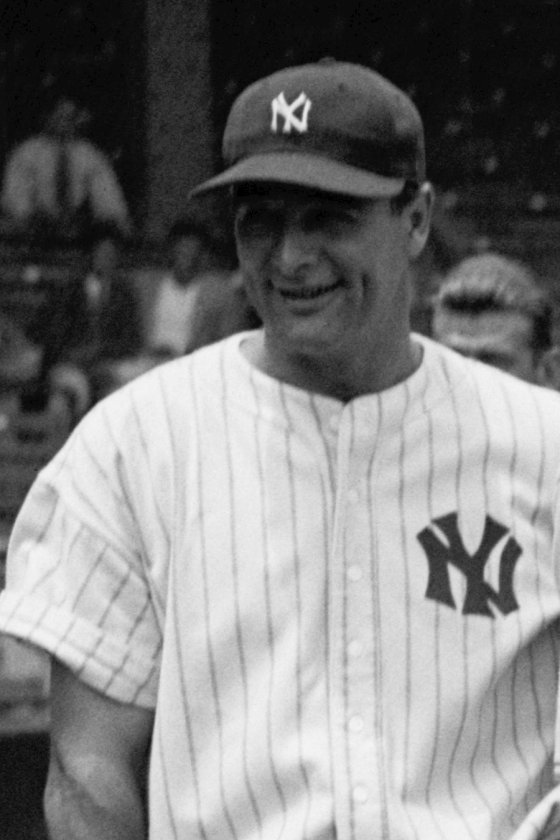
Player knowledge
Lou Gehrig
1B 1923–1939 Hall of Fame
- Born
- June 19, 1903, in New York, New York
- Bats / Throws
- L/L
- Height / Weight
- 6'0", 200 lbs
- High School
- High School of Commerce
- Full Name
- Henry Louis Gehrig
- Died
- June 2, 1941, Bronx, New York (age 37)
- Nicknames
- The Iron Horse, Larrupin’ Lou, Columbia Lou
- MLB Debut
- June 15, 1923, vs. St. Louis Browns (Yankee Stadium)
- Final Game
- April 30, 1939, vs. Washington Senators (Yankee Stadium)
- Uniform
- No. 4 (1929–1939), retired by the Yankees in 1939, the first retired number in MLB history
- Consecutive Games
- 2,130 (June 1, 1925–April 30, 1939), the record until 1995
- Hall of Fame
- Elected December 7, 1939, in a special BBWAA vote that waived the waiting period
The story
Bio
Lou Gehrig showed up. For nearly 14 years he never missed a game: 2,130 in a row, through broken fingers, back spasms, and beanings. As a high schooler he hit a grand slam out of the ballpark now called Wrigley Field. As a Yankee he hit four homers in one afternoon at Shibe Park and drove in 185 runs in a single season, still the American League record. He did most of it batting right behind Babe Ruth, the loudest star in the game, and most of it without saying much at all. Then, at 36, he stood at a microphone at Yankee Stadium and called himself the luckiest man on the face of the earth.
Henry Louis Gehrig grew up in Manhattan, starred at Columbia University, and signed with the Yankees in 1923. He took over first base from Wally Pipp in June 1925 and kept it until May 1939. Along the way he won two MVP awards and the 1934 Triple Crown, played on six World Series champions, and finished with 493 home runs, 1,995 RBI, and a .340 average. When a mysterious weakness ended his streak, doctors at the Mayo Clinic found amyotrophic lateral sclerosis, the disease Americans now often call by his name. He died in 1941, at 37.
Here is the whole story, from the sandlots of upper Manhattan to Murderers’ Row, the farewell at Yankee Stadium, and Cooperstown. He spent all 17 of his big-league seasons with the New York Yankees. When you’re done, see how much stuck with the Lou Gehrig Yankees quiz.
Lou Gehrig
A Kid from Manhattan
Gehrig was born June 19, 1903, in Manhattan’s Yorkville neighborhood, to German immigrant parents; his mother worked as a cook and housekeeper, including at a Columbia University fraternity house, and Lou was the only one of their four children to survive early childhood. He spoke German at home and went by Lou. When he was about five, the family moved uptown to Washington Heights, a short walk from Hilltop Park and the Polo Grounds.
That was all it took. Lou became a Giants fan, saving his quarters for left-field bleacher seats, and one of the best sandlot players in the city. At the High School of Commerce he starred in both baseball and football.
On June 26, 1920, Commerce traveled to Chicago to play Lane Tech in a game between the champions of the two cities. More than 10,000 people filled Cubs Park, the ballpark later renamed Wrigley Field. Commerce led 8–6 in the ninth when the 17-year-old Gehrig came up with the bases loaded. He hit a grand slam over the right-field wall and out of the big-league park. The Chicago Tribune marveled that the blow came from a boy who had not yet started to shave. A New York paper called him “Babe” Gehrig, the first of many Ruth comparisons.
Lou Gehrig
Columbia Lou
Gehrig finished at Commerce in January 1921 and headed to Columbia University on a football scholarship, planning to study engineering. Before he ever played for Columbia, the Giants noticed him. As the story is usually told, he crushed balls during a tryout at the Polo Grounds, then let a grounder roll through his legs, and manager John McGraw lost interest. Giants scout Arthur Irwin steered him to the Hartford Senators of the Eastern League anyway.
That summer Gehrig played a dozen games for Hartford under the name Lou Lewis. Playing for pay, even under a fake name, broke college rules. Columbia coach Andy Coakley found out and persuaded rival schools to accept a lighter penalty than expulsion: Gehrig lost a year of college eligibility. He returned in the fall of 1922 as a bruising fullback for the Columbia football team.
In spring 1923 “Columbia Lou” played first base and pitched for the baseball team. He hit .444 with 7 home runs, school records, and some of his drives were still talked about decades later. On April 18, 1923, the day Yankee Stadium opened, he struck out 17 Williams College batters, another school record. Yankees scout Paul Krichell was following him. After watching Gehrig homer twice against Rutgers, Krichell told general manager Ed Barrow he had found another Babe Ruth. Gehrig signed with the Yankees in late April 1923.
Lou Gehrig
Seasoning in Hartford
Gehrig made his big-league debut on June 15, 1923, as a late-inning replacement at first base in a 10–0 win over the St. Louis Browns at Yankee Stadium. The Yankees already had a fine first baseman, Wally Pipp, so they sent him back to Hartford, this time under his own name. He hit .304 with 24 home runs in 59 games.
Called back in September, he finished his first big-league season 11-for-26, a .423 average. Manager Miller Huggins wanted him on the World Series roster against the Giants, but McGraw objected and Commissioner Kenesaw Mountain Landis said no. The Yankees won their first title without him.
Gehrig spent most of 1924 in Hartford again and tore the Eastern League apart: .369 with 37 home runs in 134 games. In another September call-up he went 6-for-12. He was ready.
Lou Gehrig
Wally Pipp’s Headache
In early 1925 Gehrig was a pinch hitter and spare part. On June 1, 1925, he pinch-hit for shortstop Paul “Pee Wee” Wanninger. Nobody noticed at the time, but that was game one of the streak. The next day, June 2, Huggins started him at first base in place of Pipp. Gehrig went 3-for-5, and Huggins told him the job was his.
The famous version of the story says Pipp showed up with a headache, asked for two aspirin, and Huggins gave him the day off. Pipp later joked that he took “the two most expensive aspirins in history.” In 1953 he told a different tale: a batting-practice fastball hit him in the head, and he spent two weeks in the hospital. That beaning was real, but it happened on July 2, a month after Gehrig took over.
The likelier truth is less colorful. Pipp was hitting .244, the Yankees were stuck in seventh place, and Huggins shook up his lineup, benching Pipp, Aaron Ward, and Wally Schang the same day. Gehrig finished 1925 with a .295 average and 20 home runs, and in January 1926 the Yankees sold Pipp to Cincinnati.
Lou Gehrig
Murderers’ Row
In 1926, his first full season, Gehrig hit .313 with 47 doubles, 109 RBI, and a league-leading 20 triples. In his first World Series game he drove in both runs in a 2–1 win over the Cardinals, and he hit .348 for the Series, but St. Louis won in seven games.
Then came 1927. Batting cleanup behind Ruth, Gehrig anchored the lineup New York writers called Murderers’ Row. For most of the summer he matched Ruth homer for homer. They were tied at 25 at the end of June and tied again at 44 on Labor Day. Ruth then caught fire and finished with a record 60. Gehrig finished with 47, along with a .373 average, a league-leading 173 RBI, 52 doubles, and 18 triples. His 117 extra-base hits trailed only Ruth’s 119 in 1921 on the all-time list.
The Yankees went 110–44 and swept Pittsburgh in the World Series, with Gehrig contributing two doubles and two triples. He was named the American League’s Most Valuable Player; under the rules of the day, past winners like Ruth were not eligible. That fall the two sluggers toured the country on a barnstorming trip, leading local teams called the Larrupin’ Lous and the Bustin’ Babes.
Lou Gehrig
In Ruth’s Shadow
The pair were a study in contrasts. Ruth was loud, generous, and always in the papers. Gehrig was shy, careful, and happiest out of the spotlight. Early on they were friends who went fishing together; by the mid-1930s they had drifted apart and rarely spoke. On the field, though, they were the most feared one-two punch in baseball.
In the 1928 World Series, another sweep of the Cardinals, Gehrig hit .545 with 4 home runs and 9 RBI. Ruth hit .625 and grabbed the headlines with three homers in Game 4. When the Yankees added numbers to their uniforms in 1929, they were assigned by spot in the batting order. Ruth, batting third, got No. 3. Gehrig, batting fourth, got No. 4. That September, Huggins, the only big-league manager Gehrig had known, died after a short illness.
Gehrig hit .379 with 41 homers and 173 RBI in 1930. In 1931, under new manager Joe McCarthy, he drove in 185 runs, still the American League record, and collected 211 hits and 163 runs. He tied Ruth for the home run lead at 46, and it should have been 47. On April 26, 1931, against the Senators, his drive cleared the fence and bounced back into an outfielder’s glove. Teammate Lyn Lary, on base, thought it had been caught and left the base path, and Gehrig was called out for passing him.
Lou Gehrig
Four in One Day
On June 3, 1932, at Shibe Park in Philadelphia, Gehrig homered in his first three times up against the Athletics’ George Earnshaw, then hit a fourth off reliever Roy Mahaffey. He was the first player in the 20th century to hit four home runs in a game. In the ninth he had a chance for a fifth and drove a ball to deep center, where Al Simmons made a leaping catch. “Well, Lou,” McCarthy told him, “nobody can take today away from you.”
The newspapers nearly did. The same day, John McGraw announced his retirement after 30 years as manager of the Giants, and McGraw got the big headlines.
That October the Yankees swept the Cubs, and Gehrig hit .529 with 3 home runs, 9 runs, and 8 RBI. In Game 3 at Wrigley Field, Ruth made the gesture that became the called shot and hit Charlie Root’s next pitch into the center-field seats. Whether Ruth really pointed to center field is still argued; in a radio interview a few days later, rediscovered in 2020, Gehrig said he did. What is not in doubt is what came next: Gehrig hit Root’s very next pitch for a home run, his second of the game. As usual, the Babe got the headlines.
Lou Gehrig
The Iron Horse
By 1931 sportswriters were calling Gehrig the Iron Horse. He played through broken fingers, back trouble, and beanings, and a few times he kept the streak alive with a single at-bat. In 1933 a reporter, Dan Daniel, told him how close he was to the record. Gehrig said he had no idea.
On August 17, 1933, at Sportsman’s Park in St. Louis, Gehrig played in his 1,308th consecutive game, breaking the record of former Yankees shortstop Everett Scott. American League president Will Harridge presented him with a silver statuette at home plate. Gehrig shrugged it off. He called the streak “a real stunt,” and said he doubted anybody else would try it.
That July he had started at first base in baseball’s first All-Star Game, at Comiskey Park, the first of seven straight All-Star selections. In 1933 he married Eleanor Twitchell.
Lou Gehrig
Triple Crown Captain
In 1934, Ruth’s last season in New York, Gehrig led the league in all three Triple Crown categories: a .363 average, 49 home runs, and 166 RBI. Ruth left for the Boston Braves that winter, and in 1935 McCarthy named Gehrig the Yankees captain. With less protection in the lineup, pitchers worked around him, and he drew a career-high 132 walks.
Just as Gehrig stepped out of Ruth’s shadow, a new one fell across him. Joe DiMaggio, 21 and already famous from the Pacific Coast League, arrived in 1936 and took over the headlines. Gehrig had the better year anyway. He hit .354, led the league with 49 homers, 167 runs, a .478 on-base percentage, and a .696 slugging percentage, and won his second MVP award.
The Yankees beat the Giants in the 1936 and 1937 World Series. Gehrig homered off the Giants’ ace Carl Hubbell in both, and his Game 4 homer in 1937 was the 10th and last of his World Series career. In 1937 he hit .351 with 37 homers and 158 RBI, his last great season.
Lou Gehrig
The Power Fades
On May 31, 1938, Gehrig played his 2,000th straight game. As the summer went on, though, something was wrong. He tried a lighter bat and a new stance, then went back to his old one. He still hit .295 with 29 homers and 114 RBI, and the Yankees swept the Cubs for a third straight title, but all four of his World Series hits were singles.
In spring training of 1939 he looked worse. On Opening Day he lined out to a Red Sox rookie named Ted Williams. After eight games he was hitting .143 with one RBI. One writer noticed that he was meeting the ball squarely and it simply wasn’t going anywhere. When he struggled to reach first base in time to take a routine throw, pitcher Johnny Murphy told him, “Nice play, Lou.” Gehrig later said that was when he knew something was wrong with him.
His last game was April 30, 1939, against Washington. On May 2 in Detroit, he went to McCarthy before the game and said, “I’m benching myself, Joe,” for the good of the team. As captain, he carried the lineup card to home plate himself. Babe Dahlgren played first base. The public-address announcer at Briggs Stadium told the crowd it was the first time in 2,130 consecutive games that Gehrig’s name was not in the Yankees lineup, and the Detroit fans stood and cheered him.
Lou Gehrig
The Luckiest Man
In June 1939, Gehrig went to the Mayo Clinic in Rochester, Minnesota. After six days of tests, doctors confirmed on June 19, his 36th birthday, that he had amyotrophic lateral sclerosis, or ALS, a rare and incurable disease that gradually destroys the nerves that control the muscles. His playing career was over.
The Yankees declared July 4, 1939, Lou Gehrig Appreciation Day. Between games of a doubleheader against the Senators, 61,808 fans watched members of the 1927 team, including Ruth, return to honor him. Wally Pipp and Everett Scott came too. Mayor Fiorello La Guardia spoke, McCarthy spoke through tears, and the gifts included a silver trophy from his teammates and one from the rival Giants. Gehrig, who disliked speaking in public, finally stepped to the microphone.
“Fans, for the past two weeks you have been reading about a bad break,” he began. “Today I consider myself the luckiest man on the face of the earth.” He thanked the fans, his teammates, his managers, and the people closest to him, and he closed: “I might have been given a bad break, but I’ve got an awful lot to live for.” The crowd stood and cheered for nearly two minutes, and Ruth threw his arms around him. The speech has been called baseball’s Gettysburg Address. That year the Yankees retired his No. 4, the first number ever retired in Major League Baseball. On December 7, 1939, the baseball writers elected him to the Hall of Fame in a special vote that waived the usual waiting period. At 36, he was the youngest player ever elected at the time.
Lou Gehrig
Parole Commissioner
Gehrig wanted to work, and he wanted the work to matter. In October 1939 Mayor La Guardia appointed him to a 10-year term on the New York City Parole Commission, and he was sworn in on January 2, 1940. He turned down more lucrative offers to take the job. He visited the city’s jails and prisons and asked that reporters stay away. He kept going to his office as his strength faded and stepped down about a month before his death.
Gehrig died at his home in the Bronx on June 2, 1941, at 37, sixteen years to the day after he replaced Wally Pipp at first base. Mayor La Guardia ordered flags in the city lowered to half-staff, and ballparks around the country did the same. A month later the Yankees dedicated a monument to him in center field at Yankee Stadium. It praised him as “a man, a gentleman and a great ballplayer.”
Lou Gehrig
The Pride of the Yankees
Hollywood told his story within a year. The Pride of the Yankees (1942) starred Gary Cooper as Gehrig, with Ruth and several former teammates playing themselves. It earned 11 Academy Award nominations and won for film editing, and Cooper’s re-creation of the “luckiest man” line became one of the most famous in movie history. His widow, Eleanor, spent the rest of her life raising money and awareness for ALS research.
The honors kept coming. Since 1955 his Columbia fraternity, Phi Delta Theta, has presented the Lou Gehrig Memorial Award to the major leaguer who best shows his character and integrity on and off the field. In 1969 the baseball writers voted him the greatest first baseman of all time. On Mickey Mantle Day that June, Mantle told the Yankee Stadium crowd, “Now I think I know how Lou Gehrig felt.” In 1999 fans made Gehrig the top vote-getter on the MLB All-Century Team.
His streak lasted 56 years. On September 6, 1995, Baltimore’s Cal Ripken Jr. played his 2,131st consecutive game, and Ripken eventually stretched the record to 2,632. In 2021, Major League Baseball made June 2 Lou Gehrig Day, honoring both the day he became the Yankees’ first baseman and the day he died, and using it to raise awareness of ALS. In the United States the disease is still widely known as Lou Gehrig’s disease.
Lou Gehrig
Records and Honors
- 2 AL MVP awards (1927, 1936)
- 1934 AL Triple Crown: .363, 49 HR, 166 RBI
- 185 RBI in 1931: still the American League single-season record
- 2,130 consecutive games (1925–1939), the major-league record until Cal Ripken Jr. in 1995
- 6 World Series titles (1927, 1928, 1932, 1936, 1937, 1938) and 7 All-Star selections (1933–1939)
- 493 home runs, 1,995 RBI, and a .340/.447/.632 slash line
- 13 straight seasons with 100 runs and 100 RBI (1926–1938), and seven seasons of 150 or more RBI
- Led the AL in RBI five times and in home runs three times
- First player of the 20th century to hit four home runs in a game (June 3, 1932)
- 23 career grand slams, the record until Alex Rodriguez passed him in 2013
- 113.5 career WAR, per Baseball-Reference
- No. 4 retired by the Yankees (1939), the first retired number in MLB history
- National Baseball Hall of Fame (special election, December 1939) and top vote-getter on the MLB All-Century Team (1999)
Lou Gehrig
Iron Horse Fun Facts
- He wore No. 4 because he batted fourth, right behind Ruth’s No. 3.
- He struck out 17 batters for Columbia on April 18, 1923, the day Yankee Stadium opened.
- His first pro games, for Hartford in 1921, were played under the name Lou Lewis.
- A teammate’s base-running mistake cost him a home run in 1931, and he ended up tied with Ruth for the league lead instead of winning it outright.
- He homered on the pitch right after Babe Ruth’s called shot in the 1932 World Series.
- He played himself in Rawhide (1938), a Western and his only feature film.
- He never had a formal Hall of Fame induction ceremony; Cooperstown finally gave him a special tribute in 2013.
- In 1989, 50 years after his streak ended, the U.S. Postal Service issued a Lou Gehrig stamp.
Think you know the Iron Horse now? Prove it with all ten quizzes in the Lou Gehrig collection, take the Lou Gehrig Yankees quiz, revisit his Murderers’ Row partner on the Babe Ruth page, meet the Yankees legends who followed him on the Mickey Mantle and Yogi Berra pages, or browse the full New York Yankees quiz collection.
The postseason
October Accolades
| Year | Series | Result | G | H-AB | BA | HR | RBI |
|---|---|---|---|---|---|---|---|
| 1926 | World Series | Cardinals def. Yankees, 4–3 Drove in both runs in a 2–1 Game 1 win and hit .348, but St. Louis took Game 7 | 7 | 8-23 | .348 | 0 | 4 |
| 1927 | World Series | Yankees def. Pirates, 4–0 Two doubles and two triples as Murderers’ Row swept Pittsburgh | 4 | 4-13 | .308 | 0 | 4 |
| 1928 | World Series | Yankees def. Cardinals, 4–0 Hit .545 with four homers, two of them in Game 3, in another sweep | 4 | 6-11 | .545 | 4 | 9 |
| 1932 | World Series | Yankees def. Cubs, 4–0 Hit .529; homered on the pitch after Ruth’s called shot in Game 3, his second of the day | 4 | 9-17 | .529 | 3 | 8 |
| 1936 | World Series | Yankees def. Giants, 4–2 Homered in Games 3 and 4, the second off Carl Hubbell | 6 | 7-24 | .292 | 2 | 7 |
| 1937 | World Series | Yankees def. Giants, 4–1 His Game 4 homer off Carl Hubbell was the 10th and last of his World Series career | 5 | 5-17 | .294 | 1 | 3 |
| 1938 | World Series | Yankees def. Cubs, 4–0 Four singles in his final Series as the Yankees won a third straight title | 4 | 4-14 | .286 | 0 | 0 |
| Postseason | 7 series | 34 | 43-119 | .361 | 10 | 35 | |
The clubs
Teams
-
New York Yankees
1923–1939
Two MVPs, the 1934 Triple Crown, six titles, 2,130 straight games, and the first retired number in MLB history
The numbers
Season Stats
| Season | Team | League | WAR | Games | PA | AB | Runs | Hits | RBI | 2B | 3B | HR | SB | BB | BA | OBP | SLG | OPS |
|---|---|---|---|---|---|---|---|---|---|---|---|---|---|---|---|---|---|---|
| 1923 | New York Yankees | AL | 0.4 | 13 | 29 | 26 | 6 | 11 | 8 | 4 | 1 | 1 | 0 | 2 | .423 | .464 | .769 | 1.234 |
| 1924 | New York Yankees | AL | 0.2 | 10 | 13 | 12 | 2 | 6 | 5 | 1 | 0 | 0 | 0 | 1 | .500 | .538 | .583 | 1.122 |
| 1925 | New York Yankees | AL | 3.2 | 126 | 497 | 437 | 73 | 129 | 68 | 23 | 10 | 20 | 6 | 46 | .295 | .365 | .531 | .896 |
| 1926 | New York Yankees | AL | 6.9 | 155 | 697 | 572 | 135 | 179 | 109 | 47 | 20 | 16 | 6 | 105 | .313 | .420 | .549 | .969 |
| 1927 | New York Yankees | AL | 11.9 | 155 | 717 | 584 | 149 | 218 | 173 | 52 | 18 | 47 | 10 | 109 | .373 | .474 | .765 | 1.240 |
| 1928 | New York Yankees | AL | 9.5 | 154 | 678 | 562 | 139 | 210 | 147 | 47 | 13 | 27 | 4 | 95 | .374 | .467 | .648 | 1.115 |
| 1929 | New York Yankees | AL | 7.5 | 154 | 694 | 553 | 127 | 166 | 125 | 32 | 10 | 35 | 4 | 122 | .300 | .431 | .584 | 1.015 |
| 1930 | New York Yankees | AL | 9.6 | 154 | 703 | 581 | 143 | 220 | 173 | 42 | 17 | 41 | 12 | 101 | .379 | .473 | .721 | 1.194 |
| 1931 | New York Yankees | AL | 8.6 | 155 | 738 | 619 | 163 | 211 | 185 | 31 | 15 | 46 | 17 | 117 | .341 | .446 | .662 | 1.108 |
| 1932 | New York Yankees | AL | 8.2 | 156 | 708 | 596 | 138 | 208 | 151 | 42 | 9 | 34 | 4 | 108 | .349 | .451 | .621 | 1.072 |
| 1933 | New York Yankees | AL | 7.1 | 152 | 687 | 593 | 138 | 198 | 140 | 41 | 12 | 32 | 9 | 92 | .334 | .424 | .605 | 1.030 |
| 1934 | New York Yankees | AL | 10.0 | 154 | 690 | 579 | 128 | 210 | 166 | 40 | 6 | 49 | 9 | 109 | .363 | .465 | .706 | 1.172 |
| 1935 | New York Yankees | AL | 8.3 | 149 | 673 | 535 | 125 | 176 | 120 | 26 | 10 | 30 | 8 | 132 | .329 | .466 | .583 | 1.049 |
| 1936 | New York Yankees | AL | 9.7 | 155 | 719 | 579 | 167 | 205 | 152 | 37 | 7 | 49 | 3 | 130 | .354 | .478 | .696 | 1.174 |
| 1937 | New York Yankees | AL | 8.2 | 157 | 700 | 569 | 138 | 200 | 158 | 37 | 9 | 37 | 4 | 127 | .351 | .473 | .643 | 1.116 |
| 1938 | New York Yankees | AL | 4.6 | 157 | 689 | 576 | 115 | 170 | 114 | 32 | 6 | 29 | 6 | 107 | .295 | .410 | .523 | .932 |
| 1939 | New York Yankees | AL | -0.3 | 8 | 33 | 28 | 2 | 4 | 1 | 0 | 0 | 0 | 0 | 5 | .143 | .273 | .143 | .416 |
| Career | 17 seasons | AL | 113.6 | 2,164 | 9,665 | 8,001 | 1,888 | 2,721 | 1,995 | 534 | 163 | 493 | 102 | 1,508 | .340 | .447 | .632 | 1.080 |