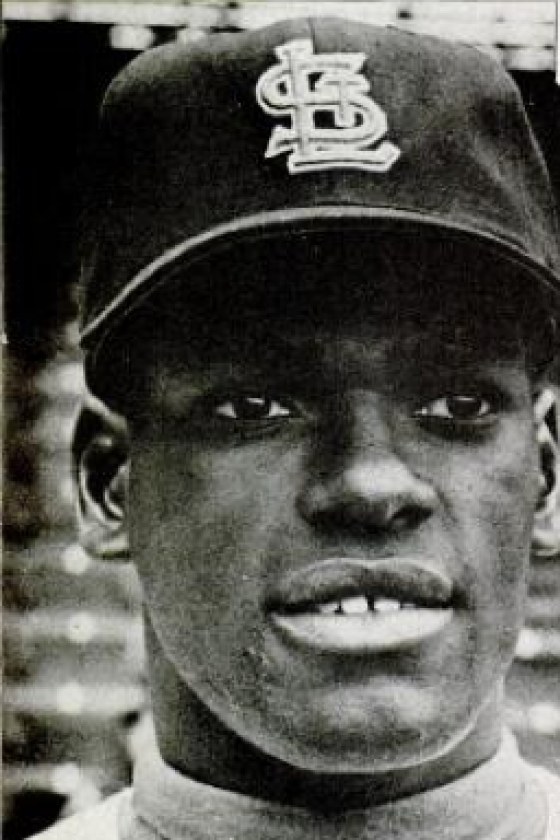
Player knowledge
Bob Gibson
P 1959–1975 Hall of Fame
- Born
- November 9, 1935, in Omaha, Nebraska
- Bats / Throws
- R/R
- Height / Weight
- 6'1", 189 lbs
- High School
- Omaha Technical High School
- Full Name
- Pack Robert Gibson (he later had “Pack” legally dropped)
- Died
- October 2, 2020, in Omaha, Nebraska (age 84)
- Nicknames
- Hoot, Gibby
- MLB Debut
- April 15, 1959, vs. Los Angeles Dodgers (Los Angeles Memorial Coliseum)
- Final Game
- September 3, 1975, vs. Chicago Cubs
- Uniform
- No. 45, retired by the Cardinals on September 1, 1975
- 1968 Season
- 22–9, 1.12 ERA, 13 shutouts, NL Cy Young and NL MVP
- World Series
- 7–2 with a 1.89 ERA and 92 strikeouts in three Series
- Hall of Fame
- Class of 1981, first ballot, 84.0% of the vote
The story
Bio
Bob Gibson pitched like the game was a personal insult. He worked fast, glared in for the sign, and finished every delivery tumbling toward first base as if he had been fired from a cannon. Hitters who crowded the plate learned to regret it. In 1968 he put up a 1.12 ERA, the lowest of the live-ball era, and he was so dominant that baseball lowered the pitcher’s mound the next year.
Gibson grew up in Omaha, starred in basketball at Creighton, and toured with the Harlem Globetrotters before choosing baseball. He spent all 17 of his big-league seasons with the Cardinals. He survived a manager who doubted him, broke his leg on a line drive and came back to win a World Series, and won two Cy Young Awards, an MVP, and nine Gold Gloves. In October he was nearly unbeatable: 7–2 in three World Series with two World Series MVP awards. When he retired, only Walter Johnson had more strikeouts.
Here is the whole story, from the ballfields of north Omaha to the mound at Busch Stadium and the plaque gallery in Cooperstown. His entire career belonged to the St. Louis Cardinals. When you’re done, test yourself with the Bob Gibson Cardinals quiz.
Bob Gibson
Omaha and Josh
Gibson was born November 9, 1935, in Omaha, Nebraska, the youngest of seven children, and was raised by his mother. He was born Pack Robert Gibson but never cared for the first name and later had it legally dropped. He was a sickly child, battling rickets and breathing trouble, yet he could always be found outside with a ball.
His oldest brother, Josh Gibson, was the coach who shaped him. Josh, no relation to the Negro Leagues catcher of the same name, ran youth programs at a recreation center near home. He organized basketball and baseball teams, and Bob played on all of them. On Josh’s baseball team, the Y Monarchs, Bob caught and played shortstop and pitched only now and then. In 1951 the Monarchs became the first Black team to win Omaha’s American Legion city championship.
Basketball was his first love. At Omaha Technical High School he was a unanimous all-city pick as a senior. Baseball was harder. He was kept off the team as a junior, officially for reporting a day late to tryouts. Years later he learned that the coach at the time did not allow Black players. So he ran track instead and set an Omaha indoor record in the high jump. A new coach arrived for his senior year, and Gibson pitched, played the outfield, and hit .368.
Bob Gibson
Creighton and the Globetrotters
Cardinals scout Runt Marr offered him a modest contract out of high school, but Josh insisted on college. Indiana University turned Gibson away, saying it already had its “quota” of Black players. With Josh’s help he landed at Creighton University in Omaha as the school’s first African American basketball scholarship player. He left as Creighton’s career leader in scoring average at 20.2 points per game, and the school later retired his basketball number, 45.
He played baseball at Creighton, too, for a coach named Bill Fitch, who went on to a long career coaching in the NBA. Gibson caught, pitched, and played third base and the outfield. As a senior he led his conference with a .333 average and went 6–2 on the mound.
In the spring of 1957, the Harlem Globetrotters came to Omaha and invited a local college player to suit up for the opposing college all-stars. Gibson got in late in the third quarter and played so well that the Globetrotters recruited him. The Cardinals still wanted him, too, so he worked out a deal: finish the summer in the Cardinals’ farm system, then tour with the Globetrotters for four months. After that, he chose baseball for good.
Bob Gibson
Learning in the Minors
Gibson reported to Triple-A Omaha in June 1957. His manager there, Johnny Keane, told the infielder-catcher-pitcher to focus on pitching. Gibson never forgot how Keane treated him. Keane, he said, was “the closest thing to a saint that I ever came across in baseball.” He won his first pro game on June 23, beating Columbus, Ohio, 4–3.
In July the Cardinals sent him to Class A Columbus, Georgia, in the South Atlantic League. In the segregated South he had to live and eat in the Black part of town, away from his teammates, and fans shouted racial taunts from the stands. He went 4–3 in eight starts and was glad to leave.
At spring training in St. Petersburg, Florida, in 1958, he again had to live apart from his white teammates. That season he split time between Omaha and Triple-A Rochester and went 8–9 with a 2.84 ERA. League managers voted his fastball the best in the league.
Bob Gibson
The Hemus Years
Gibson made the Cardinals in 1959 under a new player-manager, Solly Hemus. He debuted on April 15, 1959, against the Dodgers in Los Angeles, and the first batter he faced, Jim Baxes, hit a home run. He went back to the minors, returned in late July, and won his first big-league start on July 30 with a shutout of the Cincinnati Reds.
The next two years were a grind. Hemus bounced him between the bullpen and the rotation, and between St. Louis and the minors. Gibson and his roommate Curt Flood both said Hemus told them they would never make it in the majors. Gibson felt Hemus barely knew him: the manager kept calling him “Bridges,” mixing him up with Marshall Bridges, an older, skinnier, left-handed pitcher who was also Black. After a fight with Pirates pitcher Bennie Daniels, Hemus told his own team that he had used a racial slur against Daniels. For Gibson and Flood, that settled any doubt about how their manager saw them.
The Cardinals fired Hemus on July 6, 1961, and promoted Johnny Keane. Keane put Gibson in the rotation and left him there. Gibson went 11–6 the rest of the way and finished 13–12 with a 3.24 ERA.
Bob Gibson
Keane’s Faith
With Keane behind him and sharper control of his fastball and slider, Gibson broke through in 1962. He made his first All-Star team, went 15–13 with a 2.85 ERA, and struck out 208. In September he broke his ankle during batting practice, which ended his season early.
The Cardinals were also changing off the field. In the early 1960s Gibson, Flood, and first baseman Bill White pushed for Black and white players to be housed together, and the club ended its segregated spring training arrangements. Gibson also challenged white teammates directly. One hot spring day on the team bus, he asked a young Tim McCarver, a catcher from Memphis, for a lick of his ice-cream cone. McCarver stammered that he would “save him some.” The two later became close friends, and McCarver credited Gibson with helping him overcome the prejudices he had grown up with.
In 1963 Gibson started slowly after his ankle injury, then won 18 games and drove in 20 runs. With teammate Stan Musial playing his final season, the Cardinals made a hard September run but finished six games out. “Gibby is one of baseball’s greatest competitors,” Musial said.
Bob Gibson
October 1964
On August 23, 1964, the Cardinals trailed the Phillies by 11 games. Then Philadelphia collapsed, losing 10 straight in late September, and St. Louis got hot. Gibson went 9–2 in his last 11 starts. On the final day of the season, with the pennant on the line against the Mets, he came out of the bullpen in the fifth inning and threw four innings of relief for his 19th win. The Cardinals won the pennant.
In the World Series against the Yankees, Gibson faced Mel Stottlemyre three times. He lost Game 2, then won Game 5 at Yankee Stadium. Keane handed him the ball for Game 7 in St. Louis on just two days’ rest. Gibson was running on fumes by the ninth, when Phil Linz and Clete Boyer homered to make it 7–5, but Keane left him in. Gibson retired Bobby Richardson for the final out, and the Cardinals were champions for the first time since 1946.
He struck out 31 batters in the Series, a record at the time, and was named World Series MVP. Asked why he stayed with a tired pitcher, Keane said simply that he was committed to Gibson’s heart. In the clubhouse, he quietly told his ace, “Hoot, you’re on your way.” Keane resigned right after the Series, and Red Schoendienst took over.
Bob Gibson
Broken Leg, Big October
Gibson won 20 games for the first time in 1965, getting No. 20 against Houston on the final day, and won 21 in 1966. He also began a run of nine straight Gold Gloves in 1965. The Cardinals, though, finished seventh and then sixth.
In 1967 the Cardinals rolled into first place. Then, on July 15, 1967, Pittsburgh’s Roberto Clemente lined a ball off Gibson’s right leg. Gibson didn’t know the leg was broken. He pitched to three more batters before his right fibula snapped just above the ankle. The young staff held the fort, and Gibson returned on September 7. The Cardinals won 101 games and the pennant by 10½ games.
The World Series against the Boston Red Sox belonged to him. Gibson won Games 1, 4, and 7, all complete games, and Game 4 was a five-hit shutout. He allowed just 14 hits and three earned runs in 27 innings for a 1.00 ERA. In Game 7 he beat Boston’s Cy Young winner, Jim Lonborg, and even homered off him. Gibson was named World Series MVP for the second time. That winter his first autobiography, From Ghetto to Glory, came out.
Bob Gibson
The Year of the Pitcher
Pitchers ruled baseball in 1968. Detroit’s Denny McLain won 31 games, and Don Drysdale threw 58⅔ straight scoreless innings. Gibson topped them all. He went 22–9 with a 1.12 ERA, the lowest since Dutch Leonard’s 0.96 in 1914, and threw 28 complete games and 13 shutouts. In June and July he won all 12 of his starts, eight of them shutouts, with a 0.50 ERA. Along the way he won 15 straight games and threw 47 consecutive scoreless innings.
He still lost nine times, because his team rarely scored. Two of the losses were 1–0, including a no-hitter by the Giants’ Gaylord Perry on September 17. The Cardinals won the pennant by nine games. Gibson won the NL Cy Young Award unanimously and the NL MVP. McLain won both awards in the American League, the only year pitchers have swept both MVPs.
Game 1 of the World Series, on October 2, 1968, matched Gibson against McLain. Gibson struck out at least one Tiger in every inning. In the ninth, after a leadoff single, he struck out Al Kaline, Norm Cash, and Willie Horton to finish a shutout with 17 strikeouts, breaking Sandy Koufax’s World Series record of 15. He beat McLain again in Game 4, 10–1, and homered. Game 7 was scoreless into the seventh before Jim Northrup hit a two-run triple over center fielder Curt Flood’s head. Mickey Lolich and the Tigers won, 4–1. Gibson finished the Series with 35 strikeouts, another record.
Bob Gibson
A Lower Mound
After 1968, baseball decided hitters needed help. For 1969 it shrank the strike zone and lowered the mound from 15 inches to 10. Some still call those changes the “Gibson rules.”
They barely slowed him down. In 1969 he went 20–13 with a 2.18 ERA and 28 complete games. On May 12 against the Dodgers he struck out the side on nine pitches, an immaculate inning. In 1970 he fought through a July slump, even experimenting with a knuckleball, then got hot. On August 12 he pitched all 14 innings of a 5–4 win over San Diego. He won 23 games and his second Cy Young Award, and he also hit .303.
Bob Gibson
No-Hitter in Pittsburgh
On August 4, 1971, Gibson beat the Giants for his 200th career win. Ten days later, on August 14, 1971, he no-hit the Pittsburgh Pirates, 11–0, at Three Rivers Stadium. He struck out 10, including the final batter, and drove in three runs himself. It was the first no-hitter in Pittsburgh since 1907, and it came against the team that would win that year’s World Series.
In 1972 he started 0–5, then won 19 games. On June 21 against San Diego he passed Jesse Haines for the most wins in Cardinals history. That summer he made his final All-Star team.
Bob Gibson
The Intimidator
“For my money, the most intimidating, arrogant pitcher ever to kick up dirt on a mound is Bob Gibson,” wrote Tim McCarver. Gibson worked quickly, with pinpoint control of a hard slider and two different fastballs. Vin Scully said he pitched as though he was double-parked. As Joe Posnanski tells it, Hank Aaron once warned young teammate Dusty Baker not to dig in, stare, or smile against Gibson.
He did not make friends with opponents, even at All-Star Games. After catching him in the 1965 All-Star Game, Joe Torre complimented him in the shower. Gibson said nothing, got dressed, and left. Even his own catchers got the treatment. When McCarver once came out for a mound visit, Gibson sent him back: “The only thing you know about pitching is that it’s hard to hit.”
Gibson insisted the menace was exaggerated. He pitched inside, and any batter who leaned over the plate could expect a close one, but he rarely hit anyone on purpose. He hit 102 batters in his career, fewer than Don Drysdale’s 154, despite facing more hitters. He preferred the word intensity to meanness, and he called pitching about 90 percent mental. He also joked that he only glared because he couldn’t see the catcher’s signs. He never wore his glasses on the mound.
Bob Gibson
3,000 and Out
Knee trouble marked his final seasons. In August 1973 he tore cartilage in his knee running the bases, and the Cardinals lost the division to the Mets by 1½ games. On July 17, 1974, he struck out Cincinnati’s César Gerónimo for his 3,000th strikeout. Only Walter Johnson had reached the mark before him, and Gibson was the first to do it in the National League.
He announced in January 1975 that it would be his last season. He went 3–10 that year, moved to the bullpen, and earned his final win in relief against the Phillies on July 27. The Cardinals retired his No. 45 on September 1, 1975, and he pitched for the last time on September 3. He left with 251 wins, a 2.91 ERA, 255 complete games, 56 shutouts, and 3,117 strikeouts, then a National League record.
Bob Gibson
Cooperstown and Beyond
Gibson was elected to the National Baseball Hall of Fame in 1981, his first year on the ballot, named on 337 of 401 ballots for 84.0 percent. That same year his old teammate Joe Torre, then managing the Mets, hired him as an “attitude coach,” a title nobody in the majors had held before. Gibson followed Torre to Atlanta as pitching coach from 1982 through 1984, and the Braves won the NL West in 1982. He later hosted a Cardinals radio show on KMOX, worked a season as an ESPN analyst, and served as Torre’s pitching coach again with the Cardinals in 1995.
He told his story in print several times. Stranger to the Game (1994), written with Lonnie Wheeler, is his frank autobiography. In Sixty Feet, Six Inches (2009) he and Reggie Jackson traded views on the battle between pitcher and hitter, and Pitch by Pitch (2015) walked through his 17-strikeout game. In 1999 he was named to MLB’s All-Century Team, and in 2014 he joined the inaugural class of the Cardinals Hall of Fame. A bronze statue of Gibson by Harry Weber stands outside Busch Stadium.
Gibson died of pancreatic cancer on October 2, 2020, in Omaha, at age 84, 52 years to the day after his 17-strikeout game. He had been treated for more than a year. Cardinals fans gathered at his statue to pay their respects, and in 2021 the team wore a “45” patch on their uniforms in his memory.
Bob Gibson
Records and Honors
- 2 NL Cy Young Awards (1968, 1970) and the 1968 NL MVP
- 2 World Series MVP awards (1964, 1967) and two World Series titles
- 1.12 ERA in 1968, the live-ball era record, with 13 shutouts
- 9 consecutive Gold Gloves (1965–1973)
- Picked for nine All-Star Games in eight seasons (1962 had two games)
- 251 wins and 3,117 strikeouts: second only to Walter Johnson in strikeouts at his retirement, and the first NL pitcher to 3,000
- 17 strikeouts in Game 1 of the 1968 World Series, still the Series record, and 35 strikeouts in that Series
- 7–2 with a 1.89 ERA in World Series play, with seven straight complete-game wins
- No-hitter at Pittsburgh on August 14, 1971
- Cardinals career leader in wins, starts, complete games, shutouts, innings, and strikeouts
- National Baseball Hall of Fame, class of 1981 (first ballot, 84.0%)
- No. 45 retired by the Cardinals (1975), MLB All-Century Team (1999), and Cardinals Hall of Fame (2014)
Bob Gibson
Gibby Fun Facts
- He played four months with the Harlem Globetrotters before committing to baseball.
- Creighton retired his basketball No. 45, the same number the Cardinals retired for him.
- He set an Omaha indoor high jump record in high school.
- In 1968, whenever he didn’t finish a game, it was because he had been lifted for a pinch hitter. No manager pulled him from the mound all season.
- He is one of two pitchers, with Dave McNally, to hit two home runs in World Series play.
- He batted .303 in 1970 and hit 24 home runs in his career.
- He didn’t wear glasses on the mound, so Tim McCarver painted his fingernails to make the signs easier to see.
- Joe Torre’s title for him on the 1981 Mets, “attitude coach,” was a first in the majors.
Ready to face Gibby? Take all ten quizzes in the Bob Gibson collection, try the Bob Gibson Cardinals quiz, visit his teammate on the Stan Musial page and his co-author on the Reggie Jackson page, or browse the full St. Louis Cardinals quiz collection.
The postseason
October Accolades
| Year | Series | Result | G | W-L | IP | ERA | H | BB | SO |
|---|---|---|---|---|---|---|---|---|---|
| 1964 | World Series | Cardinals def. Yankees, 4–3 World Series MVP; lost Game 2, won Game 5 at Yankee Stadium, then won Game 7 on two days’ rest with a then-record 31 strikeouts for the Series | 3 | 2-1 | 27.0 | 3.00 | 23 | 8 | 31 |
| 1967 | World Series | Cardinals def. Red Sox, 4–3 World Series MVP; three complete-game wins, a five-hit shutout in Game 4, and a home run off Jim Lonborg in Game 7 | 3 | 3-0 | 27.0 | 1.00 | 14 | 5 | 26 |
| 1968 | World Series | Tigers def. Cardinals, 4–3 Struck out a record 17 Tigers in a Game 1 shutout and homered in a Game 4 win, then lost Game 7 to Mickey Lolich, 4–1 | 3 | 2-1 | 27.0 | 1.67 | 18 | 4 | 35 |
| Postseason | 3 series | 9 | 7-2 | 81.0 | 1.89 | 55 | 17 | 92 | |
The clubs
Teams
-
St. Louis Cardinals
1959–1975
Two Cy Youngs, the 1968 MVP, two World Series MVPs, 251 wins, 3,117 strikeouts, and No. 45 retired
The numbers
Season Pitching Stats
| Season | Team | League | WAR | W | L | ERA | G | GS | CG | SHO | SV | IP | H | R | ER | HR | BB | SO | WHIP |
|---|---|---|---|---|---|---|---|---|---|---|---|---|---|---|---|---|---|---|---|
| 1959 | St. Louis Cardinals | NL | 1.5 | 3 | 5 | 3.33 | 13 | 9 | 2 | 1 | 0 | 75.2 | 77 | 35 | 28 | 4 | 39 | 48 | 1.533 |
| 1960 | St. Louis Cardinals | NL | -0.6 | 3 | 6 | 5.61 | 27 | 12 | 2 | 0 | 0 | 86.2 | 97 | 61 | 54 | 7 | 48 | 69 | 1.673 |
| 1961 | St. Louis Cardinals | NL | 4.4 | 13 | 12 | 3.24 | 35 | 27 | 10 | 2 | 1 | 211.1 | 186 | 91 | 76 | 13 | 119 | 166 | 1.443 |
| 1962 | St. Louis Cardinals | NL | 5.6 | 15 | 13 | 2.85 | 32 | 30 | 15 | 5 | 1 | 233.2 | 174 | 84 | 74 | 15 | 95 | 208 | 1.151 |
| 1963 | St. Louis Cardinals | NL | 2.3 | 18 | 9 | 3.39 | 36 | 33 | 14 | 2 | 0 | 254.2 | 224 | 110 | 96 | 19 | 96 | 204 | 1.257 |
| 1964 | St. Louis Cardinals | NL | 6.0 | 19 | 12 | 3.01 | 40 | 36 | 17 | 2 | 1 | 287.1 | 250 | 106 | 96 | 25 | 86 | 245 | 1.169 |
| 1965 | St. Louis Cardinals | NL | 6.3 | 20 | 12 | 3.07 | 38 | 36 | 20 | 6 | 1 | 299.0 | 243 | 110 | 102 | 34 | 103 | 270 | 1.157 |
| 1966 | St. Louis Cardinals | NL | 6.1 | 21 | 12 | 2.44 | 35 | 35 | 20 | 5 | 0 | 280.1 | 210 | 90 | 76 | 20 | 78 | 225 | 1.027 |
| 1967 | St. Louis Cardinals | NL | 2.5 | 13 | 7 | 2.98 | 24 | 24 | 10 | 2 | 0 | 175.1 | 151 | 62 | 58 | 10 | 40 | 147 | 1.089 |
| 1968 | St. Louis Cardinals | NL | 11.2 | 22 | 9 | 1.12 | 34 | 34 | 28 | 13 | 0 | 304.2 | 198 | 49 | 38 | 11 | 62 | 268 | 0.853 |
| 1969 | St. Louis Cardinals | NL | 10.4 | 20 | 13 | 2.18 | 35 | 35 | 28 | 4 | 0 | 314.0 | 251 | 84 | 76 | 12 | 95 | 269 | 1.102 |
| 1970 | St. Louis Cardinals | NL | 8.9 | 23 | 7 | 3.12 | 34 | 34 | 23 | 3 | 0 | 294.0 | 262 | 111 | 102 | 13 | 88 | 274 | 1.190 |
| 1971 | St. Louis Cardinals | NL | 5.0 | 16 | 13 | 3.04 | 31 | 31 | 20 | 5 | 0 | 245.2 | 215 | 96 | 83 | 14 | 76 | 185 | 1.185 |
| 1972 | St. Louis Cardinals | NL | 7.1 | 19 | 11 | 2.46 | 34 | 34 | 23 | 4 | 0 | 278.0 | 226 | 83 | 76 | 14 | 88 | 208 | 1.129 |
| 1973 | St. Louis Cardinals | NL | 3.9 | 12 | 10 | 2.77 | 25 | 25 | 13 | 1 | 0 | 195.0 | 159 | 71 | 60 | 12 | 57 | 142 | 1.108 |
| 1974 | St. Louis Cardinals | NL | 1.5 | 11 | 13 | 3.83 | 33 | 33 | 9 | 1 | 0 | 240.0 | 236 | 111 | 102 | 24 | 104 | 129 | 1.417 |
| 1975 | St. Louis Cardinals | NL | -0.3 | 3 | 10 | 5.04 | 22 | 14 | 1 | 0 | 2 | 109.0 | 120 | 66 | 61 | 10 | 62 | 60 | 1.670 |
| Career | 17 seasons | NL | 81.8 | 251 | 174 | 2.91 | 528 | 482 | 255 | 56 | 6 | 3,884.1 | 3,279 | 1,420 | 1,258 | 257 | 1,336 | 3,117 | 1.188 |