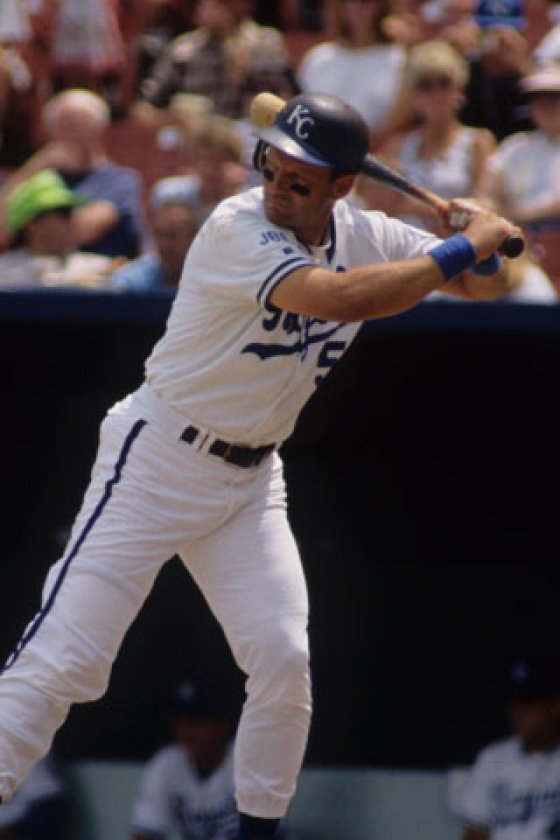
Player knowledge
George Brett
3B / 1B 1973–1993 Hall of Fame
- Born
- May 15, 1953, in Glen Dale, West Virginia
- Bats / Throws
- L/R
- Height / Weight
- 6'0", 185 lbs
- Hometown
- El Segundo, California
- High School
- El Segundo High School
- Full Name
- George Howard Brett
- Nicknames
- Mullet, courtesy of hitting coach Charley Lau
- MLB Debut
- August 2, 1973, vs. Chicago White Sox at Comiskey Park
- Final Game
- October 3, 1993, at Arlington Stadium
- Uniform
- No. 25 (1973–1974), No. 5 (1975–1993); No. 5 retired by the Royals in 1994
- Batting Titles
- 1976 (.333), 1980 (.390), and 1990 (.329), the only player to win one in three decades
- Postseason
- .337 with 10 home runs in 43 games
- Hall of Fame
- Class of 1999, first ballot, 98.2% of the vote
The story
Bio
George Brett spent all 21 of his big-league seasons with one team, and to a lot of fans he simply is the Kansas City Royals. He hit .390 in 1980, the closest anyone has come to .400 over a full season since Ted Williams. He won batting titles in three different decades, something no one else has done. And he gave baseball one of its most replayed tantrums, sprinting out of the dugout at Yankee Stadium over a little too much pine tar.
George Howard Brett was the kid brother in a family of ballplayers, a Southern California beach kid whom plenty of scouts passed over. A hitting coach rebuilt his swing in his first full season, and two years later he was a batting champion. He hit with a chaw in his cheek and pine tar instead of batting gloves, played through a long list of injuries, and saved his best for October: a .337 average and 10 home runs in 43 postseason games, a pennant-clinching blast off Goose Gossage, and the 1985 World Series title. He finished with 3,154 hits and went into the Hall of Fame on 98.2 percent of the ballots.
Here is the whole story, from the beaches of El Segundo to Royals Stadium, Yankee Stadium, and Cooperstown. Every one of his 2,707 games came for the Kansas City Royals, so when you’re done, see how much stuck with the George Brett Royals quiz.
George Brett
The Kid Brother from El Segundo
Brett was born May 15, 1953, in Glen Dale, West Virginia, the youngest of four boys born to Jack and Ethel Brett. His three older brothers, John, Ken, and Bobby, had all been born in Brooklyn. Jack, a World War II veteran who had been shot in the leg in France, went to work as an accountant for the toy company Mattel, and the family settled in El Segundo, California, a small beach town just south of Los Angeles International Airport. Jack was a strict father and a Yankees fan, and George, by his own account the least driven of the boys, felt that strictness most.
All four Brett brothers played professional baseball. The star was Ken, a left-hander who reached the Red Sox as a teenager and pitched in the 1967 World Series at 19, the youngest pitcher ever to appear in the Fall Classic. George, 14, watched from the stands. His own heroes were Mickey Mantle, Carl Yastrzemski, and Baltimore’s slick-fielding third baseman, Brooks Robinson.
George was a late bloomer. As a ninth grader at El Segundo High he stood 5-foot-1 and 105 pounds, and a junior-varsity coach wanted to cut him. Varsity coach John Stevenson, who had coached all three older Brett boys, overruled him, though George broke his wrist and missed that season anyway. He grew into a quarterback (moved to receiver as a senior after one interception too many) and a shortstop with a Yaz-style stance and such a knack for big hits that teammates called him “Mr. Drama.” His 1971 senior team went 33–2 and won the CIF championship, and one of his high school teammates was future Orioles pitcher Scott McGregor. Brett later admitted that without baseball he probably would have ended up a bartender or a construction worker.
George Brett
A Diamond in the Rough
Plenty of scouts saw a kid with some baby fat and moved on, and no college offered him a baseball scholarship. Royals scouts Rosey Gilhousen and Tom Ferrick saw desire and instincts instead. Gilhousen pushed hardest, and Kansas City, an expansion club in only its third season, took Brett in the second round of the 1971 draft, 29th overall.
He reported to the rookie-level Billings Mustangs in Montana that June dressed for the beach, and manager Gary Blaylock politely asked him to wear a shirt and shoes next time. Billings is also where the Royals moved him from shortstop to third base. He hit .291 there, .274 for the San Jose Bees in 1972, and .284 for Triple-A Omaha in 1973. On the flight to his first big-league camp he met another Royals prospect, Jamie Quirk, who became a lifelong friend.
George Brett
Charley Lau and the Mullet
Brett got the call when third baseman Paul Schaal was hurt, and he debuted on August 2, 1973, at Comiskey Park in Chicago, batting eighth. He lined out to pitcher Stan Bahnsen his first time up, then got his first hit on a broken-bat bloop to left. He hit just .125 in 13 games.
Manager Jack McKeon was not sold on him, and Brett opened 1974 back in Omaha. After the Royals traded Schaal to the Angels on April 30, Brett took over at third in May and struggled at both ends. Nearing the All-Star break he was barely above .200 when hitting coach Charley Lau took him on as a project, teaching him to cover the whole plate and close the holes big-league pitchers were exploiting. They worked together every day. When Brett skipped a session, Lau called him a “mullet head.” Shortened to “Mullet,” it became his nickname, and he never skipped again. He finished at .282.
George Brett
No. 5 and a Batting Title
In 1975 Brett traded his No. 25 for No. 5, in honor of Brooks Robinson. Midseason, Whitey Herzog replaced McKeon and brought Lau back. Brett hit .308, the first .300 season of his pro career, and led the American League with 195 hits and 13 triples.
The 1976 season made him a star. From May 8 to 13 he collected three or more hits in six straight games, tying the major-league record. He landed on the cover of Sports Illustrated, made the first of 13 straight All-Star teams, and on August 17 against Cleveland he stole home to win an extra-inning game. The Royals won their first division title.
The batting race came down to the last day, at Royals Stadium, with Brett and teammate Hal McRae separated by a fraction of a point and Minnesota’s Rod Carew and Lyman Bostock close behind, all four in the same game. In the ninth inning Brett lofted a fly to left that the Twins’ Steve Brye let fall in front of him. It bounced over his head on the artificial turf, and Brett circled the bases for an inside-the-park home run. McRae, batting next, grounded out, and Brett won at .333, by less than a point. McRae, who is Black, was furious and accused Brye of misplaying the ball on purpose for racial reasons. Brett said he would have split the title in half if he could, and the two stayed close friends. Brett finished second in the MVP voting to the Yankees’ Thurman Munson.
George Brett
Three Octobers Against the Yankees
Kansas City won the AL West in 1976, 1977, and 1978, and all three times the Yankees were waiting in the ALCS. Brett’s first postseason game began with two errors in the first inning, but in the decisive Game 5 at Yankee Stadium he tied it 6–6 with a three-run homer in the eighth. Chris Chambliss led off the bottom of the ninth with a home run, and New York went to the World Series.
Game 5 in 1977, at Royals Stadium, was uglier. Brett tripled home a run off Ron Guidry in the first and slid hard into third, and Graig Nettles kicked him. Brett came up swinging, and both benches emptied. Both men stayed in the game, and the Yankees scored three in the ninth to take the pennant again. In Game 3 in 1978, Brett hit three home runs off Catfish Hunter, and the Royals still lost, 6–5, on the way to another series defeat. That fall Kansas City let Lau go, and the Yankees hired him.
Brett broke his right thumb in a charity basketball game before the 1979 season and started slowly, then led the league with 212 hits and 20 triples. With 42 doubles, 20 triples, and 23 homers, he joined the short list of players with at least 20 of each in one season. Kansas City missed the playoffs anyway, and Herzog was fired.
George Brett
Chasing .400
Under new manager Jim Frey, Brett hit just .259 in April 1980. He was scorching by June, and then on June 10 in Cleveland he tore a ligament in his right foot trying to steal second. He was batting .337 when he went down and didn’t return until July 10.
What came next was the best stretch of hitting baseball had seen in decades. He hit .494 in July and started a 30-game hitting streak on July 18. On August 17 against Toronto at Royals Stadium he went 4-for-4, and his bases-clearing double in the eighth pushed him over the line; the scoreboard flashed .401. After a 5-for-5 night in Milwaukee on August 26 he peaked at .407. The whole country checked the box scores every morning.
More injuries and a crush of reporters wore on him in September, but he was still at .400 as late as September 19. A 4-for-27 slump followed, and he finished at .390, 175 hits in 449 at-bats. It remains the highest full-season average since Ted Williams hit .406 in 1941; only Tony Gwynn, at .394 in the strike-shortened 1994 season, has topped it. Brett also drove in 118 runs in 117 games, led the league in on-base and slugging percentage, hit 24 homers while striking out just 22 times, and won the AL MVP.
That August the Royals signed his brother Ken as a reliever. Wearing George’s old No. 25, Ken gave the brothers parts of two seasons as teammates, a stretch George counted among his favorite memories in the game. In Ken’s last big-league game, on October 3, 1981, George homered.
George Brett
Goose Gossage and an October Surgery
For the fourth time in five years, the Royals met the Yankees in the ALCS, and this time Kansas City won the first two games. In Game 2, Brett was standing behind the cutoff man when Willie Wilson’s throw sailed, and his relay to catcher Darrell Porter cut down Willie Randolph at the plate to save a 3–2 win. In Game 3 at Yankee Stadium, the Royals trailed 2–1 in the seventh, with two on and two out, when Brett stepped in against Goose Gossage. He hit the first pitch into the third deck. The three-run homer won the game 4–2, finished the sweep, and sent Kansas City to its first World Series.
Against the Phillies, Brett left Game 2 with hemorrhoid pain and had minor surgery before Game 3. In his first at-bat back, at Royals Stadium, he homered, and the Royals won in 10 innings, 4–3. “My problems are all behind me,” he cracked afterward. He hit .375 in the Series, but Philadelphia won its first championship in six games.
George Brett
Temper, Temper: The Pine Tar Game
Brett’s fire had a downside. In May 1981 he hit a UPI photographer in the head with a crutch after a loss at Royals Stadium and apologized the next day, and that September he shoved a reporter during a confrontation at a hotel in Anaheim. The strike split the 1981 season in two, the Royals made the playoffs under new manager Dick Howser, and Oakland swept them in the Division Series.
Then came July 24, 1983, at Yankee Stadium. With two out in the ninth, U L Washington on first, and New York up 4–3, manager Billy Martin brought in Gossage. Brett pulled a high, inside pitch over the right-field wall for a 5–4 lead. As he rounded the bases, Martin came out and asked the umpires to look at his bat. The rules said a substance like pine tar could extend no more than 18 inches from the handle, and Brett’s reached about 24. Home plate umpire Tim McClelland laid the bat across the 17-inch-wide home plate to measure it, then pointed at the Royals dugout and called Brett out. The homer was gone, and so was the game.
Brett exploded out of the dugout, and crew chief Joe Brinkman had to wrap him in a headlock. In the chaos, Royals pitcher Gaylord Perry tried to spirit the bat away to the clubhouse before umpires and security guards intercepted it. Kansas City protested, and American League president Lee MacPhail overturned the call: the bat should have been taken out of the game, he ruled, but the home run counted. Play resumed on August 18 from the moment after the homer. Martin, still fuming, put pitcher Ron Guidry in center field and left-handed first baseman Don Mattingly at second, then had his pitcher appeal at every base. The new crew chief, Dave Phillips, produced a signed statement from the original umpires that Brett had touched them all. Dan Quisenberry closed out a 5–4 Royals win. Brett, ejected for his outburst, watched it on TV at a restaurant near the airport.
George Brett
1985: Champions at Last
Kansas City won the division again in 1984, but the Tigers swept them in the ALCS, and Brett had played just 104 games around more than 40 days on the disabled list. Part-owner Avron Fogelman, who was paying him more than anyone else on the team, told him to report in the best shape of his life and go help win a World Series.
He listened. Brett showed up noticeably leaner in 1985 and put together one of his finest seasons: .335 with 30 homers, a career high, and 112 RBI, plus his only Gold Glove. He finished second in the MVP voting to the Yankees’ Don Mattingly. In the final week, with the Royals chasing the Angels, he went 9-for-20 with five home runs, and Kansas City clinched on October 5.
The ALCS had just expanded to best-of-seven, and Toronto won the first two games. In Game 3 at Royals Stadium, Brett took over: 4-for-4 with two homers off Doyle Alexander and a double, plus a stop down the third-base line and a whirling, off-balance throw that nailed Damaso Garcia at the plate. He scored the winning run in the eighth on Steve Balboni’s single. The Royals fell behind three games to one, won the last three, and Brett was named ALCS MVP.
The World Series against St. Louis was nicknamed the “I-70 Series” for the highway linking the two Missouri cities. The Cardinals were managed by Herzog, who considered Brett the best player he ever managed and told his pitchers not to let him beat them. Kansas City again fell behind three games to one. In Game 6, down 1–0 in the ninth, Jorge Orta was called safe at first on a play replays showed he was out, umpire Don Denkinger’s famous miss, and pinch hitter Dane Iorg’s two-run single won it. The Royals romped 11–0 in Game 7 behind Bret Saberhagen. Brett hit .370 with four hits in the clincher, and Kansas City had its first World Series title.
George Brett
A Batting Title in a Third Decade
Injuries kept nagging him (he missed roughly 300 games over his career), and in 1988 he moved across the diamond to first base to spare his body. He answered with a .306 average, 24 homers, and 103 RBI. After a .282 season in 1989, he started 1990 so badly that he thought about retiring. Manager John Wathan, his former teammate, talked him into sticking it out. Brett was hitting .267 with two homers at the All-Star break, then batted .388 the rest of the way. He caught Oakland’s Rickey Henderson in September and won the batting title on the final day at .329. With crowns in 1976, 1980, and 1990, he became the only player to win a batting title in three different decades.
A confirmed bachelor through most of his career, Brett married Leslie Davenport before the 1992 season. They raised three sons: Jackson, Dylan, and Robin.
George Brett
Hit No. 3,000 and One Last Single
By 1992 Brett was mostly a designated hitter, playing for his old teammate Hal McRae, now the Royals’ manager. He reached Anaheim at the end of September four hits shy of 3,000. On September 30, 1992, he doubled, singled, and singled again, and in the seventh inning he bounced a one-hopper over the glove of second baseman Ken Oberkfell for hit No. 3,000. His brother Ken was calling the game in the Angels’ broadcast booth. Moments later, a little too busy savoring it, Brett was picked off first. The first-base umpire who called him out was Tim McClelland, the same man who had called him out in the Pine Tar Game.
On September 25, 1993, at the ballpark that had just been renamed Kauffman Stadium, he announced he would retire at season’s end. The Royals had offered him good money to play another year, but he said playing for the paycheck wouldn’t be fair to the club or the city: “The game deserves better than that.” His final game, on October 3, 1993, was also the last game ever played at Arlington Stadium in Texas. In his last at-bat he singled up the middle off Rangers closer Tom Henke and scored on a homer by teammate Gary Gaetti.
George Brett
Royal for Life
Kansas City retired his No. 5 on May 14, 1994, less than a year after his last game; only Dick Howser’s No. 10 had been retired before it. In 1999, his first year on the ballot, Brett was elected to the Hall of Fame on 488 of 497 ballots, or 98.2 percent, at the time the fourth-highest share ever, behind only Tom Seaver, Nolan Ryan, and Ty Cobb. He was the first player to go into Cooperstown wearing a Royals cap.
He never really left. Brett became a Royals vice president, worked as a spring training and roving hitting instructor, and in 2013 spent two months as the club’s interim hitting coach before returning to the front office as vice president of baseball operations. When the Royals beat the Mets in the 2015 World Series, he got a second ring. In 1998 he and his brother Bobby led a group that tried, unsuccessfully, to buy the Royals; the brothers went on to own minor-league teams and run the Brett Bros. baseball equipment company. For decades Brett has also raised money to fight ALS in memory of his friend Keith Worthington, who died of the disease in 1984. Ken Brett died in 2003.
George Brett
Records and Honors
- 3,154 hits: second only to Adrián Beltré among third basemen
- 3,000 hits, 300 homers, and a .300 average: one of five players ever, with Hank Aaron, Willie Mays, Stan Musial, and Miguel Cabrera
- .390 in 1980: the highest full-season average since Ted Williams’s .406 in 1941
- Three batting titles (1976, 1980, 1990): the only player to win one in three different decades
- 1980 AL MVP, plus runner-up finishes in 1976 and 1985
- 665 doubles: among the ten most in major-league history
- 13 straight All-Star selections (1976–1988), three Silver Sluggers (1980, 1985, 1988), and the 1985 Gold Glove
- 1985 World Series champion and 1985 ALCS MVP
- .337 with 10 home runs in 43 postseason games
- 88.6 career WAR, per Baseball-Reference
- Hall of Fame class of 1999 (98.2% of the vote) and No. 5 retired by the Royals (1994)
George Brett
George Brett Fun Facts
- In 1980 he hit 24 home runs and struck out only 22 times.
- His brother Ken gave up Hank Aaron’s 700th home run in 1973.
- Umpire Tim McClelland called him out at both ends of his fame: in the Pine Tar Game and on the pickoff right after hit No. 3,000.
- Lorde’s 2013 hit “Royals” was inspired by a 1976 National Geographic photo of Brett signing baseballs with his team’s name across his shirt.
- He is credited with popularizing the “Mendoza Line,” the .200 average named for shortstop Mario Mendoza, after he mentioned it in an interview and ESPN’s Chris Berman ran with it.
- In 1979 he reached 20 in doubles, triples, and homers in the same season (42, 20, and 23).
- His last big-league game was also the last game ever played at Arlington Stadium.
- Pitchers Dennis Eckersley and Ron Guidry have both named him the toughest hitter they ever faced.
Think you know the Mullet now? Prove it with all ten quizzes in the George Brett collection, take the George Brett Royals quiz, compare notes with fellow third baseman and batting champion Wade Boggs, see how the last .400 hitter and the man who came closest since did it on the Ted Williams and Tony Gwynn pages, or browse the full Kansas City Royals quiz collection.
The postseason
October Accolades
| Year | Series | Result | G | H-AB | BA | HR | RBI |
|---|---|---|---|---|---|---|---|
| 1976 | ALCS | Yankees def. Royals, 3–2 Tied Game 5 with a three-run homer in the eighth before Chris Chambliss’s walk-off | 5 | 8-18 | .444 | 1 | 5 |
| 1977 | ALCS | Yankees def. Royals, 3–2 Two triples; his hard slide into third in Game 5 started a brawl with Graig Nettles | 5 | 6-20 | .300 | 0 | 2 |
| 1978 | ALCS | Yankees def. Royals, 3–1 Three home runs off Catfish Hunter in Game 3, all in a 6–5 loss | 4 | 7-18 | .389 | 3 | 3 |
| 1980 | ALCS | Royals def. Yankees, 3–0 Third-deck, three-run homer off Goose Gossage clinched Kansas City’s first pennant | 3 | 3-11 | .273 | 2 | 4 |
| 1980 | World Series | Phillies def. Royals, 4–2 Hit .375 and homered in Game 3 after minor surgery for hemorrhoids | 6 | 9-24 | .375 | 1 | 3 |
| 1981 | ALDS | Athletics def. Royals, 3–0 The strike-split season ended in a sweep by Oakland | 3 | 2-12 | .167 | 0 | 0 |
| 1984 | ALCS | Tigers def. Royals, 3–0 Kansas City’s 84–78 division winners were no match for Detroit | 3 | 3-13 | .231 | 0 | 0 |
| 1985 | ALCS | Royals def. Blue Jays, 4–3 ALCS MVP; went 4-for-4 with two homers in Game 3 as KC rallied from 3–1 down | 7 | 8-23 | .348 | 3 | 5 |
| 1985 | World Series | Royals def. Cardinals, 4–3 Hit .370, with four hits in the 11–0 Game 7 clincher | 7 | 10-27 | .370 | 0 | 1 |
| Postseason | 9 series | 43 | 56-166 | .337 | 10 | 23 | |
The clubs
Teams
-
Kansas City Royals
1973–1993
3,154 hits, three batting titles, the 1980 MVP, and the 1985 World Series title
The numbers
Season Stats
| Season | Team | League | WAR | Games | PA | AB | Runs | Hits | RBI | 2B | 3B | HR | SB | BB | BA | OBP | SLG | OPS |
|---|---|---|---|---|---|---|---|---|---|---|---|---|---|---|---|---|---|---|
| 1973 | Kansas City Royals | AL | -0.2 | 13 | 41 | 40 | 2 | 5 | 0 | 2 | 0 | 0 | 0 | 0 | .125 | .125 | .175 | .300 |
| 1974 | Kansas City Royals | AL | 1.4 | 133 | 486 | 457 | 49 | 129 | 47 | 21 | 5 | 2 | 8 | 21 | .282 | .313 | .363 | .676 |
| 1975 | Kansas City Royals | AL | 5.8 | 159 | 697 | 634 | 84 | 195 | 90 | 35 | 13 | 11 | 13 | 46 | .308 | .353 | .456 | .809 |
| 1976 | Kansas City Royals | AL | 7.5 | 159 | 705 | 645 | 94 | 215 | 67 | 34 | 14 | 7 | 21 | 49 | .333 | .377 | .462 | .839 |
| 1977 | Kansas City Royals | AL | 7.6 | 139 | 627 | 564 | 105 | 176 | 88 | 32 | 13 | 22 | 14 | 55 | .312 | .373 | .532 | .905 |
| 1978 | Kansas City Royals | AL | 5.4 | 128 | 558 | 510 | 79 | 150 | 62 | 45 | 8 | 9 | 23 | 39 | .294 | .342 | .467 | .809 |
| 1979 | Kansas City Royals | AL | 8.6 | 154 | 701 | 645 | 119 | 212 | 107 | 42 | 20 | 23 | 17 | 51 | .329 | .376 | .563 | .939 |
| 1980 | Kansas City Royals | AL | 9.4 | 117 | 515 | 449 | 87 | 175 | 118 | 33 | 9 | 24 | 15 | 58 | .390 | .454 | .664 | 1.118 |
| 1981 | Kansas City Royals | AL | 3.3 | 89 | 379 | 347 | 42 | 109 | 43 | 27 | 7 | 6 | 14 | 27 | .314 | .361 | .484 | .846 |
| 1982 | Kansas City Royals | AL | 6.0 | 144 | 629 | 552 | 101 | 166 | 82 | 32 | 9 | 21 | 6 | 71 | .301 | .378 | .505 | .884 |
| 1983 | Kansas City Royals | AL | 4.3 | 123 | 525 | 464 | 90 | 144 | 93 | 38 | 2 | 25 | 0 | 57 | .310 | .385 | .563 | .947 |
| 1984 | Kansas City Royals | AL | 2.8 | 104 | 422 | 377 | 42 | 107 | 69 | 21 | 3 | 13 | 0 | 38 | .284 | .344 | .459 | .802 |
| 1985 | Kansas City Royals | AL | 8.3 | 155 | 665 | 550 | 108 | 184 | 112 | 38 | 5 | 30 | 9 | 103 | .335 | .436 | .585 | 1.022 |
| 1986 | Kansas City Royals | AL | 4.0 | 124 | 529 | 441 | 70 | 128 | 73 | 28 | 4 | 16 | 1 | 80 | .290 | .401 | .481 | .881 |
| 1987 | Kansas City Royals | AL | 2.7 | 115 | 508 | 427 | 71 | 124 | 78 | 18 | 2 | 22 | 6 | 72 | .290 | .388 | .496 | .884 |
| 1988 | Kansas City Royals | AL | 5.2 | 157 | 681 | 589 | 90 | 180 | 103 | 42 | 3 | 24 | 14 | 82 | .306 | .389 | .509 | .898 |
| 1989 | Kansas City Royals | AL | 1.7 | 124 | 528 | 457 | 67 | 129 | 80 | 26 | 3 | 12 | 14 | 59 | .282 | .362 | .431 | .793 |
| 1990 | Kansas City Royals | AL | 4.1 | 142 | 607 | 544 | 82 | 179 | 87 | 45 | 7 | 14 | 9 | 56 | .329 | .387 | .515 | .902 |
| 1991 | Kansas City Royals | AL | 0.4 | 131 | 572 | 505 | 77 | 129 | 61 | 40 | 2 | 10 | 2 | 58 | .255 | .327 | .402 | .729 |
| 1992 | Kansas City Royals | AL | 0.5 | 152 | 638 | 592 | 55 | 169 | 61 | 35 | 5 | 7 | 8 | 35 | .285 | .330 | .397 | .727 |
| 1993 | Kansas City Royals | AL | -0.2 | 145 | 612 | 560 | 69 | 149 | 75 | 31 | 3 | 19 | 7 | 39 | .266 | .312 | .434 | .746 |
| Career | 21 seasons | AL | 88.6 | 2,707 | 11,625 | 10,349 | 1,583 | 3,154 | 1,596 | 665 | 137 | 317 | 201 | 1,096 | .305 | .369 | .487 | .857 |